
Related videos:
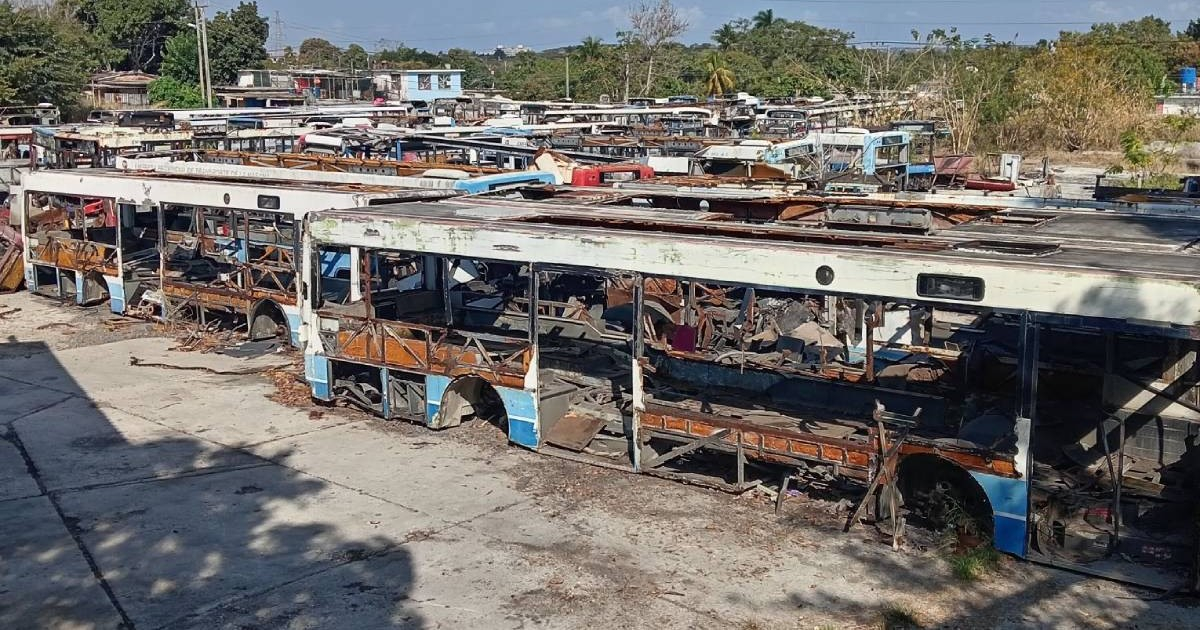
A graph published last Wednesday by Cuban economist Pedro Monreal summarizes in eight figures the collapse of the bus manufacturing industry in Cuba: from 473 units produced in 2019 to just 12 projected for 2026, a decrease of 97.5% in just seven years.
Monreal shared on his account on X the graph titled "The Unstoppable Evaporation of Cuba's Transportation Equipment Industry," a description that encapsulates decades of accelerated deterioration under the regime's centralized model.
The data shows a curve with no possibility of recovery: 473 units in 2019, 344 in 2020, 154 in 2021, 60 in 2022, a slight recovery to 72 in 2023, a new drop to 53 in 2024, and projections of 17 for 2025 and 12 for 2026.
The only bus assembly plant in Cuba is the Bus Production Company Evelio Prieto Guillama (CAISA), located in Guanajay, Artemisa, with over 52 years of history and more than 35,000 vehicles processed throughout its existence.
At its peak, CAISA manufactured 350 units of the Diana model in 2016, earning it the Proeza Laboral distinction. In 2024, the company planned to produce five Diana buses but only delivered one, failing to meet its corporate objectives due to challenges in importing parts and components.
Due to the inability to maintain bus production, CAISA diversified in January 2025 into the manufacturing of two-wheeled Diana motorcycles as an alternative for industrial survival, reported the state newspaper Trabajadores.
According to another official source, Juventud Rebelde, the government announced in January 2026 the repair of 100 buses, thanks to a Chinese donation of parts valued at 10 million dollars, which arrived in August 2025, with a stabilized pace of eight units per month. The initial expectation of repairing 20 units before the end of 2025 was not met.
The productive collapse directly translates into the paralysis of public transport. Transportation Minister Eduardo Rodríguez Dávila acknowledged in March 2026 that the national buses operate with only one departure daily, trains run every eight days, and the ferry to Isla de la Juventud has just two weekly frequencies.
The regime itself acknowledged on January 31, 2026, that public transportation only meets 42% of the planned goals.
The collapse of the sector is part of a broader structural economic crisis. The Cuban economy , accumulating a decline of over 15% since 2020, according to the Center for Cuban Economic Studies.
On its part, The Economist Intelligence Unit projects an additional contraction of 7.2% for 2026, reported the agency Efe.
Monreal, who also described Decree 127/2025 as conservative regarding economic reforms, notes that the fulfillment of plans in 2025 was only 51%, evidence that the centralized model is incapable of reversing a decline that, in the case of buses, is already approaching industrial extinction.
Filed under: