
Related videos:
The Cuban writer and activist Jorge Fernández Era commemorated this Saturday three years of monthly peaceful protests from Valencia, Spain, in front of the plaque marking the place where José Martí lived in his childhood, while in Cuba the activist Alina Bárbara López Hernández was detained by the regime while trying to exercise that same right.
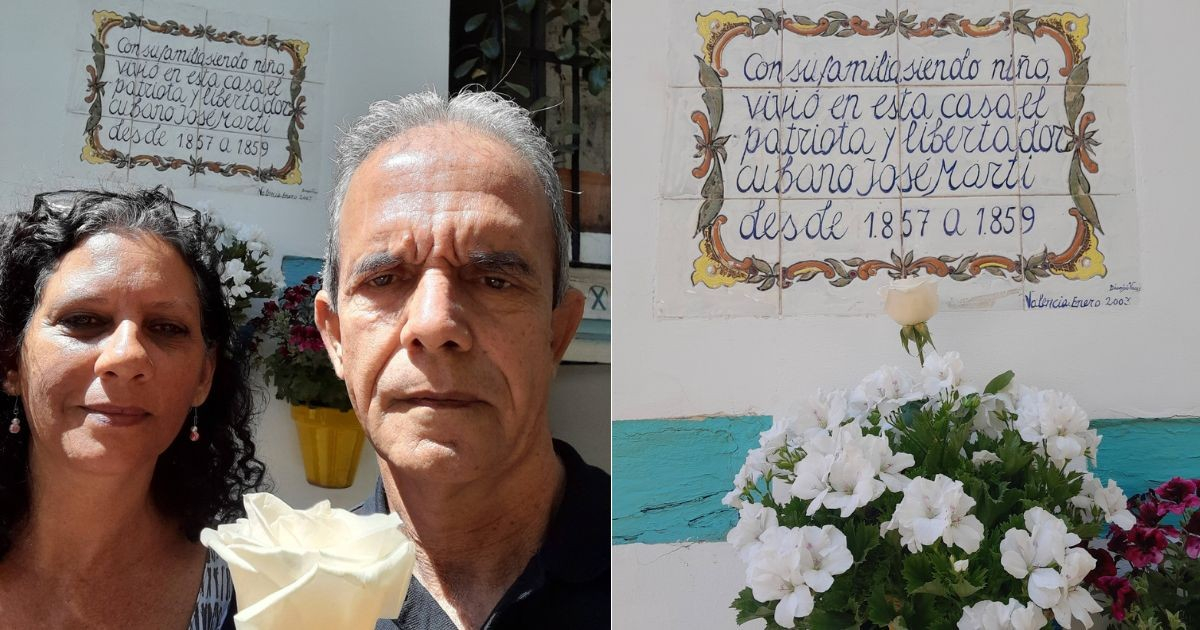
"Today marks three years since I joined the peaceful protest that every 18th Alina, Jenny, Miryorly, and a few other Cuban patriots hold in Cuba for the freedom of political prisoners and other demands," Fernández Era wrote on Facebook, accompanying the message with a photograph in front of the commemorative plaque on the Valencian street where the Cuban National Hero resided between 1857 and 1859 as a child.
In a previous post published on the same day, the journalist and comedian had announced that between 2:30 and 3:30 in the afternoon, he would be at the Plaza del Miracle del Mocadoret in Valencia alongside his wife Laideliz Herrera Laza, in parallel to the usual protest by López Hernández in the Parque de la Libertad in Matanzas.
Her demands from Spanish soil are the same as those she upheld for years in Cuba: "the freedom of all political prisoners, the call for a Constituent Assembly, sustained attention to people in extreme poverty, and the cessation of harassment against those who claim a rule of law where fundamental human rights are not violated."
Fernández Era arrived in Spain on March 29, 2026 with his wife, after the Cuban Prosecutor's Office suspended the criminal proceedings against him in November 2025, which included charges of "disobedience," "sedition," and other offenses that exposed him to a possible life sentence, and lifted the precautionary measures of house arrest and prohibition on leaving the country that had been imposed on him since 2023.
The event acquired a particularly symbolic character as it coincided with the arrest of Alina Bárbara López in Matanzas, who was arrested this Saturday while trying to exercise her right to civic protest and was held at the Playa Police Unit without being able to communicate with anyone.
Her daughter Cecilia Borroto López reported the usual repressive pattern: "illegal detention, refusal to allow Alina to communicate with her family, denial of information to family members, and a 'conversation' that is actually an interrogation/monologue with State Security."
The comments on Fernández Era's post reflected, in an ironic and humorous tone, the contrast between his new situation in exile and the years of surveillance endured in Cuba. Activist Miryorly García commented: "And what about the patrol? How sad, lonely, and strange they must feel today, those little comrades 'who look after you'." Another internet user added: "They must feel very strange without someone waiting for their movements in front of the house. Finally, they are 'free'; enjoy and restore your soul."
The plaque in front of which Fernández Era protested was crafted in January 2003 by the renowned ceramist Dionisio Vacas and commemorates that Martí lived in that Valencian house with his family between 1857 and 1859. The activist held a white rose in the photograph, a direct reference to one of the Apostle's most famous poems and a symbol adopted by the Cuban civic movement.
Cecilia Borroto López concluded her statement with a direct demand regarding the new arrest of her mother: "We demand her immediate release. Alina has nothing to 'discuss'." By forcing its opponents into exile, confinement, or direct physical violence, the Havana regime has systematically acted like the Spanish colonial empire against which José Martí fought.
Filed under: