
Related videos:
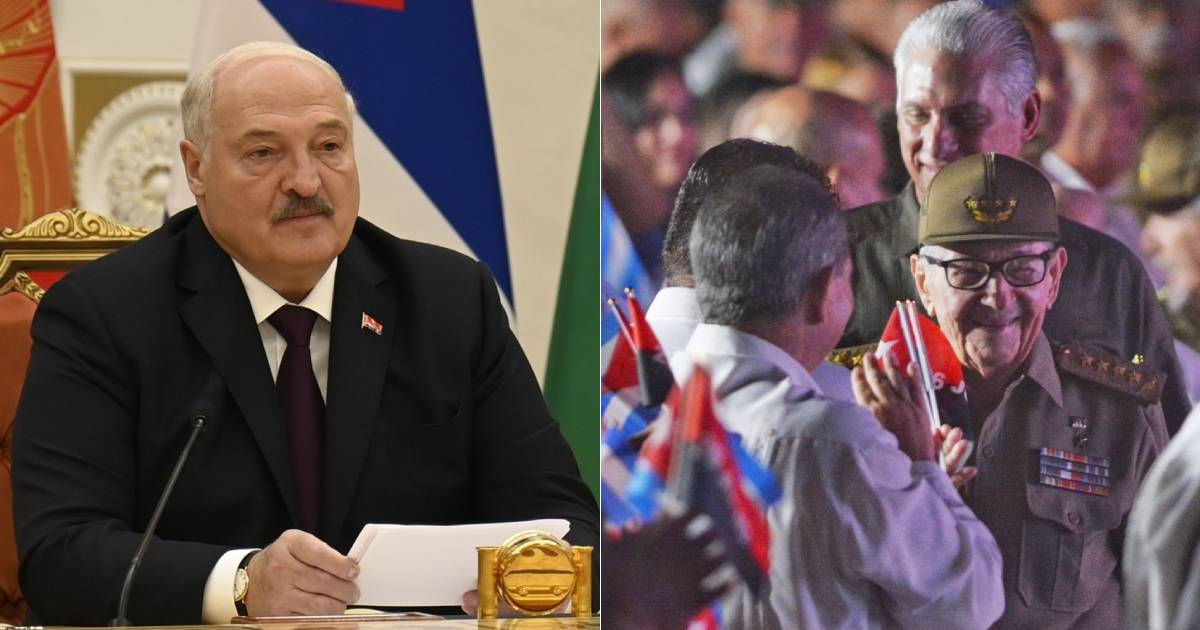
The Belarusian dictator Aleksandr Lukashenko warned the United States on Monday about the consequences of a potential military intervention in Cuba, during an interview with the Russian state channel RT in which he stated, "if they interfere in Cuba and start a war against the Cubans, history shows that things will not end well for you."
The statements come at a time of escalating tensions between Washington and Havana, following months of increasingly aggressive remarks from President Donald Trump towards the Cuban regime.
Lukashenko noted that there will always be countries that discreetly and calmly support Cuba in the event of a conflict, and he added that it would be difficult to predict how events would unfold.
The Belarusian ruler also referred to the geographical location of the island to question the logic of any military action: "Cuba is right in the backyard of the United States, not far from Donald Trump's house. Do they really need it? Of course not."
In the same interview, Lukashenko urged the Trump administration to establish "normal relations" with Cuba, Mexico, Nicaragua, and Venezuela, and called for the release of Nicolás Maduro, captured by U.S. special forces in Caracas on January 3, 2026. "There is no need to admit mistakes or anything of the sort. Reverse it and free this man; come to an agreement with Venezuela," he said.
Lukashenko also accused Trump of being "the real dictator," arguing that he lacks the resources to impose his will, while Trump "has them, and he dictates: in Venezuela, in Cuba, he attempts to dictate, in Iran, in China; he tries to impose something on all countries."
The warnings from the Belarusian leader are set against the backdrop of increasing military cooperation between Minsk and Havana. In April 2026, the twelfth meeting of the Joint Technical-Military Cooperation Commission between Cuba and Belarus was held in Minsk, and in May 2025, a Belarusian company modernized anti-aircraft systems for the Cuban Revolutionary Armed Forces.
The tension between Washington and Havana intensified following the capture of Maduro, an operation in which 32 Cuban soldiers who were protecting him died and that cut the supply of between 26,000 and 35,000 daily barrels of Venezuelan crude to the island, exacerbating an energy crisis with blackouts lasting up to twenty hours a day.
Trump signed the January 29, 2026 Executive Order 14380, declaring the Cuban government an "extraordinary threat" to national security and imposing tariffs on countries that supply oil to Cuba. On March 28, he stated Cuba is next and two days later declared: It will fail in no time, and we will be there.
The Cuban regime responded with its own warnings: on April 16, Díaz-Canel called for preparedness like in 1961, and on April 18, the Deputy Minister of Foreign Affairs stated that Cuba would defend itself against any aggression.
Lukashenko, who has been the only president of Bielorrusia since 1994 and whose regime holds over a thousand political prisoners, concluded his statements with a phrase that summarizes his stance: I am not an emperor like Trump or Putin to expect universal love.
Filed under: