
Related videos:
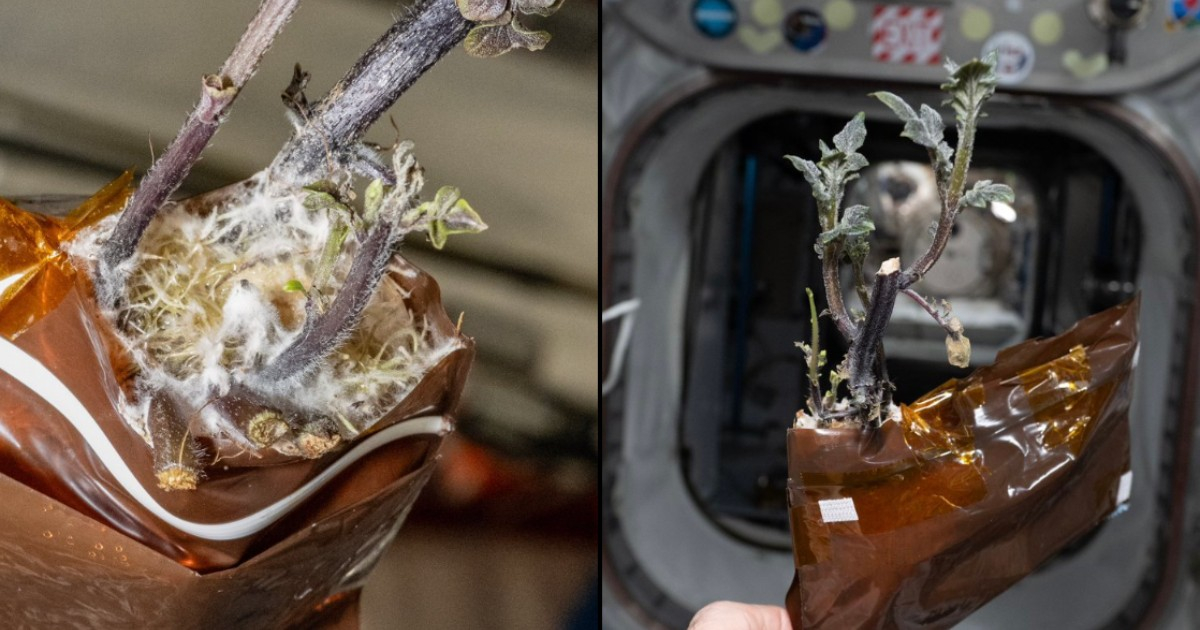
The NASA astronaut Don Pettit shared this Monday new images of his personal purple potato growing experiment aboard the International Space Station (ISS), showcasing a phenomenon he coined as roots growing in the wrong direction in orbital weightlessness: in orbital weightlessness, roots grow upwards instead of downwards.
"In the weightlessness of orbit, roots generally grow towards moisture, but sometimes they become confused and grow upwards," Pettit wrote on his X account, alongside photographs of his early purple potatoes already transplanted into a hydroponic bag, which he referred to as his true "space potatoes."
The images show the plant being held inside the ISS, with roots emerging from the substrate in various directions, in an environment where control panels and space mission badges provide a distinctive backdrop.
The phenomenon has a precise scientific explanation: on Earth, roots grow downward due to positive gravitropism, guided by the hormone auxin that flows to the tip of the root upon detecting gravity. In microgravity, this mechanism loses its directional reference and the roots primarily orient themselves toward moisture and away from light, allowing them to grow in any direction, even upward.
This new development is a continuation of an experiment that Pettit began weeks ago when he published a photograph of the same purple potato with roots that resembled tentacles, causing mass confusion on social media: many users thought it was a space creature.
The astronaut then clarified that it was a purple potato, which he informally named "Spudnik-1", a play on words between "Sputnik" and "spud", the colloquial term for potato in English.
Pettit was inspired by the novel and film "The Martian" by Andy Weir to choose potatoes as a crop, highlighting their nutritional efficiency by total mass, including roots, making them an ideal candidate for future long-duration missions.
The experiment is of a personal nature, conducted during their free time, and is not part of the official programs of NASA, although it falls within the broader scientific interest of the agency regarding food cultivation in microgravity.
NASA operates the Veggie and Advanced Plant Habitat systems on the ISS, with which it has harvested lettuce, radishes, peppers, and zinnias, and considers the development of space agriculture a central challenge for missions to the Moon and Mars.
Pettit, one of NASA's most experienced and prolific astronauts in scientific outreach, returned to Earth on April 20, 2025, after 220 days in orbit during Expeditions 71 and 72, having completed over 3,500 orbits and traveled more than 93 million miles.
Filed under: