
Related videos:
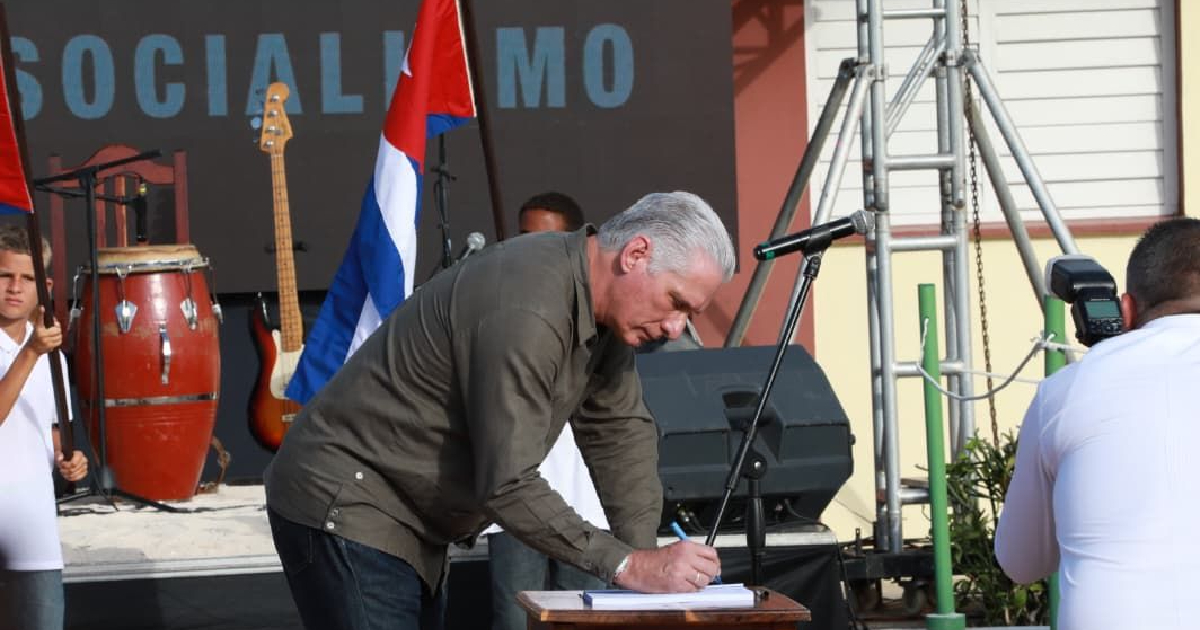
What we are witnessing today in Cuba with the campaign "My Signature for the Homeland" is not a show of strength; it is, in fact, the clearest confession of a deep weakness.
The initiative, championed by Miguel Díaz-Canel, is presented as a patriotic response to external tensions. However, there is something revealing in all of this: when a government needs to seek mass signatures to prove that it still represents the people, what it is admitting, without saying it, is that real legitimacy is no longer enough. It needs to stage support. It needs to transform adherence into a ceremony, obedience into an image.
And here is a detail that many outside of Cuba do not always understand: these signature collections do not operate like in an open society. They do not arise spontaneously or from the grassroots. They are organized from the structures of power and are channeled through workplaces, universities, schools, and state-linked organizations.
In that context, signing is rarely seen as a completely free choice. A direct threat is not necessary; the environment alone is sufficient. The fear of standing out, of being pointed at, of complicating one's life is enough. The silent pressure of the group is enough.
That's why some of those firms don't talk about support, but rather about adaptation. They don't measure conviction: they measure flexibility.
The regime tries to sell this campaign as an expression of "civil society," but what it really shows is its ability to activate that network of everyday obedience. Presenting as spontaneous what comes from the apparatus of power is not popular mobilization: it is a political choreography.
And the problem is not just the gesture, but the moment. Cuba is going through a severe crisis: prolonged blackouts, shortages, economic decline, an increasingly suffocating life. In that context, this petition seems somewhat obscene: while people need solutions, the power demands a signature.
As if a signature could replace a decent wage. As if a slogan could power an electric plant. As if repeating "homeland" would solve hunger.
Moreover, in a system without full political freedoms, a signature campaign is never neutral. It’s not just support; it’s visibility of that support. It’s a record. It’s a potential mark of distinction. It is also a way to remind us who is aligned and who is not.
Here is one of the harshest truths of this moment: the government does not just want support; it wants that support to be visible. It wants names, bodies, and visible gestures. Because authoritarianism is not satisfied with merely commanding: it needs to be evident that it can do so.
There is also an evident contradiction. While the internal discourse calls for confrontation and solidarity, the government itself maintains diplomatic contacts with the United States. This double narrative reveals that the campaign is not only a response to an external threat but also an internal necessity: to strengthen cohesion where it is starting to wane.
It is important to state clearly: refusing any external pressure on Cuba is one thing, but accepting that such pressure serves as a permanent excuse to justify internal immobility is quite another. The Cuban crisis does not have a single cause, and reducing it to a narrative of siege is, at its core, a way to evade responsibilities.
That’s why this signature campaign resembles less an act of sovereignty and more a desperate gesture of political survival. It reflects an exhausted power, lacking real solutions, that resorts once again to epic rhetoric because it cannot deliver results.
When a government cannot provide well-being, it offers symbols. When it cannot provide a future, it demands loyalty. And when it cannot inspire, it exerts pressure.
The underlying question is not how many signatures they manage to collect. The real question is: how many of those signatures are freely given.
Because a free people signs what it wants. A conditioned people signs what it can. And that difference changes everything.
Filed under:
Opinion article: Las declaraciones y opiniones expresadas en este artículo son de exclusiva responsabilidad de su autor y no representan necesariamente el punto de vista de CiberCuba.