
Related videos:
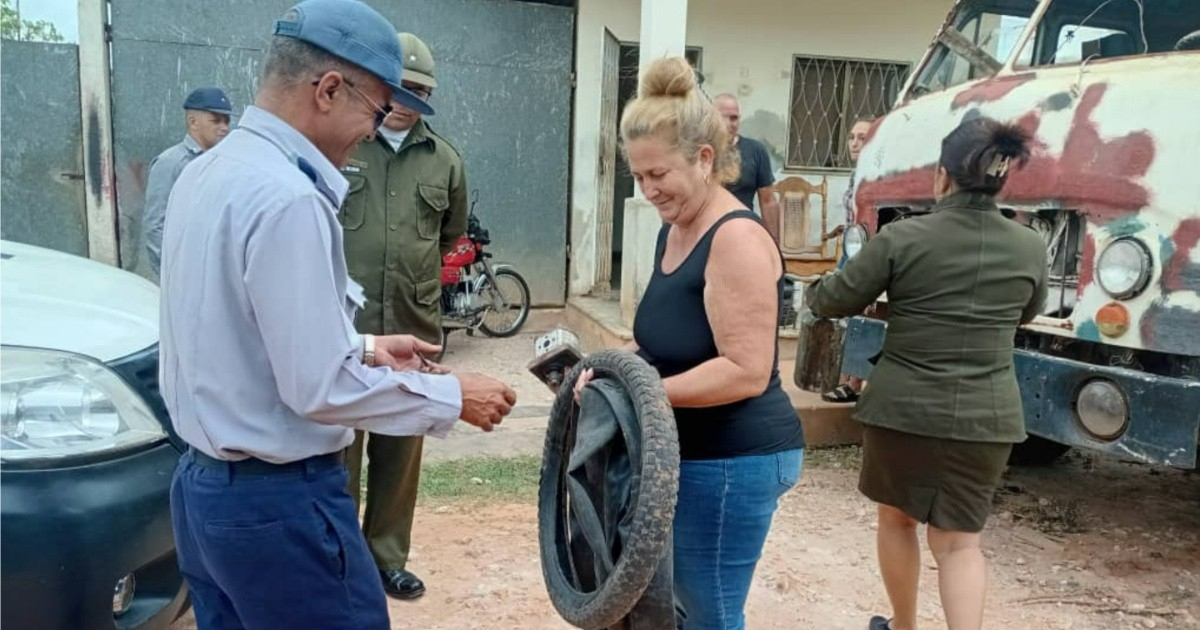
The Ministry of the Interior (Minint) released a statement this week through the local official newspaper Girón, the official press organ of Matanzas, boasting that it resolved a burglary that occurred in less than a week in the town of San Antonio de Cabezas, in the municipality of Unión de Reyes.
According to the official report, operational guard forces acted after a complaint from the affected party, Ariel García González, from whom car parts, tires, tools, and a bicycle with significant sentimental value, having belonged to his daughter who passed away 17 years ago, were stolen.
"A working group was formed that allowed for rapid progress in the investigation and achieving the identification of those involved," stated Major Yasiel Prado Valdés, delegate of Minint in the region.
The investigation resulted in three raids: two in homes within the village and one at a relative's house, where the bicycle was recovered.
The detainees —aged 19 and 20— also confessed to having stolen four oil tanks to sell them in the informal market, and they have a history that includes offenses against livestock and burglaries.
The case is part of a propaganda strategy that the Minint has intensified in April 2026, with public events in several provinces: the return of a television in Isla de la Juventud, the restitution of goods in Cienfuegos, the recovery of solar panels in Colón, and the arrest of a young man for stealing ten pigeons in Matanzas itself.
The message that the Minint repeats in all these events is always the same: the people "trust the police more and more" and this is "the best police in the world."
The reality documented by independent sources strongly contradicts that narrative.
According to the Cuban Observatory of Citizen Audit (OCAC), in 2025, there were 2,833 verified crimes in Cuba, an increase of 115% compared to 2024 and 337% compared to 2023, with an average of seven to eight crimes daily.
Thefts were the predominant crime, with 1,536 cases throughout 2025, an increase of 479% since 2023.
Matanzas —the province where the Minint has just publicized its operation— was precisely the most affected by crime in Cuba during 2025, with 503 verified crimes, surpassing Granma (424), Havana (398), and Santiago de Cuba (323).
The gap between official propaganda and citizen experience is palpable: in Santiago de Cuba, a family waited over ten hours without a police response after being robbed on April 4th, under the excuse of "shift change."
In the face of institutional inaction, entire communities have begun to take justice into their own hands, and on April 21st, a young man lost his hand in a confrontation with robbers in the middle of the street, an incident that illustrates the level of helplessness the population has reached.
Behind the rise in crime, there is a structural engine that the Minint omits in its statements: the Cuban economy contracted by 5% in 2025 and 15% cumulatively since 2020, while the real wage fell by 33.5% between 2021 and 2024.
This precarious situation is compounded by the fact that it is estimated that 20% of the members of the National Revolutionary Police have left the force due to desertion, leaving entire areas without coverage, while citizens report that the fuel and vehicles that are scarce for patrols "are never lacking when it comes to repressing dissent."
The two young individuals detained in San Antonio de Cabezas are, more than the police success that Minint wants to promote, the most visible face of an unprecedented crime crisis that 67 years of communist dictatorship have made inevitable.
Filed under: