
Related videos:
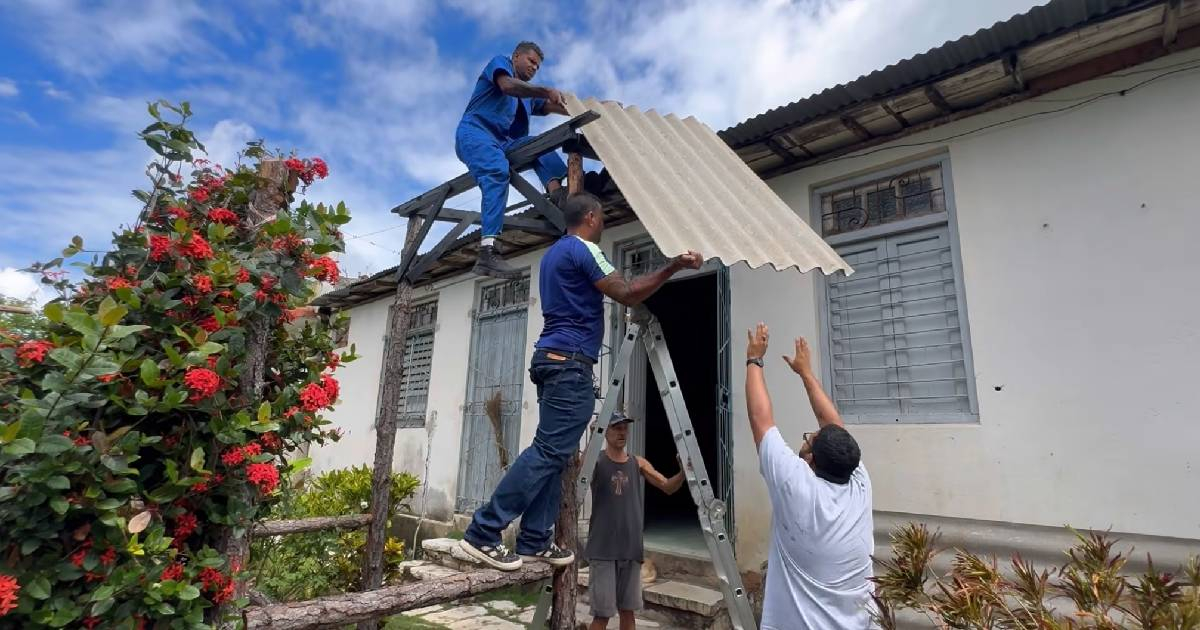
A group of Cubans documents in a video the exhausting process of repairing a home destroyed by Hurricane Melissa, without state support, counting the nails one by one and cooking with charcoal at 1,000 pesos per bag to feed the construction workers.
The YouTube channel of priest Leandro NaunHung published episode 320, a first-person testimony that showcases the reality of self-managed reconstruction in eastern Cuba, six months after Melissa devastated the region.
In the images, the group is seen lifting tiles onto the roof with makeshift ladders, securing each piece with eight nails brought in "from outside"—from outside of Cuba—and dealing with power outages that last for three or four consecutive days.
"The power here, you know there’s a problem with the power, but this circuit seems to have a serious situation, because when they turn the power on, I don’t know if it’s the demand, the power surges, and then we go three, four days without electricity," explains one of the protagonists.
What outrages the group the most is the total absence of the government: the official technicians never showed up to assess the damage or to supervise the repairs.
"When the engineers who never came finally arrive, they will say... what we did," one of them says with irony.
Despite that, the team acknowledges having made progress thanks to mutual solidarity: "At least we have tried to prevent the house from getting more damaged inside, and little by little we have been fixing it, regardless of everything."
The house, previously described as "a sieve," is gradually regaining its shape through collective effort: "We, little by little, with our efforts, the love that our companions here have, are shaping the home that Cyclone Melisa destroyed."
This case is no exception. Five months after the hurricane, only 17% of the damaged homes in Santiago de Cuba have been rehabilitated, around 18,400 units out of more than 106,500 affected according to the Provincial Defense Council.
The UN raised the total impact to over 90,000 homes in five provinces of eastern Cuba, with more than 3.5 million people affected.
The reconstruction is progressing at an extremely slow pace due to the confluence of material shortages, lack of fuel, and corruption in the distribution of resources. Irregularities in the delivery of materials to the affected were reported in the Chicharrones neighborhood of Santiago de Cuba, where resources ended up in the hands of leaders and associates of the regime.
As an emergency solution, the government resorted to installing shipping containers as housing, but the victims in Guantánamo who received them are reporting leaks, faulty pipes, and prices close to a million pesos per unit.
Filed under: