
Related videos:
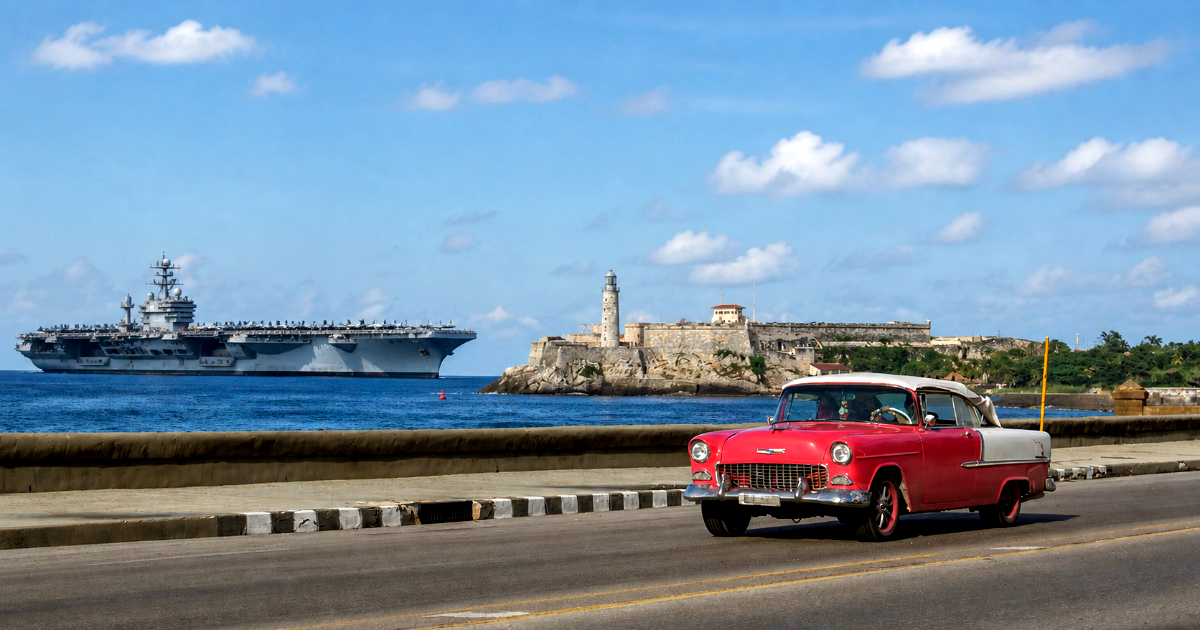
The mere image seems pulled from a movie, but today it no longer sounds impossible: an American aircraft carrier off the Malecón in Havana, just a few meters from the shore, as a direct threat to the regime.
The question is not only what the Cuban regime would do. The key question is another one: What would ordinary Cubans do?
The answer is not simple, but there are clear signs.
Cuba is experiencing one of the most critical moments in its history. Power outages lasting over 20 hours, extreme shortages, collapse of basic services, and an accelerated deterioration of daily life have pushed the country to a breaking point.
This is compounded by a sustained increase in spontaneous protests for food, electricity, and living conditions, despite a repression that remains systematic.
In that context, the reaction of Cubans would not be uniform, but it would be predictable in three major directions.
The first: the contained explosion
There is an accumulated fatigue that is not theoretical, it is physical. Hunger, darkness, rampant inflation, shortages, endless lines, collapse of production, proliferation of waste and diseases, hospitals without resources.
This weariness has created a social pressure that has been expressed before, such as on July 11, 2021, and is now rising again in the form of pot-banging protests, nighttime demonstrations, and local outbursts.
If an aircraft carrier appears off the coast of Havana, many would not see it as a threat, but rather as a signal. A signal never seen in 67 years of troubled relations with the neighboring power. The signal that something might change. And that could act as a catalyst.
It might not be an organized mobilization. It might start off being something more chaotic that could grow into a massive outburst with Cubans taking to the streets.
Perhaps it could begin with people stepping out onto balconies, into the streets, gazing at the sea, loudly expressing what has so far been whispered. In some neighborhoods, this might translate into immediate, spontaneous protests. In others, it could manifest as a tense anticipation.
And that popular reaction could catalyze more massive protests, organized and driven by an unprecedented social dynamic: the fear that shifts allegiance, as Cubans would feel they now have a military power that would protect them in the event of violent repression of their freedom of expression and assembly.
Because the Cuban does not need someone to explain what is happening. They have been waiting for years for a breaking point and for a reaction from the international community that will put an end to what they, defenseless against a totalitarian dictatorship, cannot achieve through peaceful means.
The second reaction: fear
The regime has built over decades a control apparatus based on surveillance, repression, and exemplary punishment. Arrests following recent protests, political prisoners, and the persecution of dissidents remain a daily reality.
That fear doesn't disappear just because a ship appears on the horizon.
Many Cubans would first think about the consequences: What happens if I go out? What happens if this doesn't change? What happens if there is violence? Experience weighs heavily. The events of July 11 and a series of subsequent protests have left a clear lesson: protesting comes at a cost.
For that reason, although the discontent is deep, not everyone would take to the streets. There would be caution, silence, and observation. People would be waiting to see who takes the first step, how the regime would respond to that first step, and what reaction the regime's response would provoke in the Trump administration.
The third: the emotional fracture
Reactions on social media already suggest a divided scenario, but not necessarily dominated by the fear of an all-out war.
There are those who demand immediate action, even without further announcements. Others believe nothing at all. And a third group observes cautiously, trying to understand what kind of scenario might actually unfold.
That nuance is key. Everything suggests that, if a military action were to occur, it would not be a classic invasion or a prolonged conflict.
The most recent precedents suggest a different type of dynamic: targeted, swift, and surgical operations aimed at strategic objectives that leave the regime with no effective response capability, as happened in Venezuela with the capture of Nicolás Maduro following selective attacks on key installations.
Under this framework, the perception within Cuba shifts. It's not so much the fear of an open war, but rather the uncertainty of a swift strike that could completely alter the balance of power in a matter of hours or days.
Many Cubans are not thinking about massive bombings, but rather a scenario where the regime is paralyzed, without any room for maneuver. This possibility—more concrete and less abstract—coexists with the desire for immediate change.
This is compounded by a decisive factor: the internal wear of the system. This context reduces the regime's margin for maneuver not only in economic terms but also in social control. The level of popular support is one of the lowest in decades, and that weighs heavily in any crisis scenario.
Furthermore, the Venezuelan precedent has changed the rules of the game. The operation that ended with Maduro's capture and forced a reconfiguration of power sent a clear message: the United States does not need a prolonged war to intervene decisively.
This introduces a key variable in the calculation of the Cuban regime.
If you choose to employ mass violence against demonstrators in a context of high tension —for example, in response to protests triggered by an event such as the presence of an aircraft carrier— the risk of an external response increases significantly.
It wouldn't necessarily be an invasion, but rather a controlled escalation aimed at neutralizing specific capabilities. That factor acts as a limit.
So, what would actually happen?
The most likely scenario is one of extreme tension, with localized protests, spontaneous social movements, and a population attentive to every signal. Not a war, but a moment of intense pressure where each actor measures their steps.
The Cuban has been waiting for a breaking point for years. Not necessarily a conflict, but an event that disrupts the inertia.
An aircraft carrier off the Malecón could represent just that.
It would not alone imply an immediate change, but it would indicate something equally significant: the feeling that the impunity enjoyed by a violent regime for decades may be shattered.
And in a country where control has largely been maintained through the perception that nothing changes, altering that idea can be the beginning of a much deeper process.
Filed under: