
Related videos:
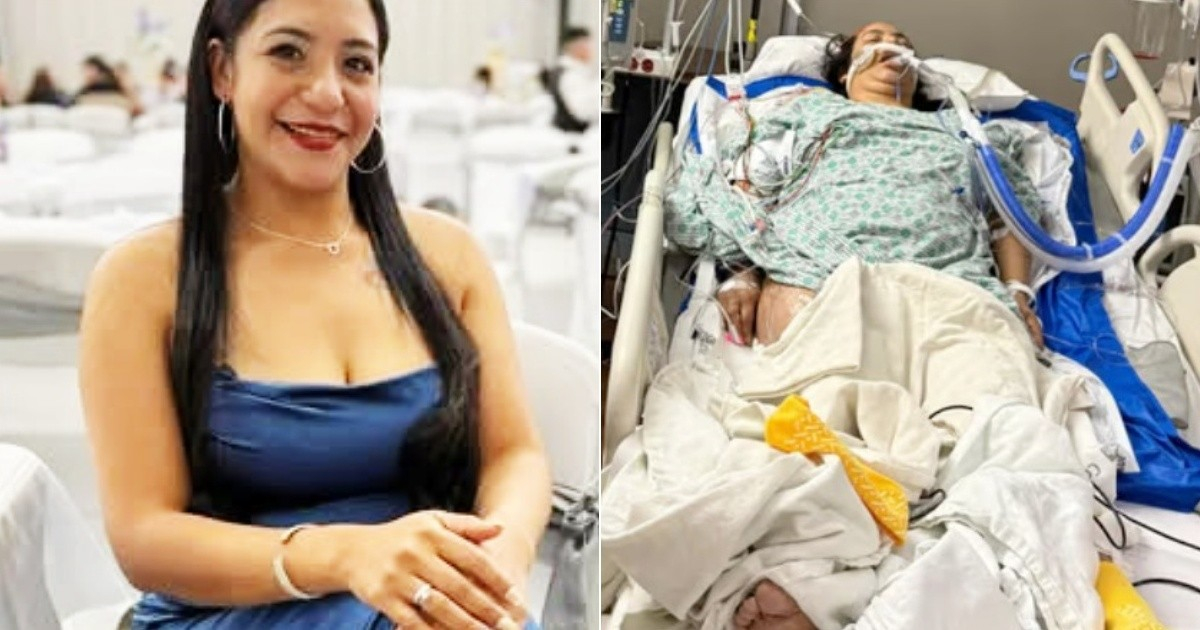
Yeseni Meléndez, a 36-year-old Venezuelan resident of Columbus, Ohio, suffered a stroke on April 26 while attending a court hearing to pay a $100 traffic fine, and since then she has been fighting for her life in an intensive care unit.
Her husband, Joel Medina, 26 years old, reported that the chronic stress caused by the constant fear of deportation was the trigger for the collapse.
"We live in total uncertainty, and that stress is what caused my wife's artery to burst," he stated to Univision.
What happened in the court?
Yeseni had been detained for driving without a license while she was in the process of obtaining one. The authorities scheduled a hearing for her a week later. She attended with an interpreter named Luis.
According to Joel's account in an interview with journalist Elián Zidán, everything was proceeding normally when the unexpected happened: "She went to that hearing and at that moment everything was going well, the judge was going to impose the fine, which was 100 dollars."
It was then that Yeseni turned her head towards her interpreter, made a gesture with her face, and disappeared.
Given the seriousness of the case, she was airlifted to Ohio Riverside Hospital in Columbus. Doctors had to perform emergency surgery to reconstruct a cerebral artery.
How did the husband find out?
Joel was not present at the hearing by his own choice: he feared that if they arrested his wife, their two-year-old son, Gael, would be left alone.
“That court hearing made us very anxious; in fact, that day we decided that I would not go to court in case they took her away, so our two-year-old son wouldn't be left alone,” she explained.
He found out hours later when a friend from Yeseni's workplace called him.
Upon arriving at the hospital, he found her intubated. "Can you imagine? It had already been three hours, from 8 in the morning until 11, and there was still no reaction," he recounted.
It was then that the doctors confirmed to him: “The doctor came and told me that she had suffered a stroke.”
The fear of ICE, behind the stress
The family arrived in the United States in 2023 on a humanitarian visa and has Temporary Protected Status (TPS).
Both work and pay taxes, but the climate of immigration persecution had plunged them into a state of constant alert.
“The state of alarm is such that we decided some time ago not to go out except for essential activities like going to work or buying food for the week,” Joel admitted.
Yeseni has been hospitalized in the ICU for almost two weeks.
According to her husband, she has begun to open her eyes: "Thank God, she's a little bit better. Right now, she has reacted a bit more; she is opening her eyes."
The economic situation is critical. "I’m afraid to find out how much the bill will be. We’re talking about thousands of dollars and we don’t know how long he will need to be in intensive care," admitted Joel, who had to take a leave of absence from work to care for little Gael.
The family launched a fundraising campaign to cover the expenses.
The husband points out that the courts have become a trap for Venezuelan immigrants and those from other nationalities.
Although an appeals court declared in January that the decision to eliminate Venezuelan TPS was illegal, uncertainty remains.
As of April 4, 2026, 60,311 people were held by the Immigration and Customs Enforcement (ICE), an increase of 75% compared to 2025, in the context of the tightening of the immigration policy of the Trump administration.
The case adds to a series of detentions of migrants during regular judicial proceedings that civil rights organizations are denouncing as a systematic practice.
Joel summarizes it with pain: "I pray every day for my wife to get better and for us to be able to face the hospital debt."
Filed under: