
Related videos:
Raúl Borges Rodríguez, a chief petty officer in the Revolutionary Armed Forces assigned to the Holguín military region, has accumulated over 4,000 parachute jumps and has rescued nearly a thousand people in dangerous situations throughout his military career.
His story began with a systematic rejection: between the ages of 15 and 16, the medical commission declared him unfit to be a paratrooper because he "does not meet the required height and weight."
He persisted until the instructor Alberto Font, from the parachuting club of the Patriotic-Military Education Society, accepted him even with two kilograms below the minimum required.
Font had a guiding conviction in his work: "A hero is someone who displays enough courage, assesses risks, determines the dangers that arise from them, and makes decisions with the certainty provided by constant preparation."
When he was called up for military service, Borges had already accumulated 20 jumps.
I never imagined back then that decades later I would receive the Calixto García Medal of Valor three times, the highest decoration of its kind in the Cuban armed forces.
The third medal was recently awarded to him by Division General Eugenio Rabilero, head of the Eastern Army, during the celebration of the 65th anniversary of that military command.
The recognition acknowledged their actions during the passage of Hurricane Melissa through the eastern part of the country in October 2025.
When weather conditions still prevented helicopters from flying, Borges joined the group that used heavy trucks and amphibious vehicles to evacuate flooded areas in Cacocum, saving around 200 people initially.
As the weather improved, the helicopters took off for isolated communities.
In La Fortuna, he descended by cable to rescue a woman and her two children.
In La Tania, a rural community in Urbano Noris surrounded by the waters of the Cauto River, the helicopter landed three times with the maximum possible load, prioritizing children, pregnant women, the elderly, and the sick.
The greatest danger was in Altagracia, where the roofs of the huts appeared like small islands amid the murky waters.
He descended onto the roof of a house where a mobile phone was sending out distress calls, checked the strength of the covering, and rescued four people who had taken refuge in a barbecue area that, miraculously, had not been reached by water.
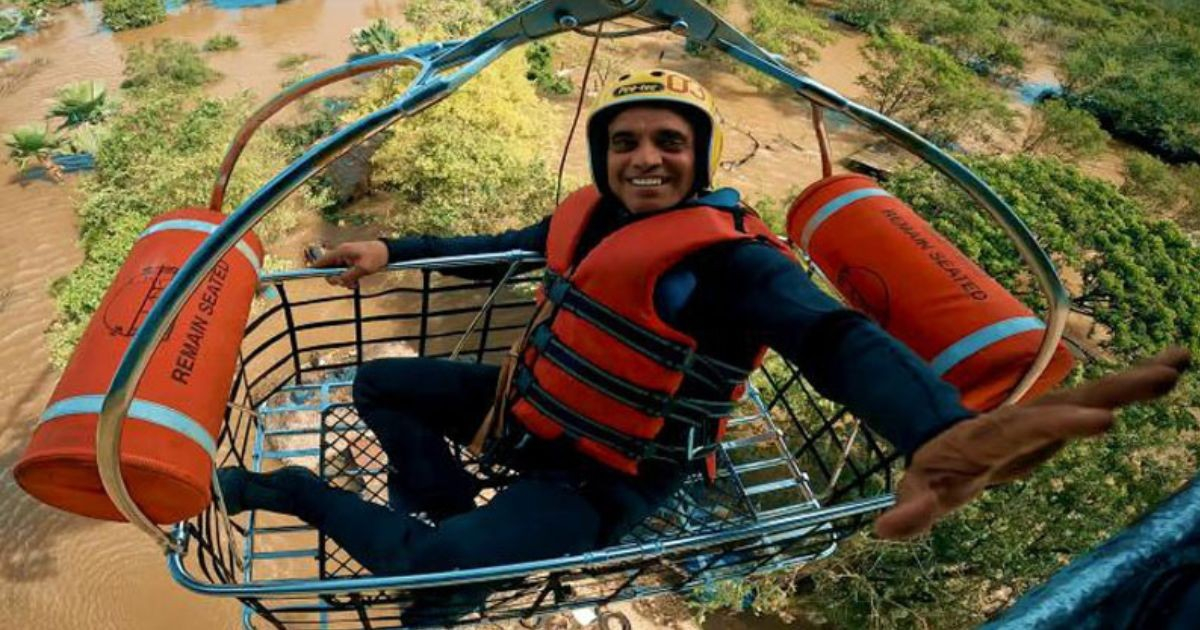
Later, the crew was relocated to Granma, where evacuations were ongoing in communities affected by the flooding of the Cauto River, and they carried out missions in Guamo Viejo using steel cable and a metal basket due to the inability to land.
The second medal was awarded at the end of the year 2000, when she rescued a man trapped at 72 meters high in the chimney of the Roberto Ramírez Delgado sugar mill in Niquero, Granma, descending by cable amidst strong winds that threatened to destabilize the helicopter.
The first one arrived in 1989, when she was only 19 years old and a private soldier.
After the shipwreck of a yacht in the Bartlett Pit, off the Antonio Maceo Airport in Santiago de Cuba, he descended into the sea from a helicopter, located the castaways, and helped them board the aircraft.
While left alone waiting for the helicopter's return, he swam to the shore in rough sea conditions, found a stone wall several meters high, and managed to climb it using a rope thrown to him by passersby, suffering cuts and wounds on his body and feet.
The hurricane Melissa, which flooded the provincial hospital of Holguín and left families trapped in the waters, caused the evacuation of more than 735,000 people nationwide, with Holguín and Granma among the most affected provinces.
Upon receiving that first medal at the age of 19, Borges felt that "the metallic body of the medal radiated a strange warmth" and understood from that moment that "in life-and-death situations, courage does not accept retreats."
Filed under: