
Related videos:
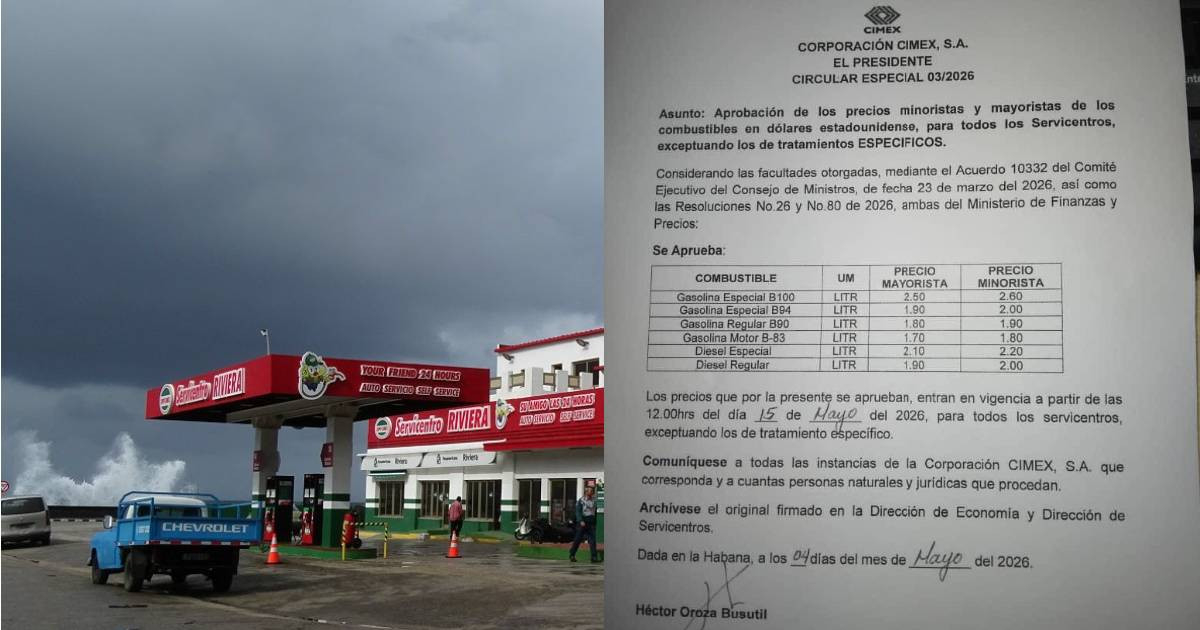
The state corporation Cimex, S.A. implemented a drastic increase in fuel prices in Cuba this Friday, setting the price of premium gasoline B100 at $2.60 per liter, nearly double its previous value in dollarized channels.
The measure was officially announced in Special Circular 03/2026, signed by the president of the corporation, Héctor Oroza Busutil, effective from 12:00 PM this Friday.
The document, which began circulating on social media and which CiberCuba confirmed its authenticity with several knowledgeable sources on the subject in the island, also establishes a new retail pricing scale for all fuels sold in foreign currency.
Special gasoline B94 now costs 2.00 USD per liter; regular B90 is 1.90 USD; motor B-83 is 1.80 USD; special diesel is 2.20 USD; and regular diesel is 2.00 USD.
Until now, premium gasoline was officially sold at around 1.30 USD per liter at dollarized service stations, with a limit of up to 20 liters per person. The increase implemented this Friday effectively represents a price hike of nearly 100%.
The measure is part of the liberalization of fuel prices announced by the Ministry of Finance and Prices, which as of today allows each importer to set their own price according to actual operating costs.
The ministry itself acknowledged that maintaining a single price "is not economically sustainable under the current conditions."
The rate hike comes at the worst possible time for the population. The Minister of Energy and Mines, Vicente de La O Levy, admitted on Wednesday that Cuba "absolutely has no fuel, no diesel, only associated gas" to generate electricity, while the electricity generation deficit exceeded 2,113 MW on Tuesday.
The public reaction on social media was one of widespread outrage. "Wow, over 7 dollars a gallon for regular gasoline; it must be the most expensive gas in the world, and if it’s not, it’s certainly near the top," wrote Oscar Rodríguez.
Luis Emilio Rico Díaz was more direct: "In dollars? Is the salary of the Cuban people in dollars? Four times more expensive than in any country in America!"
Other Cubans pointed to a deliberate strategy by the regime. "The squid game: I make the products from state units disappear, see at what price the average Cuban is willing to pay, and then they hit you hard without any lube. This is how it goes with everything," denounced Yanaylet Oggunsita Jiménez.
For her part, Ubilquis Ramos Agüero summarized the feelings of many. "I hope there is gasoline so we can at least start the cars before they break down completely."
The economist Elías Amor recently warned that the liberalization could benefit micro, small, and medium-sized enterprises (mipymes) linked to the Business Administration Group S.A. (Gaesa), the business conglomerate of the Cuban military elite that controls approximately 60% of the economy.
"There is always something hidden in the decisions of the Castro regime, and here it is clearly the case," Amor pointed out.
In the informal market, the price of gasoline reached between 4,000 and 6,000 Cuban pesos in April and May, equivalent to between seven and twelve dollars at the informal exchange rate. This makes the new official price merely a point of reference for those with access to foreign currency, while the majority of Cubans receive their salaries in pesos.
Filed under: