
Related videos:
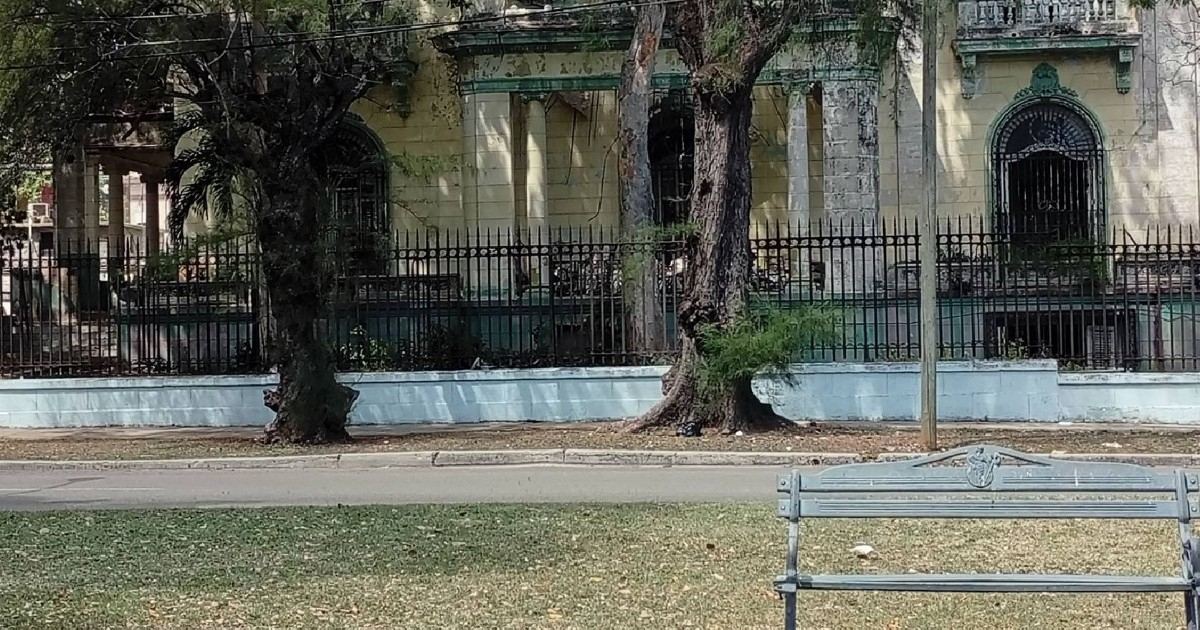
Sitting on a bench at the corner of 21 and Paseo, in front of a crumbling mansion, the resident of Havana Yordy Battle reflected on the decay of Vedado, the neighborhood where he has lived for 31 of his 41 years, in a post that blends nostalgia, humor, and critical insight.
"I can imagine it, if it were a person, like Dr. House. A stylish, decadent, brilliant, broken, and sarcastic guy," writes Battle, who describes the neighborhood as "a kind of aristocratic and sick sugar daddy."
The moment emerged from the rawest everyday life: Battle was leaving a fair at John Lennon park and was looking for a bottle of oil when he paused to contemplate the abandoned mansion.
That image —the material scarcity coexisting with the beauty of architectural ruins— is the heart of his text, which he himself calls "cryposting mea culpa."
In his reflection, Battle openly breaks away from the official discourse on property and heritage: he would prefer to see that mansion restored by a foreign investor or by the heirs of its former owners rather than continue watching it deteriorate.
"That it was never going to be mine? Yes, that's true! Now it's not mine either, nor any hopes, and look at how it's destroyed," he writes.
To strengthen his argument, he references the biblical parable of Solomon's judgment: just as the true mother preferred to give up her son rather than see him die, he prefers that someone else save the mansion rather than have it go unsaved.
"I wouldn't mind if any foreign investor, or even the heirs of the former owners, were to reclaim it, allowing it to rise from the ruins like a Phoenix," he asserts.
The deterioration described by Battle is not an isolated perception. El Vedado has accumulated decades of collapses and institutional neglect, with residents repeatedly reporting the structural danger of buildings without receiving an official response.
In December 2025, a partial collapse in Vedado raised alarms about the state of the neighborhood, and in March 2026 it became necessary to demolish a building in Havana after years of deterioration and partial collapses.
In 2024, families were living in a building at risk of collapse in Vedado without any authority providing them with a solution.
The neighborhood developed between the late 19th century and the mid-20th century as a symbol of republican urban modernity in Havana, featuring eclectic architecture, Art Deco, and Cuban modernism.
After the nationalizations from 1959 to 1968, thousands of private properties were transferred to the State. Their original owners, many of whom were exiled, never reclaimed their assets, and the 2019 Constitution prohibits the concentration of ownership in private hands, with no mechanism for restitution in place.
Battle concludes his text with an image that captures the irony of the situation: "Even if I had to 'wisely' sit on this same bench, looking at her from afar, already at 80 years old, with oil at 50 kilos a bottle, and say, 'How beautiful!'"
Filed under: