
Related videos:
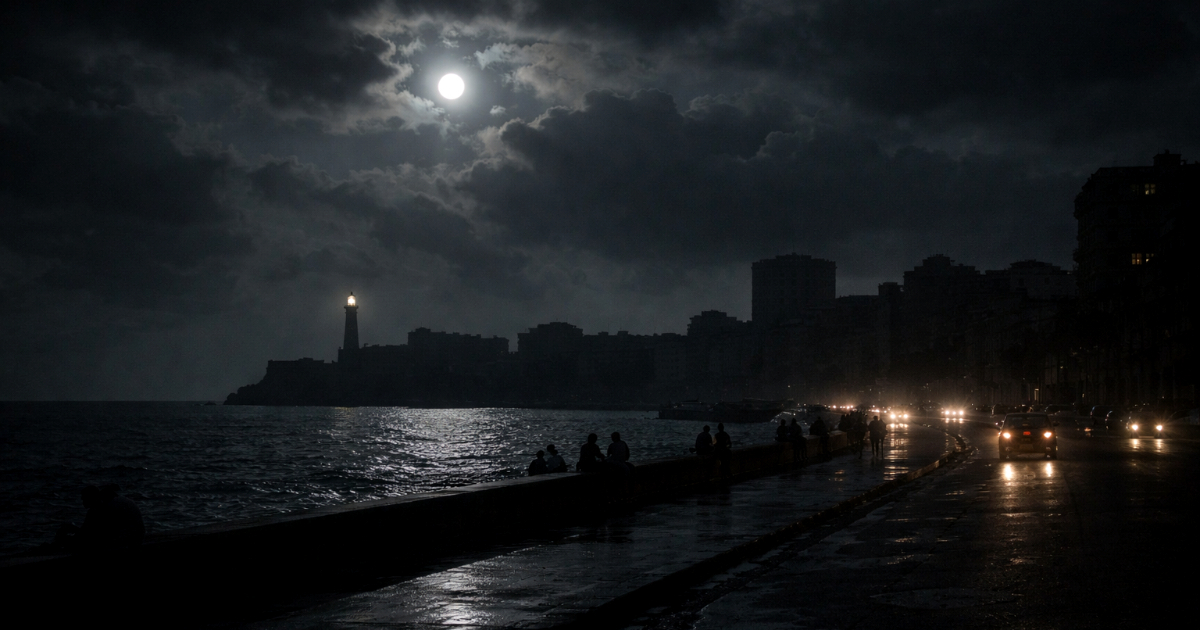
Cuba woke up this Wednesday to another day of widespread power outages: the Electric Union reported that at 6:00 AM, the availability of the National Electric System (SEN) was only 1,300 MW compared to a demand of 2,780 MW, with 1,474 MW already affected since the early morning.
For the peak nighttime period, the forecast is even gloomier: a maximum demand of 3,250 MW is expected, with a availability of only 1,300 MW, resulting in a deficit of 1,950 MW and a projected impact of 1,980 MW across all provinces of the country.
The day before was not better. The maximum impact was 1,965 MW at 9:50 PM, with outages that lasted throughout the 24 hours of the day, including the early morning.
The General Director of Electricity at the Ministry of Energy and Mines, Lázaro Guerra Hernández, confirmed this morning on Canal Caribe that there will be no immediate relief: "No new power additions are expected today; that is, those that are broken and those undergoing maintenance are not anticipated to come back online today."
Among the units out of service are Unit 1 of the CTE Ernesto Guevara De La Serna, Unit 2 of the CTE Lidio Ramón Pérez, and Units 3 and 5 of the CTE Antonio Maceo, all experiencing malfunctions.
In addition, Units 5 of the Mariel CTE, 6 of the Renté CTE, and 5 of the Nuevitas CTE are under maintenance, with an additional 418 MW out of service due to limitations in thermal generation.
The backdrop of the crisis is the critical shortage of fuel. Guerra Hernández admitted that the system operates exclusively with national sources: "At this moment, we are generating solely with national sources, the crude oil from gas, and renewable sources."
Approximately 1,400 MW remain unavailable in the national electric system due to a lack of imported fuel.
The only partial relief comes from the 54 new photovoltaic solar parks, which produced 3,222 MWh on Tuesday, reaching a maximum capacity of 432 MW at noon, temporarily reducing daytime disruptions without addressing the nighttime deficit.
The current situation is a direct consequence of months of shortages. The Minister of Energy and Mines, Vicente de la O Levy, acknowledged on May 14 that Cuba had "absolutely no fuel oil, nor absolutely any diesel." On the same day, the availability of the National Electric System (SEN) fell to 976 MW, leaving 70% of the country without electricity at the same time, the worst record of the year.
According to official data, Cuba needs eight fuel ships per month to sustain its economy and electricity generation, but between December 8, 2025, and the end of April 2026, it received only one. A Russian donation of 100,000 tons of crude oil, processed at the Cienfuegos refinery, was the only significant relief, but it ran out in early May.
The regime attributes the crisis to the U.S. embargo, but the combination of outdated infrastructure, decades of mismanagement, and complete dependence on fuel imports explains the structural collapse of a system that has been pushed to the limit for years.
The crisis of May 2026 is the most severe of the year: the record deficit reached 2,174 MW on May 14, and Cubans have been enduring weeks of blackouts of up to 20 hours a day with no short-term solution in sight.
Filed under: