
Related videos:
The post from Cubadebate announcing the cancellation of entrance exams for higher education triggered a flood of overwhelmingly critical comments on social media this Tuesday, which became the true gauge of public opinion in Cuba regarding the measure.
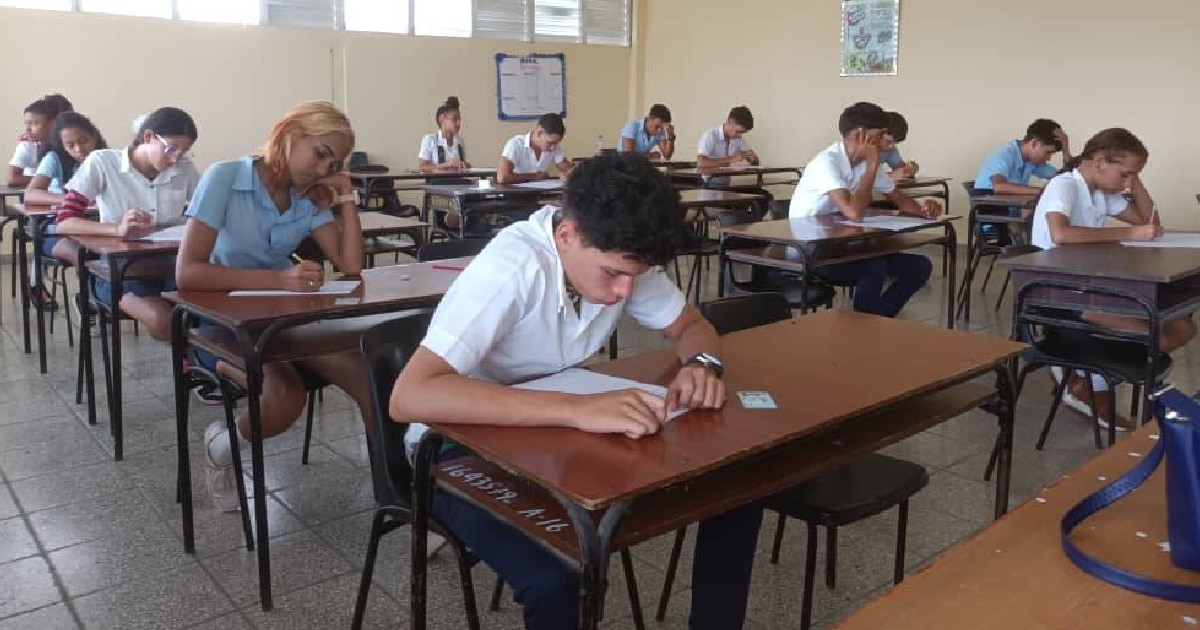
The Cuban government has suspended university entrance exams for the 2026-2027 academic year and has moved up the end of the school year to the period from June 15 to June 30, as announced yesterday by the Minister of Education, Naima Ariatne Trujillo Barreto, and the Minister of Higher Education, Walter Baluja García, during the Mesa Redonda.
One idea was echoed among many comments: the feeling that the Cuban educational system is experiencing a worrying regression. "I buy a lantern for the next literacy campaign," wrote a user, capturing with sarcasm the tone of many reactions.
The ironic reference to the Literacy Campaign of 1961—often cited by the Cuban regime as one of its key educational milestones—reflects the perception of accumulated deterioration in Cuban education.
Other comments were equally critical: "In a few years, we will experience a new Literacy Campaign; without questioning the cognitive abilities of some students, entering Higher Education is not a hobby."
One of the most recurring criticisms pointed to the contradiction with the precedent set during the pandemic: "Not even during the covid phase were entrance exams suspended, and now they are."
This contradiction is even more striking because Minister Trujillo Barreto herself stated in March 2026 that "no one has thought of saying, let's suspend the school year," and that the exams would take place on June 5 (Mathematics), June 9 (Spanish), and June 12 (Cuban History).
Some commentators recalled bluntly: "But didn't they just say it was Fake News?"
The outrage also reached those who studied under the previous rules: "Hey, I worked so hard in 12th grade because I really burned the midnight oil for the entrance exam, and now they're making it this easy."
A voice that identified itself as a teacher warned about the structural consequences: "If the system doesn't change, our nation will be worse in the future; there will be no professionals to move the country forward."
Another frequently cited comment was unequivocal: "Eliminating exams does not improve education… it merely masks the disaster. A country does not advance by promoting students by decree, but by educating capable young people. Then we end up with university graduates who cannot write, teachers lacking qualifications, and empty professionals. Demand is not cruelty; it is respect for the future."
A specific concern arose regarding the students of the pre-university vocational institutes for exact sciences (IPVCE): "Totally affected by this decision and at a complete disadvantage, because the allocation of careers for them wasn't thoroughly analyzed," noted a user, referring to the fact that their rankings are more demanding than those of regular pre-universities where, according to several commentators, grades are "given away."
There were voices defending the measure, arguing that students live under extreme conditions—blackouts lasting over twenty hours, hunger, lack of sleep—making a fair evaluation impossible, and that similar tests did not exist in the 1970s and 1980s either.
The minister, for her part, described the course process as "of extraordinary sensitivity, of sacrifice, of tremendous commitment" and attributed the difficulties to "the aggressive policies of the United States government," without acknowledging any internal responsibility for the educational collapse.
The statistic that underscores the magnitude of the problem: in the 2024-2025 academic year, only 51.5% of the candidates passed the entrance exams out of 18,402 students who took them, with extreme cases such as Las Tunas where barely 16.7% passed the tests.
Filed under: