
Related videos:
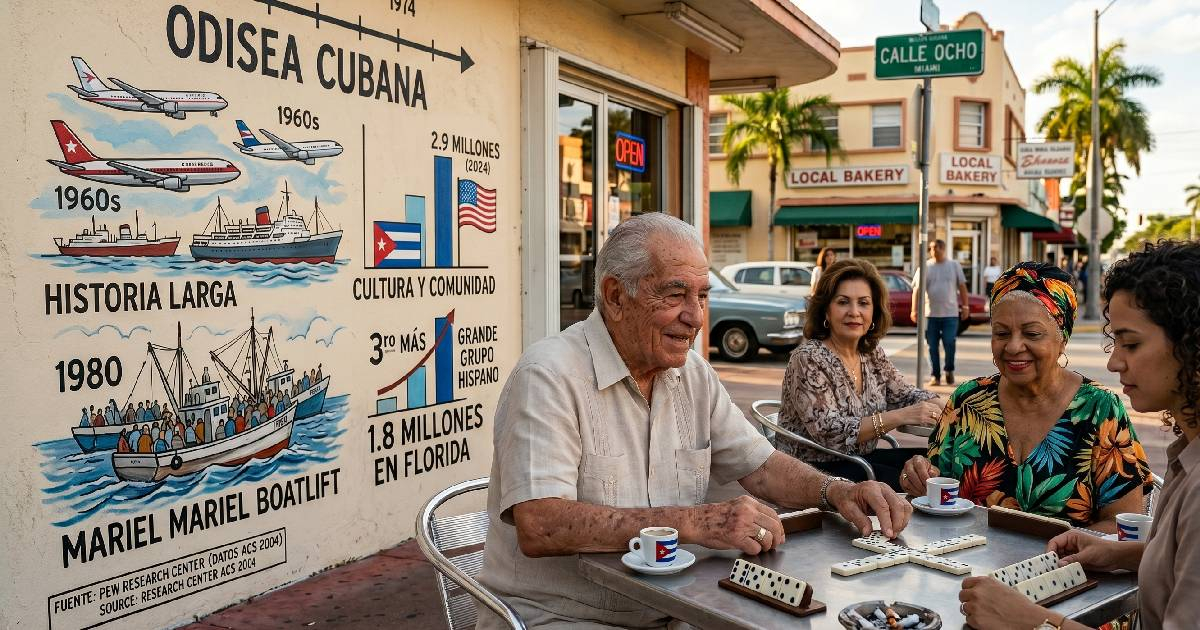
Cuban Americans are establishing themselves as the third largest Hispanic group in the United States, surpassed only by Mexicans and Puerto Ricans, according to a report published this month by the Pew Research Center, which reveals a rapidly growing community with a unique demographic profile.
In 2024, the Cuban population in the northern nation reached 2.9 million people, a 23% increase from 2019, reflecting decades of sustained arrivals from the island and a new migration surge in recent years.
More than half of that community, 57%, amounting to 1.7 million people, are immigrants born outside the country.
The report states that "the high proportion of Cubans born abroad reflects the continuous influx of immigrants over the decades, with large numbers arriving in recent years."
The Cuban migration history in the United States is characterized by successive waves. About 250,000 Cubans arrived in the 1960s following the 1959 revolution, and another 250,000 followed in the next 10 years.
The community is overwhelmingly concentrated in the state of Florida, where 61% of the country's Cubans reside, approximately 1.8 million people.
Of them, approximately 1.2 million live in the Miami metropolitan area and another 177,000 in the Tampa area.
In total, 94% of Cubans in the United States live in metropolitan areas.
Cuban Americans are also the Hispanic group with the highest median age in the country, at 38.2 years, a figure that matches the national median but is significantly higher than the 30.2 years for the overall Hispanic population.
The Pew attributes this aging to the arrival of older immigrants and the relatively low birth rate among Cuban Americans.
Regarding education, 33% of Cubans in the United States hold at least a university degree, compared to 37% of the general population, although Cubans born in the country exceed that national average.
The demographic growth of the community occurs in a context of increasing migratory and legal pressure.
Before 2017, there were virtually no unauthorized Cuban immigrants in the United States due to the immigration policy in effect at that time.
However, by July 2023, that number had climbed to 475,000 people, according to the latest estimates from Pew.
This increase coincides with the tightening of immigration policies by the administration of President Donald Trump, which has led to deportations and Cubans stranded in Tapachula, Chiapas, without documents or legal status.
In parallel, this Friday an immigration attorney warned that a new USCIS memo could affect the Cuban Adjustment Act, the main regularization mechanism for Cubans in the United States, although it does not directly repeal it at this time.
More than 300,000 Cubans have the I-220A form, whose eligibility to benefit from that law is still in federal litigation, and their situation in the event of a democratic transition in Cuba also creates legal uncertainty.
Filed under: