
Related videos:
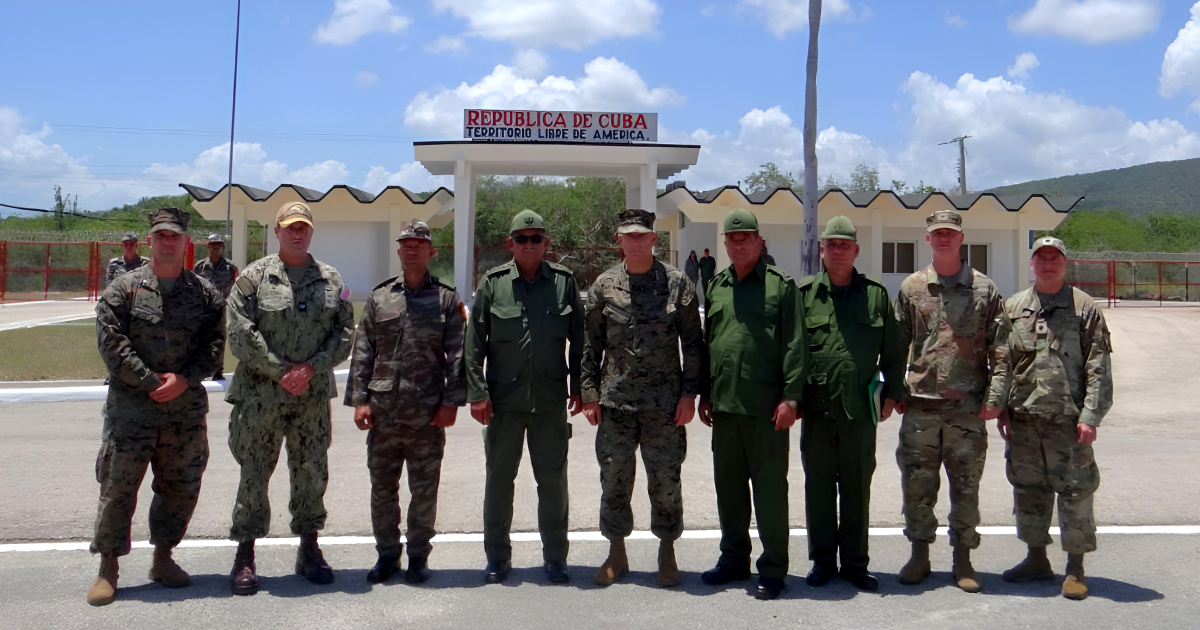
The image of several Cuban generals posing alongside the head of U.S. Southern Command, Francis L. Donovan, at the perimeter of the Guantánamo Naval Base, has sparked one of the most intense discussions among Cubans and Cuban Americans on social media in recent hours.
Paradoxically, the debate does not focus so much on the official content of the meeting as on the symbolism of the photograph and the political meaning that each sector assigns to the encounter.
The reactions reveal a clear division. While one part of the audience views the meeting as a sign that something significant might be shifting within the Cuban power structures, another believes that any public contact with the Revolutionary Armed Forces serves to legitimize those who uphold the regime's repressive apparatus.
The differences are especially noticeable when comparing the responses generated on different platforms.
On Facebook, where the Southcom post was widely shared among Cuban users and members of the exile community, an optimistic interpretation of the meeting prevailed. Numerous comments interpreted the image as a demonstration that the FAR are reacting to a new correlation of forces in the region.
Some users claimed that the photograph reflected a position of weakness for Havana in relation to Washington. Others went on to speculate about possible scenarios for political transition, internal changes within the Cuban army, or even potential negotiations concerning the future of the regime.
The surprise over the change in language used by Cuban authorities was also a recurring theme. Many users pointed out the contradiction between decades of official rhetoric against the Guantanamo Naval Base and the professional and cooperative tone used by the Ministry of Revolutionary Armed Forces (MINFAR) to describe the meeting.
However, the conversation on the social network X presented a very different picture.
According to the analysis of the responses published under the official message from SOUTHCOM, the prevailing reaction among Cuban-American users and conservative sectors was one of rejection and distrust.
For many of them, the photograph of the American generals alongside high-ranking officials of the FAR represents an uncomfortable image. Some referred to it as an unnecessary concession to the Cuban regime, while others expressed their concern over what they see as a contradiction with the pressure policy that Washington has maintained against Havana.
There were accusations that the meeting could be interpreted as a means of normalization or legitimization of an institution that many opponents consider responsible for political repression on the island.
In numerous comments, there were messages demanding a tougher policy towards the regime and questioning the usefulness of any dialogue with the Cuban military.
What is interesting is that both interpretations stem from exactly the same fact.
Neither the most optimistic sectors nor the most critical ones seem to view the meeting as just a routine gathering on perimeter security. On the contrary, both those who welcome the contact and those who condemn it attribute to it a much greater political significance.
This is particularly noteworthy because various specialists have pointed out that military contacts related to the security of the Guantanamo Naval Base are not a new development. Historically, there have been communication mechanisms between both parties to manage operational matters, border incidents, and security issues.
What does seem different this time is the context.
The meeting takes place a few weeks after the visit to Havana by CIA Director John Ratcliffe, another meeting that was initially disclosed by U.S. authorities before being confirmed by the Cuban side.
Additionally, the subsequent statement from the FAR steered clear of the traditional rhetoric regarding the alleged occupation of Guantánamo and chose instead to emphasize aspects such as perimeter security and communication among military leaders.
It is precisely this combination of factors that has turned a technical meeting into an event loaded with political symbolism.
The discussion generated on social media reflects how any gesture related to Cuba continues to be interpreted through emotions, historical memory, and the expectations for change that have accumulated over decades.
For some, photography represents a sign that something is changing within the Cuban system. For others, it is an image that should never have been produced.
And perhaps this division explains better than any official statement why Cuba remains one of the most sensitive and polarizing issues for millions of Cubans inside and outside the island.
Filed under: