
Related videos:
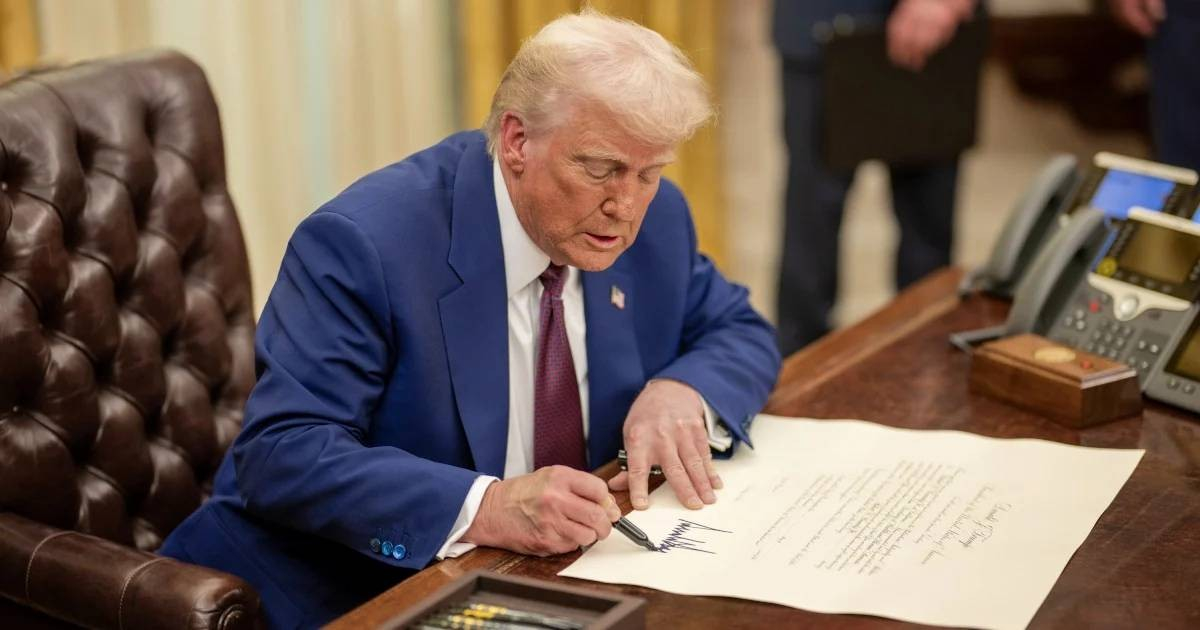
President Donald Trump announced this Tuesday on his platform Truth Social that he signed an executive order to prevent banks, credit cards, and financial institutions from being used to facilitate illegal immigration, human trafficking, drug trafficking, and the activities of criminal cartels.
The order, titled "Restoring Integrity to America's Financial System", was signed on May 19 and is led by the Department of the Treasury, with participation from the Federal Reserve, the FDIC, and the OCC.
In his post, Trump stated that "illegal immigrants and foreign scammers steal billions every year from the American taxpayer" and that the bank accounts used to facilitate illegal immigration or hold social welfare benefits received by undocumented individuals "will be closed, and the funds will face confiscation and seizure to be returned to the taxpayers."
The official also criticized that any undocumented immigrant could present a driver's license from a "blue state" or a "Biden border document" to gain unrestricted access to the U.S. financial system, calling this situation "deeply dangerous."
The order instructs the Treasury to issue a formal guide within 60 days regarding warning signs related to immigration status in bank accounts, loans, and credit cards.
In a period of 180 days, the measure aims to review the customer identification rules under the Bank Secrecy Act.
The use of the ITIN —Individual Taxpayer Identification Number— to open accounts or access credit when the applicant lacks verified immigration status is classified as a red flag. However, the order does not impose an automatic and immediate closure of all accounts held by undocumented individuals, but rather takes a risk-based regulatory approach.
The order also instructs the federal consumer financial protection agency to consider potential deportation and loss of income as factors in assessing the ability to repay loans.
Trump took the opportunity to send a direct message to the protesters opposing the operations of the Immigration and Customs Enforcement (ICE): "Your violent disruptions only strengthen our resolve."
Anti-ICE protests have spread across the country since January, with demonstrations in New York, Newark, Los Angeles, and Minneapolis. In response to the disturbances in California, the administration deployed 4,200 National Guard soldiers and 700 Marines.
The measure is part of a broader immigration offensive that includes the cessation of humanitarian parole —which affected around 110,000 Cubans— and the re-inclusion of Cuba on the list of state sponsors of terrorism in January 2025.
The impact on remittances to Cuba could be significant. Transfers from the Cuban diaspora were estimated at 2.5 billion dollars in 2023, and the increased banking friction resulting from the new order could lead to account closures or delays in those transfers, at a time when the Island is already facing severe financial restrictions due to U.S. sanctions.
Trump concluded his post with a phrase that encapsulates the goal of his administration: "It has been said that this measure is the most effective means to reverse Biden's border invasion. We will know soon!"
Filed under: