
Related videos:
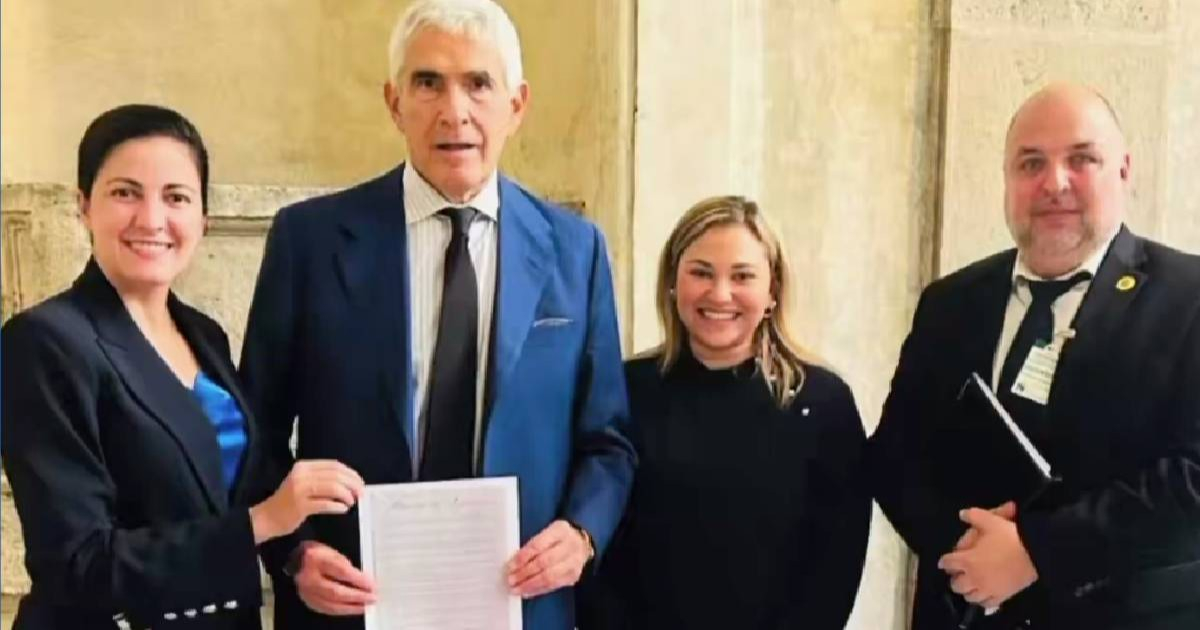
Rosa María Payá brought the Agreement for Liberation to the Italian Senate on Friday, in a day that the activist herself described as "successful" after meeting with Italian legislators in Rome to present the democratic transition plan for Cuba.
The delegation, in which Payá was accompanied by Giaxi Cires, met with Senator Maurizio Gasparri, president of the Italian Senate's Foreign Affairs Committee, and Senator Pierferdinando Cassini.
The senator Giulio Terzi di Sant'Agata, former Minister of Foreign Affairs of Italy and an active figure in discussions about democracy in Latin America, also received the delegation. He was photographed alongside Payá holding the Agreement document in an official Senate room, with the flags of Italy and the European Union in the background.
"We are very happy with the warm reception here in Rome, we are very grateful for the support of the senators, for their solidarity, and for the proposals they have made to continue promoting this effort for systemic change in Cuba," Payá stated in a video recorded at the Senate entrance.
In a message addressed to Senator Terzi, Payá expressed gratitude for his commitment and described the Agreement as "a roadmap for a peaceful transition and a unified call to end the dictatorship, free political prisoners, and restore the sovereign voice of the Cuban nation."
The visit to Rome is part of a European tour of the Liberation Agreement that began in Madrid, where on May 31, Cuban organizations in Europe confirmed the document at a Pasos de Cambio event.
The next day, Payá participated in the III Diario de Cuba Forum 2026 in the Spanish capital, where she called for uniting the Cuban democratic forces to prepare for the political transition with a direct warning: "Either we organize ourselves and provide a democratic alternative to the Cuban people, or history will overwhelm us."
The Liberation Agreement was originally presented on March 2, 2026 in Miami, driven by the Assembly of the Cuban Resistance, led by Orlando Gutiérrez-Boronat, and Steps for Change, headed by Payá, with the support of more than 30 civic and opposition organizations inside and outside of Cuba.
The document outlines the transition in three phases — Liberation, Stabilization, and Democratization — and includes the immediate release of over 1,000 political prisoners, the dismantling of the Communist Party of Cuba, and the establishment of a provisional government to convene internationally supervised free elections.
The plan explicitly excludes the Castro family and the generals from the process: "The Castro family, the group of generals that has been in power for 67 years, cannot be in control for this process to begin," Payá stated in Madrid.
The Florida Senate officially recognized the Agreement on April 29 through a proclamation signed by state senator Alexis Calatayud, and the search for European institutional support continues with Italy as the new stage for this international campaign.
Filed under: