
Related videos:
While the official television news in Cuba broadcast an alert on Saturday regarding summer hygiene and the risks of hepatitis, a resident of Santa Clara Street, between 50th and 53rd Streets in Cienfuegos, reported on Facebook that there has been no garbage collection in his neighborhood for over a month.
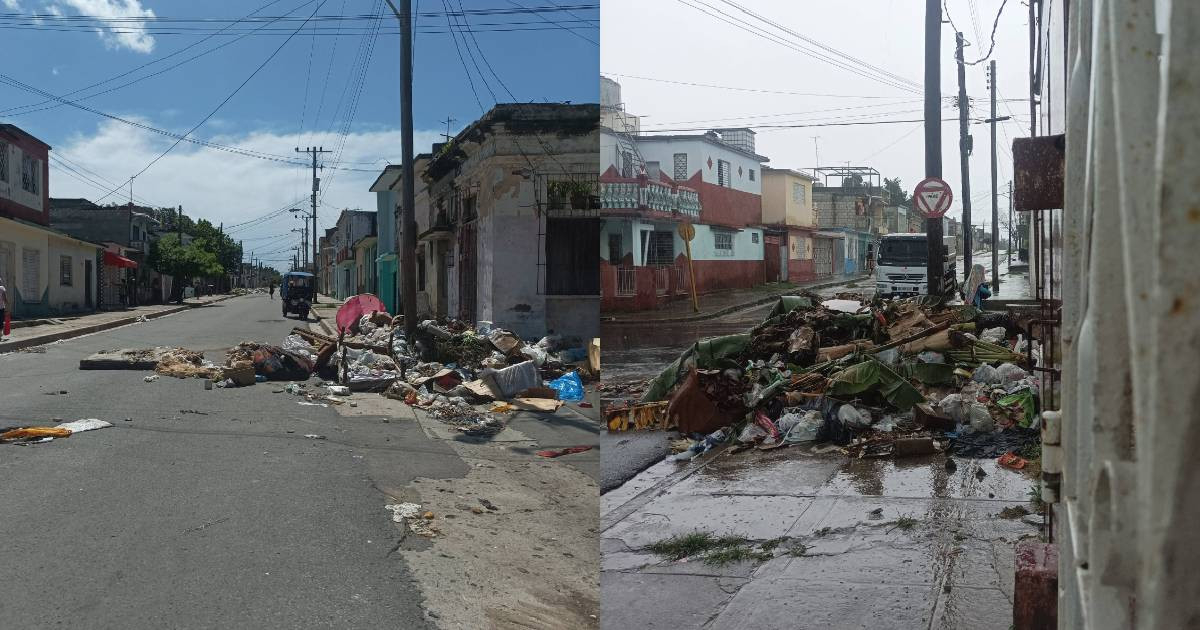
"I was watching the news, the interview with the director of ProSalud, alerting about hygiene in the summer due to hepatitis and other viruses. Calle Santa Clara, 50 and 53, Cienfuegos, hasn't had trash collected for a month, while other avenues have been serviced several times. They should see what they're talking about," wrote on his Facebook profile Mario Cruz Moscoso, accompanied by images showing piles of trash accumulated on the sidewalks and road.
The photographs reveal a street in critical condition, with plastic bags, wet cardboard, branches, old mattresses, and organic waste piled up in the corners, along with accumulated water on the pavement after the recent rains.
Neighbors from the same area confirmed in the comments that the problem is even more widespread than what the original complaint indicates.
"We have been left at the mercy of God. We are unprotected and ungoverned; no institution, whether health, community, or any other governmental body, cares about the health of the people. It has been more than a month and 15 days since the garbage was collected on Gloria towards Juanita. The sewers and drains are filling up with trash and debris carried by the rains; if a hurricane comes, it will drown us," wrote a resident of Santa Clara Street, between 50 and 51.
Another neighbor reported that the situation is similar a block away from Avenida 5 de Septiembre, in front of a primary school: "the pile of garbage nearly blocks the street. I don’t know how much longer they plan to let the filth grow."
The rains have worsened the problem. "Today, when it rained, a lot of trash flowed down the hill uncontrollably, clogging the drains," warned a resident, while another summed up the situation with a blunt phrase: "All of Cienfuegos is like this."
"Soon we should expect a major epidemic. That situation is everywhere," warned one of the neighbors in the comments on the complaint, a prediction that the official figures themselves make hard to dismiss.
The complaint from Santa Clara Street is not an isolated case. A few days ago, residents of Reparto Tulipán reported an improvised dump on Calle 75, in front of buildings inhabited by children and the elderly, while Avenida San Carlos has lost half of its roadway capacity due to the accumulation of waste.
The official response —lack of fuel for garbage trucks— is rejected by the citizens. One resident stated it bluntly: "Saying 'there is no oil' is admitting that the country is bankrupt, that they are lying on television, and that they don’t care if the people get sick."
The health backdrop makes the contradiction even more severe. This Sunday, the official Canal Caribe and the Health Promotion and Disease Prevention Unit (Prosalud) disseminated summer advice in which Dr. Pablo Feal Cañizares explained that hepatitis A "is transmitted via fecal-oral route".
He added that "flies can also contribute to this transmission," conditions that accurately describe the environment created by weeks of uncollected trash in residential areas.
The official journalist Gisela García Rivero acknowledged in that same report that "currently all provinces in the country have reported cases of hepatitis A," with the largest outbreaks occurring in Havana, Matanzas, Santiago de Cuba, Ciego de Ávila, and Camagüey.
In Matanzas, seven positive cases and 49 suspected cases were reported in just one week; in Camagüey, between 30 and 40 positive cases were being registered daily in April.
Pinar del Río also reported an increase in suspected cases in several municipalities last Friday, while the Deputy Minister of Public Health, Julio Guerra, denied that Cuba is experiencing an epidemic although he admitted to the news agency EFE that the health situation is "very complex."
Filed under: