
Related videos:
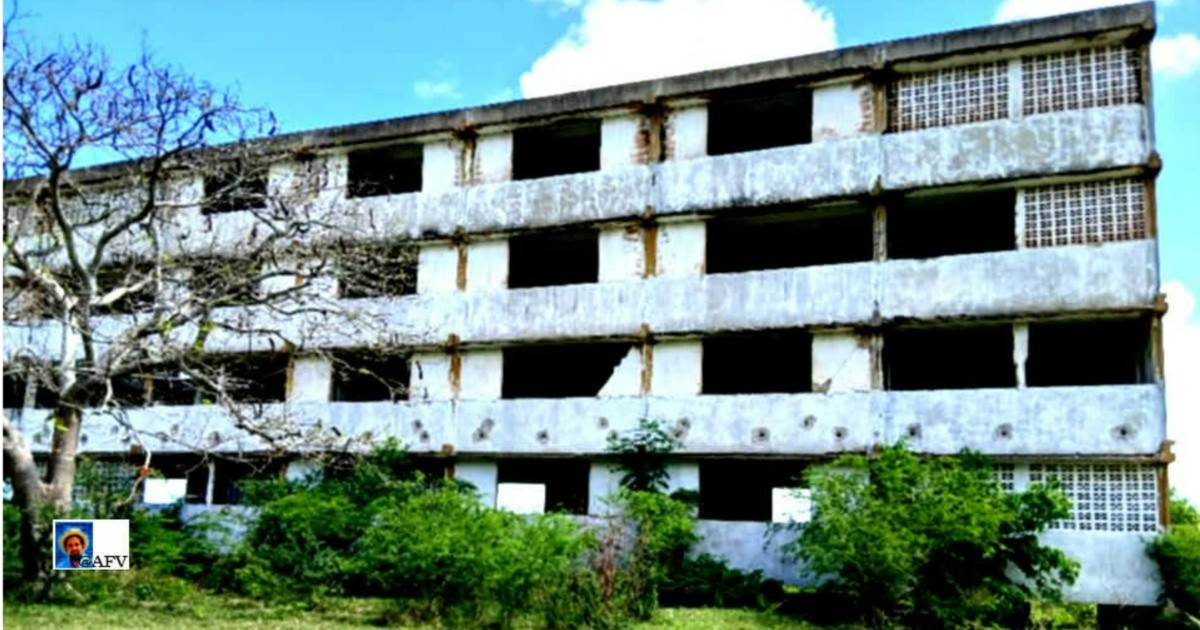
Recent images of the pre-university Bungo 9, located in the Bungo settlement, Contramaestre municipality, Santiago de Cuba province, show a multi-story building with windows missing glass, walls stained with moisture, exposed concrete structure, and uncontrolled vegetation—evidence of years of neglect that has touched those who spent their formative years there.
The writer Arnoldo Fernández documented the current state of the center in a post that captures both photographs of its deterioration and the family testimony that connects him to that place: his aunt Maira attended pre-university there in the 1970s, and the friendships forged in those classrooms —Bárbara and Loli, his study companions— ultimately became part of the family circle.
"The 1970s were passing, and Bungo 9 was more than just a learning center: it was a meeting point, a space where lasting friendships were forged and where each day left a mark," wrote Fernández.
The author visited the school several times and spoke with one of its directors, identified as Canal, which allowed him to gain a closer understanding of a story he was already familiar with from family accounts.
"Seeing images of its deterioration today is painful in a way that's hard to explain. It’s not just the loss of a physical structure, but the symbolic fading of a space that was important to so many lives," Fernández stated.
Bungo 9 was part of the network of Pre-University Institutes in the Countryside (IPUEC), rural boarding schools where students combined academic training with agricultural work. At its peak, Cuba had around 350 IPUEC and 1,400 basic secondary schools in the countryside. The centers known as "the Bungos" in Contramaestre — Bungo 5, 6, 7, and 9, among others — reflect the scale that this system reached in the area.
The dismantling of the model began in 2009 with the gradual closure of internal scholarships and was formalized in 2011 when Guideline 148 of the Communist Party acknowledged that students were not producing enough to justify the costs of the model. By 2018, the majority of these centers had been converted into housing for workers, self-consumption farms, or remained as ghost towns.
The deterioration of Bungo 9 is not an isolated case. Other emblematic IPUECs such as Sanguily 1 are now seen as ruins in videos shared on social media, and centers like the IPVCE Carlos Marx in Matanzas or the Lenin Vocational School in Havana have been documented in a state of neglect and vandalism.
The collapse of these spaces is part of a broader educational crisis: the UN estimated in April 2026 that are attending reduced school hours due to the energy crisis, and the 2025-2026 school year began with a shortage of about 24,000 teachers, as acknowledged by the Minister of Education herself.
"Bungo 9 is no longer the same, but in the memory of those who experienced it, it remains intact. Maira, Bárbara, Loli, and all those who turned their years of study into a shared story that still endures today against oblivion, continue to exist there, in some way," concluded Fernández.
Filed under: