
Related videos:
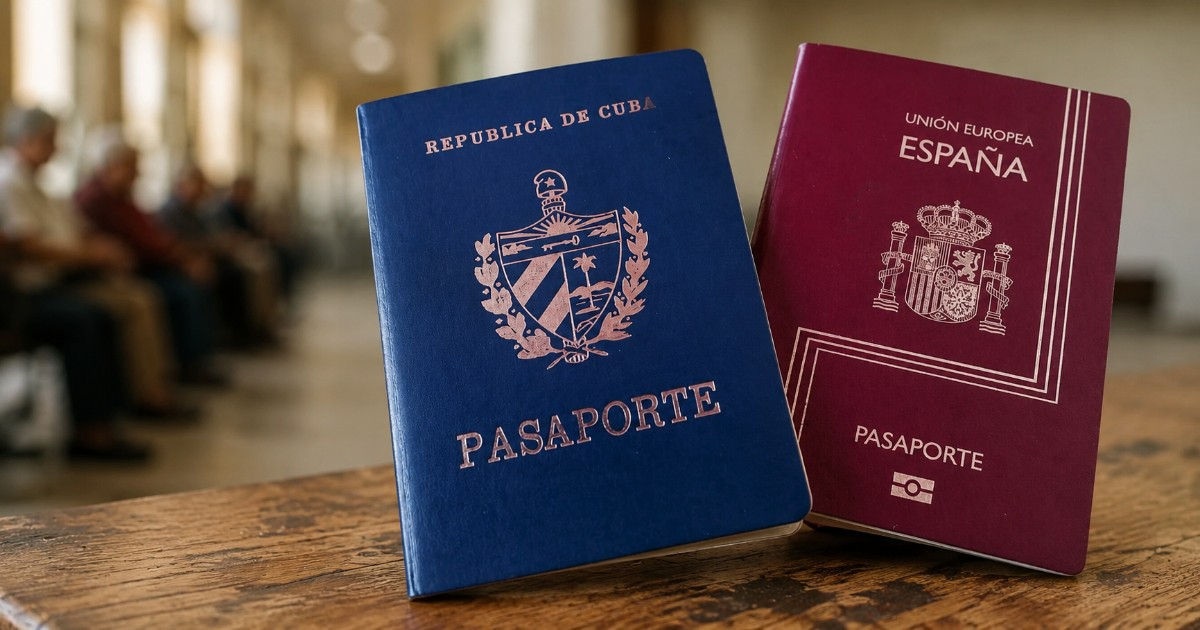
Thousands of Cubans of Asturian descent, as well as from other autonomous communities, have been trapped for years in a bureaucratic process to obtain Spanish nationality.
La Nueva España published an article this Wednesday detailing the process behind the promise of the “Grandchildren's Law.” It describes a consulate in Havana overwhelmed by more than 350,000 requests —with estimates reaching 600,000— and an island in the midst of a humanitarian crisis that turns every procedure into a challenge.
The Law of Democratic Memory (LMD) that opened the door for Spanish citizenship to children and grandchildren of emigrants, closed its application period in October 2025.
However, the accumulated volume of applications has completely overwhelmed the consular capacity. Cuba is the second country in the world in the number of applications, only behind Argentina. The waiting times in Havana extend up to three years without any guarantee of resolution.
The General Council of Spanish Citizens Abroad warned, in October 2024, that at the current pace, it could take up to twenty years to process all the files accumulated worldwide.
"When the LMD came out, we began the tedious process of waiting in line at the Cuban civil registries and the local police for the paperwork. We spent three months in line to obtain the documents. It was in February 2023. Our entire family spent a year legalizing and sorting everything out. The experience was terrible, to say the least," commented a Cuban to the Spanish media.
That person submitted the complete file in February 2024 and attended their consular appointment in March 2025, but by mid-2026, they have still not received a response.
"We don't know what stage the process is at, because they don't even update the consulate's page. As I write this, we have already been waiting anxiously for two years and almost four months," the man said.
His adult children, he estimates, will not obtain Spanish citizenship before 2030 "with an optimistic outlook."
Another descendant of Asturians who did obtain citizenship in December 2025 after nearly three years of procedures—just to schedule an appointment took a year and four months—now faces a new obstacle course.
"We have been at it for almost three years, and I still haven't finished. Now we are in the process of obtaining residence visas so we can go to Asturias, where my family is from."
The Cuban lawyer naturalized in Spain Estela Marina Pérez Cabrera, president of the Association of Descendants of Spaniards Worldwide (ADEM), has publicly denounced that a law that was born "with words like reparation, historical justice, and democratic memory" has turned into a "Kafkaesque labyrinth of endless waits."
Pérez Cabrera notes that the Cuban crisis amplifies every bureaucratic obstacle.
"Cuba is a surrealist country. Firstly, there is a critical energy situation. In the provinces, people cannot enter or leave without government authorization. And this, of course, delays the entire situation," said the lawyer.
To the elderly Cubans who await the Spanish passport as their only means of escape from the island, bureaucracy not only steals their time but also leaves them without motivation and hope for their families.
"When an adult applicant passes away before submitting their application, their entire family is left unprotected. Their adult children, who could have processed their nationality through the parent, are excluded. The appointment dies with the holder. Hope dies with them."
"Returning to the land of their ancestors is what truly draws Spanish descendants, regardless of whether the Spanish passport can be their lifeline and that of their family," stated Pérez Cabrera.
He recalled that these people "can no longer live in their homeland," because in present-day Cuba, people survive, and the elderly are probably the most vulnerable population.
Filed under: