
Related videos:
The Cuban government announced this Thursday one of the most profound economic transformations since the beginning of the reforms initiated by Raúl Castro over a decade ago: the partial opening of the fuels sector to the participation of private and foreign capital.
The measure is part of a comprehensive package of 176 economic and social transformations presented by Prime Minister Manuel Marrero Cruz before the National Assembly of People's Power, in an extraordinary session where the Government implicitly acknowledged the severity of the economic, energy, and financial crisis that the country is experiencing.
Among all the proposals made public, few carry as strong a symbolic weight as the decision to allow private actors and foreign companies to participate in the importation and marketing of fuels, an activity that has been virtually exclusive to the Cuban state for decades.
The proposal is outlined within the so-called Axis 6: Energy Transformations, one of the most revealing chapters of the reform package.
Private and foreign capital will be able to import and sell fuels
The main measure establishes:
"Allow the participation of private and foreign capital in the importation and marketing of fuels, including the retail network."
In practical terms, the provision paves the way for national private companies, cooperatives, joint ventures, and foreign investors to participate in a market that has historically been controlled by Unión Cuba-Petróleo (CUPET) and other state entities.
The decision is an implicit acknowledgment that the State no longer has the financial capacity to ensure the energy supply of the country on its own.
In recent years, the fuel shortage has caused prolonged blackouts, disruption of public transportation, interruptions in production, and frequent supply crises at gas stations.
The opening aims to attract capital and external financing to a sector that urgently needs investments and stable access to international markets.
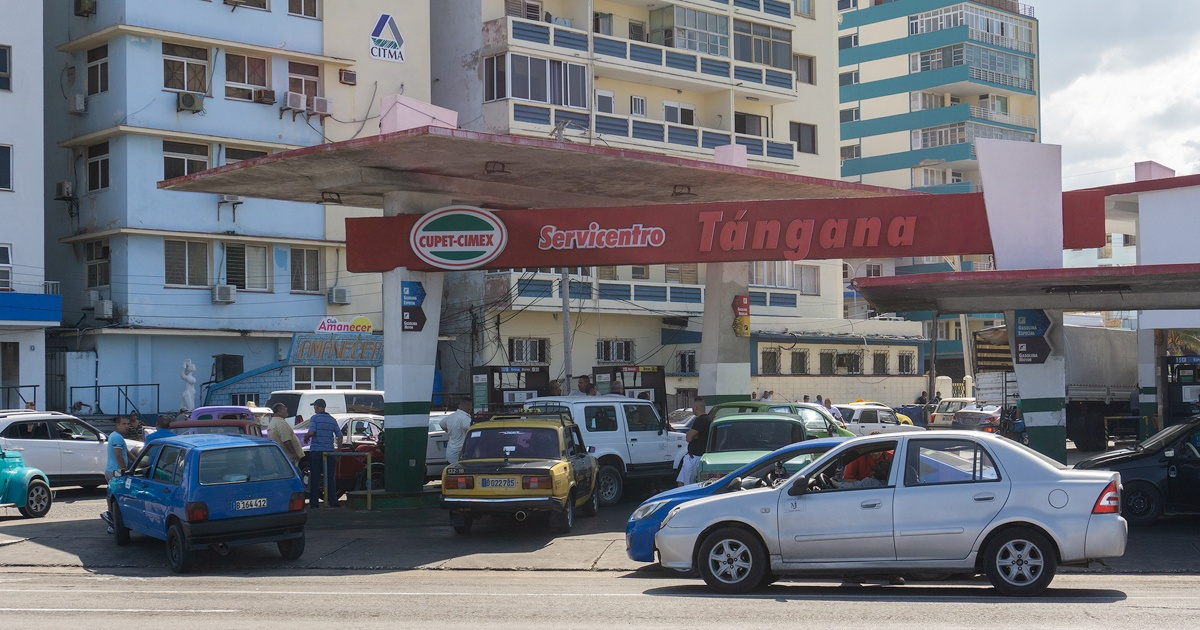
Gas stations are no longer exclusively state-owned
The reform also provides for a complete transformation of the service station network.
The document proposes: "To expand and restructure the management of the service center network, including mobile service centers."
Although the Government did not explain how the change will be implemented, the wording suggests that gas stations currently managed by state-owned companies could be operated by different economic actors.
The proposal represents a significant change in a sector where state presence has been practically absolute for decades.
Mandatory solar panels at service stations
The authorities also announced that gas stations must move towards energy self-sufficiency.
According to the document:
"Establish that the service stations managed by different economic actors incorporate photovoltaic systems with storage so that they can become independent from the National Electric System."
The measure responds to the fragility of the Cuban electrical system, which is experiencing increasingly frequent blackouts due to the deterioration of thermal power plants and a shortage of fuel.
The intention is for the gas stations to continue operating even during widespread power outages.
The government is betting on "solineras."
Another update included in the package is the promotion of charging points for electric vehicles.
The proposal states: "Encourage the establishment of charging stations to sell the service of electric vehicle charging."
The term "solinera" has been used in Cuba to describe charging stations powered by solar energy.
With this measure, the Government aims to create a minimal infrastructure to support the future expansion of electric mobility, a strategy that is also reflected in other transportation-related transformations.
Credits to boost the energy transition
The Executive acknowledges that the development of renewable energy requires financing.
Therefore, it proposes:
"Design funding lines, simplify requirements, and expand guarantees for granting credit to legal and natural persons, which will encourage the energy transition."
The measure would be aimed at both companies and citizens interested in investing in solar systems, energy storage, charging infrastructure, or other technologies related to reducing fossil fuel consumption.
The government did not specify the source of those funds or the specific terms of the loans.
State-owned companies will be able to use foreign payment platforms
Another significant modification aims to facilitate international operations related to fuel.
The document also states, "To allow state-owned companies to use foreign platforms to execute payments for the buying and selling of fuels."
The provision represents an acknowledgment of the difficulties that Cuba faces in conducting international transactions due to financial restrictions, a lack of liquidity, and problems accessing the international banking system.
New tax on fuel imports
In parallel to the partial liberalization of the sector, the State plans to create a new tax.
The proposal establishes: "Apply a tax of up to 1% on the importation of physical or financial fuel, intended for operational inventories."
Although the Government did not explain how the mechanism will work, the measure appears aimed at financing strategic reserves and ensuring minimum inventories for the operation of the energy system.
Tax incentives for investments in renewable energy
The package also includes tax benefits for those who invest in renewable sources.
According to the text presented before Parliament:
"Reduce the tax by an amount equivalent to the investment made for state and non-state economic actors who make investments in renewable energy sources."
The tax reduction would apply when these investments benefit social centers, health institutions, community services, facilities for vulnerable individuals, or public lighting projects.
The measure aims to encourage companies and private businesses to take on part of the investments that have traditionally fallen on the state budget.
An unthinkable opening just a few years ago
Energy transformations are part of a much broader package that includes the opening of private banking, the authorization of private exchange houses, the possibility for national and foreign investors to purchase shares in state-owned companies, the expansion of foreign investment, and greater participation from the private sector in numerous economic activities.
However, the opening of the fuel market stands out as one of the most strategic sectors controlled by the Cuban state since 1959.
The decision reflects how much the economic crisis has forced the government to reconsider positions that for years were presented as unchangeable.
During his speech, Marrero defended the measures, asserting that they do not represent a renunciation of socialism or the responsibilities of the state, but rather an adaptation to the current circumstances of the country.
However, the Government itself acknowledged that the transformations will entail deep changes in the national economic structure, will affect more than 148 existing legal provisions, and will require the drafting of dozens of new legal regulations.
For now, the proposals will need to be debated and subsequently turned into concrete legislation. But the political message is already clear: in the face of the worst economic and energy crisis in decades, the Cuban regime is willing to open up even sectors that until recently seemed untouchable.
Filed under: