
Related videos:
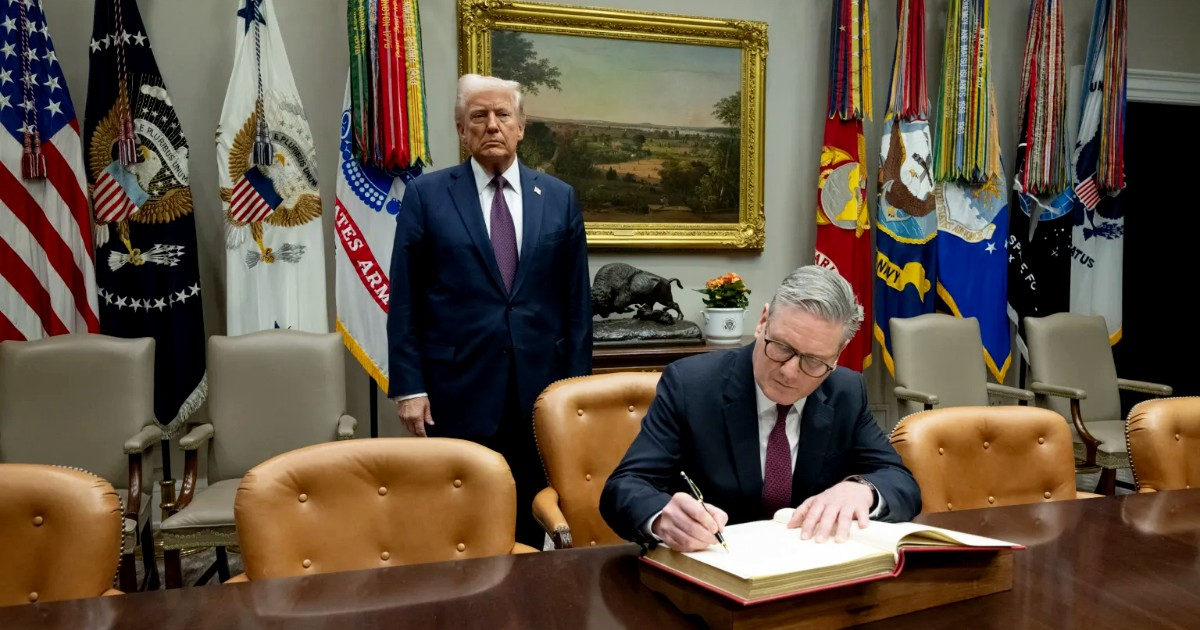
The U.S. President Donald Trump became the first to publicly announce the resignation of British Prime Minister Keir Starmer this Sunday, by posting on Truth Social and his X account that the Labour leader would be stepping down.
"Keir Starmer will resign as Prime Minister of the United Kingdom. He has seriously failed on two very important issues: IMMIGRATION AND ENERGY (OPEN THE NORTH SEA OIL!). I wish him the best!" wrote Trump, as reported by Reuters from Washington.
The publication was unusual not only for its content but also for its format: a foreign president anticipating—or confirming—the downfall of an allied government leader, with the direct and unadorned tone that characterizes Trump's communications on social media.
The message did not come out of nowhere. On the same Sunday, the British newspaper The Observer had already published that Starmer might announce his resignation on Monday, June 22, and that the Prime Minister had been at Chequers—the official country residence reflecting on his political future.
The sequence suggests that Trump globally amplified a leak that was already circulating in British media, although his publication was what turned the rumor into a worldwide headline.
The British government maintained an ambiguous stance in the face of a barrage of questions. Minister Peter Kyle stated that he had not spoken with Starmer since Friday and had no reason to believe that a resignation would be announced on Monday.
Downing Street, for its part, insisted that the Prime Minister remained "focused on the work of governing." Starmer himself had stated just two days earlier, on Friday, June 19, that he would not resign from his position.
The political crisis for Starmer had been building for weeks. The Labour Party suffered a debacle in the local elections of May 2026, losing nearly 1,500 councilors. This was compounded by the resounding victory of the Mayor of Greater Manchester, Andy Burnham, in the Makerfield by-election on June 18, which intensified internal pressures for Starmer to resign from leadership.
More than 70 Labour MPs had formally requested his resignation or a timeline for his departure, and party sources indicated that nearly a hundred parliamentarians and cabinet members supported the resignation. The Health Minister, Wes Streeting, had previously resigned, as did Minister Miatta Fahnbulleh on May 12.
Starmer came to power in July 2024 after the Labour victory that ended 14 years of Conservative government, but his tenure was quickly eroded by internal scandals, resignations of senior officials, and unfavorable electoral results.
The relationship with Trump had been ambivalent: both leaders reached a bilateral trade agreement in May 2025 that allowed the United Kingdom to export up to 100,000 vehicles to the United States with a 10% tariff, but there were also frictions over Iran and energy policy issues.
Only five days before the controversial message, both leaders had met at the G7 in Évian-les-Bains, France.
According to El País, Burnham had the explicit support of over 300 Labour MPs, a number exceeding the threshold required for a motion of no confidence, which positioned him as a credible alternative to the party leadership. The formal announcement of Starmer's resignation was expected this Monday.
Filed under: