
Related videos:
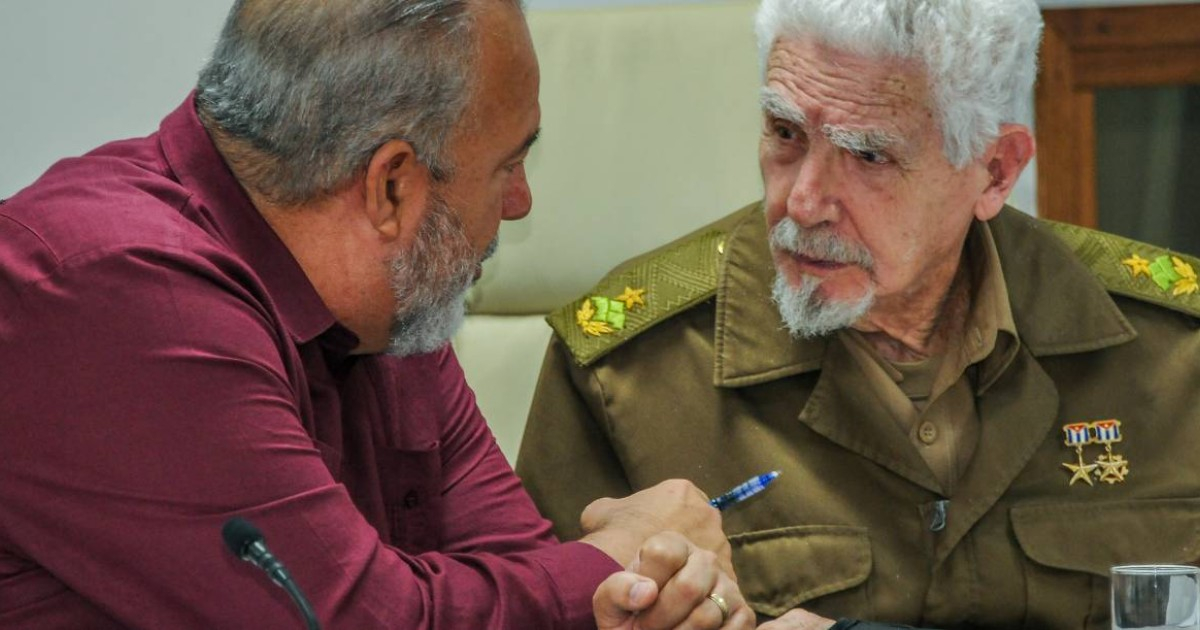
The Cuban Prime Minister Manuel Marrero Cruz expressed his sorrow on Sunday over the passing of the Commander of the Revolution Ramiro Valdés Menéndez, who died at the age of 94.
In a message posted on his official X account, Marrero stated that he felt deeply saddened and that he had the privilege of learning a great deal alongside Valdés Menéndez.
"Deep sadness at the physical departure of the Commander of the Revolution, Ramiro Valdés Menéndez, who dedicated his life to the defense of the Homeland, with absolute loyalty to Fidel and Raúl," wrote Marrero, who also described it as a "great privilege" to have worked alongside him and received his teachings in recent years.
The message from the Cuban government leader coincides with the one published that same day by Miguel Díaz-Canel, who described the loss as that of "a father" and concluded his tribute with the slogan "To victory always, Commander!"
Valdés, born on April 28, 1932 in Artemisa, was one of the last surviving members of the founding generation of the Cuban Revolution.
He participated in the assault on the Moncada Barracks in 1953, was an expeditionary on the Granma yacht, and fought as the second-in-command of Che Guevara's column during the invasion from the East to the West.
After the triumph of 1959, he became the main architect of the repressive apparatus of the Cuban state. He founded the Ministry of the Interior in 1961, created the State Security Department and the General Intelligence Directorate, and maintained close ties with the Soviet KGB.
He held the position of Minister of the Interior during two periods—1961-1968 and 1979-1985—was vice president of the Councils of State and Ministers, minister of Information and Communications, and a founding member of the Central Committee and the Political Bureau of the Communist Party of Cuba.
His absence from official events since September 2025 had sparked increasing speculation about his health, and in January and February 2026, unofficial reports circulated regarding his hospitalization in serious condition.
On June 6, 2026, during the ceremony for the 65th anniversary of MININT —the institution he founded—, his absence was particularly noticeable and Díaz-Canel paid tribute to him in his absence.
While the regime expressed official mourning, the reaction of many Cubans on social media was markedly different: numerous individuals celebrated the news, associating Valdés with decades of state repression.
With his death, the historical generation of the Cuban Revolution is reduced to just two figures: Raúl Castro, 95 years old, and Guillermo García Frías, 98 years old.
Filed under: