
Related videos:
For the second consecutive year, the authorities of the Cuban regime prohibited the Santiago congas from parading on San Juan Day this Wednesday, citing the "political-ideological situation" affecting Santiago de Cuba, according to an internal message that circulated among group leaders.
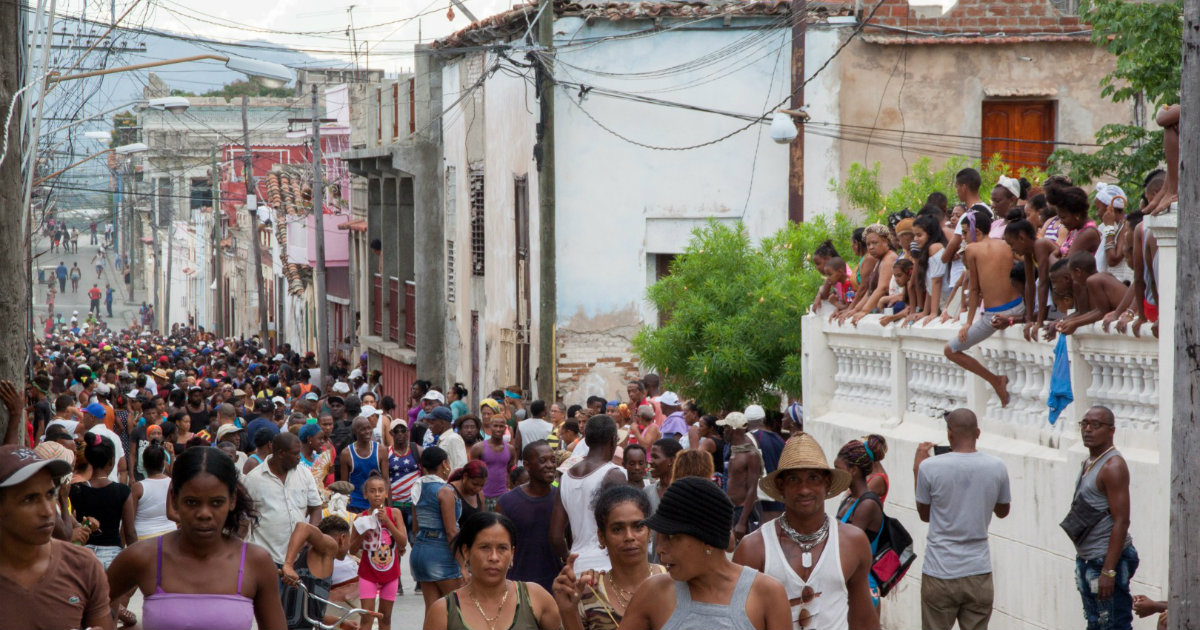
The underlying reason is no secret: the congas have the ability to gather thousands of people in the streets, and in a city that has been experiencing weeks of protests and demonstrations, that crowd is what the regime fears the most.
The internal message, circulated among the organization directors, was explicit: "Good evening Directors, we inform you that the route for the 24th, Saint John's Day, has not been authorized, taking into account, as you already know, the political-ideological situation currently facing Santiago de Cuba."
A second message added: "I hope everyone understands and supports our party's decision in the Province," and a third specified that "the performance will take place within each venue; those without a venue cannot perform."
The direct antecedent dates back to June 2025, when the group Paso Franco took to the streets and the crowds massively chanted "Súbelo Mayeta!", turning the celebration into a collective expression of protest.
That corito —born as a hashtag on social media to channel citizens' complaints towards the independent journalist Yosmany Mayeta Labrada— had established itself as a symbol of popular discontent, and the regime was not willing to repeat that experience.
The pattern repeated in December 2025 when the Conga de Los Hoyos also did not take place on its traditional date of December 27, in what Mayeta described as "paperless censorship": the Provincial Directorate of Culture stirred rumors of cancellation without issuing a formal prohibition.
The decision made this Wednesday comes just days after Santiago experienced massive banging of pots and pans in practically all of its neighborhoods —Sueño, Santa Bárbara, Antonio Maceo, Veguita de Galo, Mármol, and Altamira— in protest against power outages lasting up to 22 consecutive hours.
The protests reached a few blocks from the provincial headquarters of the Communist Party, on Escario and San Miguel streets, highlighting the level of accumulated tension in the city.
Despite the prohibition, popular resistance quickly responded. In the Reparto Flores, "La Conga de Porrones" emerged spontaneously, a grassroots initiative to keep the tradition alive, but a patrol car arrived at the scene and dispersed the gathering.
Meanwhile, at the Paseo de Marte —home to the iconic Conga Los Hoyos, popularly known as "El Tren"— dozens of Santiago residents waited for hours for the group's departure, which never occurred.
What the regime fears is not the music itself. The conga from Santiago has colonial roots: it emerged from the festivities organized by enslaved Black people in the 19th century, blending African, Spanish, and Franco-Haitian influences, and since then, it has served as a social outlet.
"The conga is somewhat like the safety valve of a pressure cooker," described a member of the Conga de Los Hoyos in 2018.
Their spontaneous choruses have always been a thermometer of popular sentiment, from "Cubans eat rice, one day yes, one day no" to the current "Turn it up, Mayeta!"
But today, that valve is intolerable for the authorities. As Mayeta Labrada pointed out in her on-the-ground report: "They are not afraid of the drums, nor the Chinese horns, nor the dancers who have filled the streets of Santiago for generations. They are afraid of the crowds. They are afraid of the ability that congas have always had to bring thousands of people together in the same space."
The San Juan congas traditionally inaugurate the festive cycle of July in Santiago, which includes the Caribbean Festival, the carnivals, and the city's anniversary on July 25, so the ban could extend over the coming weeks.
Filed under: