
Related videos:
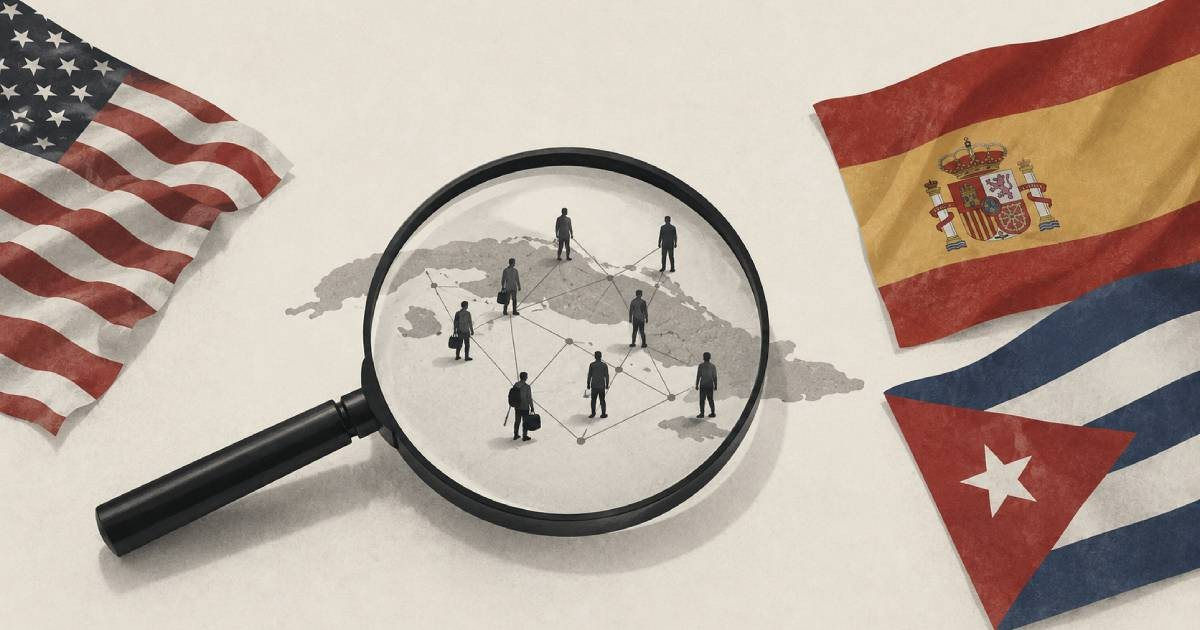
The U.S. State Department is investigating applications for Spanish nationality processed in Cuba under the so-called "grandchildren's law," amid suspicions that some may benefit individuals linked to organized crime and drug trafficking operating in the Caribbean, according to an exclusive report published this Wednesday by Vozpópuli.
According to that outlet, U.S. authorities have information suggesting that some of the applicants maintain connections with the Cuban regime and may have participated in operations carried out in Venezuela during Nicolás Maduro's government.
The main concern of Washington, according to sources consulted by Vozpópuli, is that obtaining Spanish nationality may facilitate access to the United States for individuals linked to criminal networks or deemed a risk to national security.
The report states that U.S. authorities fear that the Spanish passport could become a gateway for individuals "involved in organized crime" or linked to the Cuban political apparatus with the ability to operate outside the island.
The research takes place in a context of increasing pressure from President Donald Trump’s administration on the Cuban regime, marked by new sanctions against high-ranking officials, state-owned enterprises, and the military conglomerate GAESA.
The involvement of entities linked to GAESA in the processing of nationality applications is one of the aspects that, according to Vozpópuli, has attracted the interest of Washington.
In January 2025, the Spanish Consulate General in Havana awarded a contract to Grupo Palco to enhance services due to the high volume of applications. This Cuban state-owned company is linked to GAESA, a conglomerate that has been sanctioned by the United States since May 2026.
The implementation of the Law of Democratic Memory has generated an unprecedented demand in Cuba. More than 350,000 Cubans have begun the process to obtain Spanish nationality, while the Consulate General of Spain in Havana has accumulated over 137,700 applications.
The research also highlights the difficulties in verifying the documentation submitted by applicants. Cuba is not a part of the Hague Convention on Apostille, which necessitates the use of other mechanisms for document validation and has drawn criticism from sectors demanding greater oversight in the procedures.
The revelations align with the growing political clash in Spain regarding the so-called "grandchildren's law". The Popular Party and Vox argue that Pedro Sánchez's government has promoted an excessively broad application of the rule, while the Executive defends that it is in line with a process of historical reparation.
This Wednesday, Vox submitted a request to the Ministry of Justice to declare the nullity and to temporarily suspend the instruction that is being developed by the law, a measure that, if successful, would temporarily halt the processing of new nationality applications.
According to Vozpópuli, the U.S. investigation is also part of a broader monitoring of the relationships between leaders in the Spanish socialist environment and the governments of Cuba and Venezuela. The outlet states that the inquiries remain ongoing and that U.S. authorities continue to gather information on potential connections they deem relevant to their investigations.
Filed under: