
Related videos:
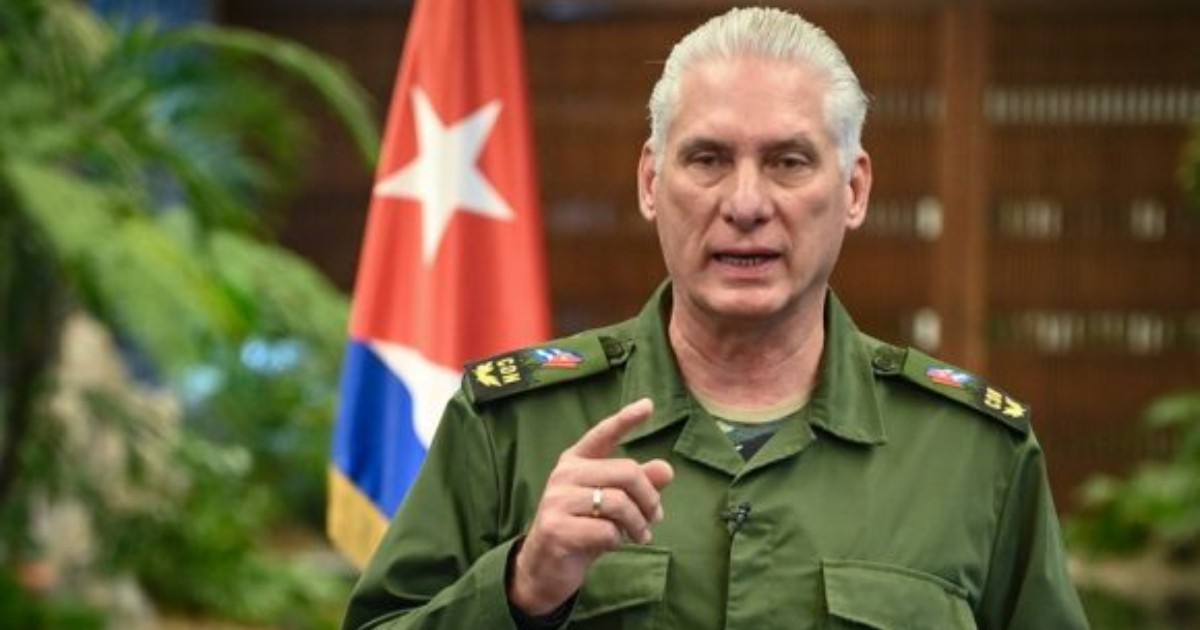
Miguel Díaz-Canel responded to the statements made by President Donald Trump in an interview with the British channel , in which he asserted that Cuba does not fear a military confrontation and that the country is preparing to not be "caught off guard or defeated."
The interview, conducted by journalist Yalda Hakim at the Presidential palace in Havana, represents Díaz-Canel's first direct response to Trump in a major Western media outlet.
The catalyst was the speech that Trump delivered on Wednesday during the inauguration of the Theodore Roosevelt Presidential Library in Medora, North Dakota, where he stated that Cuba, "after many, many decades, is coming closer to our orbit."
In response to those statements, Díaz-Canel was categorical: "We are a peaceful country. We are not a threat to anyone. Cuba is not a nation in conflict. We are not a colony. We will not relinquish our sovereignty or our independence."
The Cuban dictator characterized Washington's rhetoric as "a strategy of media poisoning and psychological warfare to frighten our country and destabilize our society," describing it as "an outrage and an affront to the dignity of our people."
His most compelling statement came when asked about the seriousness of the moment: "We do not want war, but we are not afraid. And we are preparing so that we are not caught off guard or defeated."
When the journalist reminded him that Trump took military action against Venezuela and Iran after threatening them, and asked whether Cuba takes the possibility of armed action seriously, he replied straightforwardly: "We are willing to fight to the last drop of blood to defend our rights, our independence, our sovereignty, and our achievements."
Díaz-Canel also accused the Trump administration of "telling many lies" and "manipulating international public opinion significantly," while acknowledging that Cuba is experiencing "a significant moment of intensification" of the embargo "to the point of maximum pressure."
Nevertheless, he left the door open by indicating that there are "possibilities for dialogue," although he warned that Cuba's trust in Washington is low due to the actions of the U.S. in Venezuela and Iran.
The interview comes at the worst moment for bilateral relations in decades.
Trump issued this message about Cuba amid a sustained escalation since January, when the capture of Nicolás Maduro interrupted the supply of around 70,000 daily barrels of Venezuelan oil to the Island, triggering an energy crisis with outages lasting over 24 hours and generation deficits exceeding 2,100 MW.
Since then, the Trump administration has imposed more than 240 sanctions against Cuba, including personal sanctions against Díaz-Canel himself, his wife Lis Cuesta Peraza, and Colonel Alejandro Castro Espín.
On May 1, Executive Order 14404 was signed, expanding measures and introducing secondary sanctions against third parties. The U.S. also deployed the aircraft carrier USS Nimitz in the Caribbean starting May 20 as part of Operation Southern Seas 2026.
In that same context, Cuban Foreign Minister Bruno Rodríguez warned that a military aggression against the Island would be "a bloodbath" and that "thousands and thousands of Cubans will die, along with young Americans being sent to a war that is not theirs."
Cuba has also called for an extraordinary session of the UN General Assembly on July 7 to denounce the tightening of U.S. sanctions.
Filed under: