Related videos:
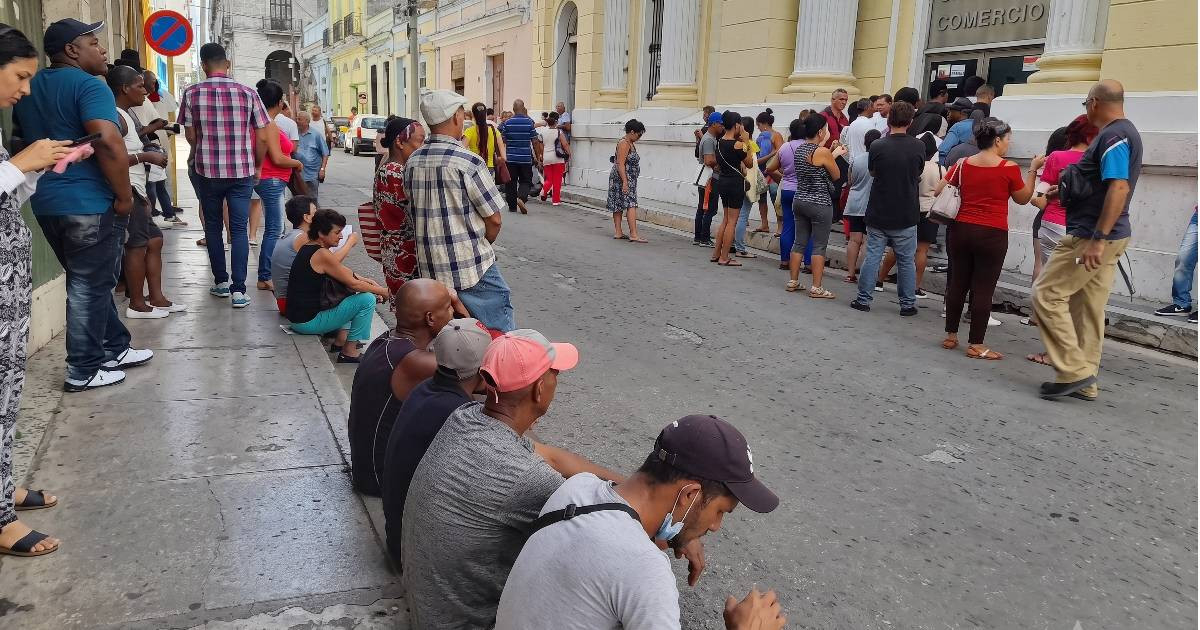
Every month, thousands of Cubans roam the city of Matanzas from establishment to establishment with their cellphones in hand and a card in their pocket, pleading for someone to accept a transfer to buy food, described the official newspaper Girón on Thursday, regarding the failed process of banking.
"Do you accept transfers, young lady?" she asks quietly, resigned to the knowledge that she will be looked at with pity only to be told bluntly that the answer is no. With her phone in hand and her card at the bottom of her bag, she walks away, feeling helpless, with the bitter taste of having worked from dawn to dusk only to now have to beg, from one establishment to another, for something as basic as food for herself and her children," illustrated the report Banking amid Pleas.
What the regime presented in August 2023 as a financial modernization, the requirement to accept electronic payments through platforms like Transfermóvil and Enzona, has turned into a dead end for the population.
Three years later, only 3.77% of transactions in Cuba are digital, despite more than 26,500 identified deficiencies, 15,240 fines, and 269 closures of establishments.
Failure is structural. Private businesses cannot accept transfers because their own suppliers do not accept them either: they need cash to restock or to buy dollars in the informal market. Banks, in turn, do not have the liquidity to provide cash to either merchants or workers.
In Matanzas, some establishments accept transfers of up to 1,000 or 2,000 pesos; others charge a surcharge of between 10% and 30% for digital payments; and only a minority accept the full transfer, the text acknowledged.
Ian Pedro Carbonell Karel, director of macroeconomic policies at the Central Bank of Cuba, admitted in May that "if electronic payment is not easier or faster than paying in cash, of course it will not be adopted."
"Times of crisis require emergency solutions. Starting by creating conditions to avoid long lines at banks under the sun, or the constant struggle of those who waste time chasing transfers, are also necessary actions if we want the people to stop begging for what is rightfully theirs," concluded the report.
The crisis is hitting the most vulnerable the hardest. The retired journalist Arturo Chang, 74 years old, was refused service earlier in July at a private business in Santa Clara when he tried to pay for 10 loaves of bread with 100 five-peso bills that the state bank itself had given him as a pension.
"Undoubtedly, it is a chain where the link that always breaks is that of the customers, especially the elderly," wrote Chang in the newspaper Trabajadores. His maximum pension is 3,653 Cuban pesos per month, less than 10 dollars.
A Cuban from the province of Granma reported that the bank only allows her to withdraw 500 pesos in cash once a week, an amount insufficient even to purchase basic medications.
The government of that province acknowledged in June that it did not have 400 million pesos to pay the pensions of more than 111,000 retirees.
Cash withdrawals "at a percentage," with commissions ranging from 35% to 50%, have become the norm as the only means of liquidity.
In Santiago de Cuba, the police detained individuals in May who were operating that scheme. Meanwhile, over 50% of the ATMs in Havana were already out of service in May, and the Banco Metropolitano is said to have reduced the withdrawal limit from 5,000 to 3,000 pesos per transaction, below the legal limit itself.
The situation worsened in June when Fincimex suspended operations with Visa and Mastercard due to U.S. sanctions against GAESA, the conglomerate of the Cuban military-business elite, leaving the island without access to major international payment networks.
On June 19, the regime approved a package of 176 measures that includes, for the first time since 1959, the authorization of private banking and the removal of limits on withdrawals.
But the reforms arrived when the system was already operating in collapse. The official newspaper Venceremos from Guantánamo acknowledged it on July 3: the crisis "has ceased to be a banking difficulty and has become a social problem."
While emergency measures are announced with no real effective date, Cubans continue to organize themselves in WhatsApp groups to find out which establishments are accepting, at the very least, some form of transfer that day.
Filed under: