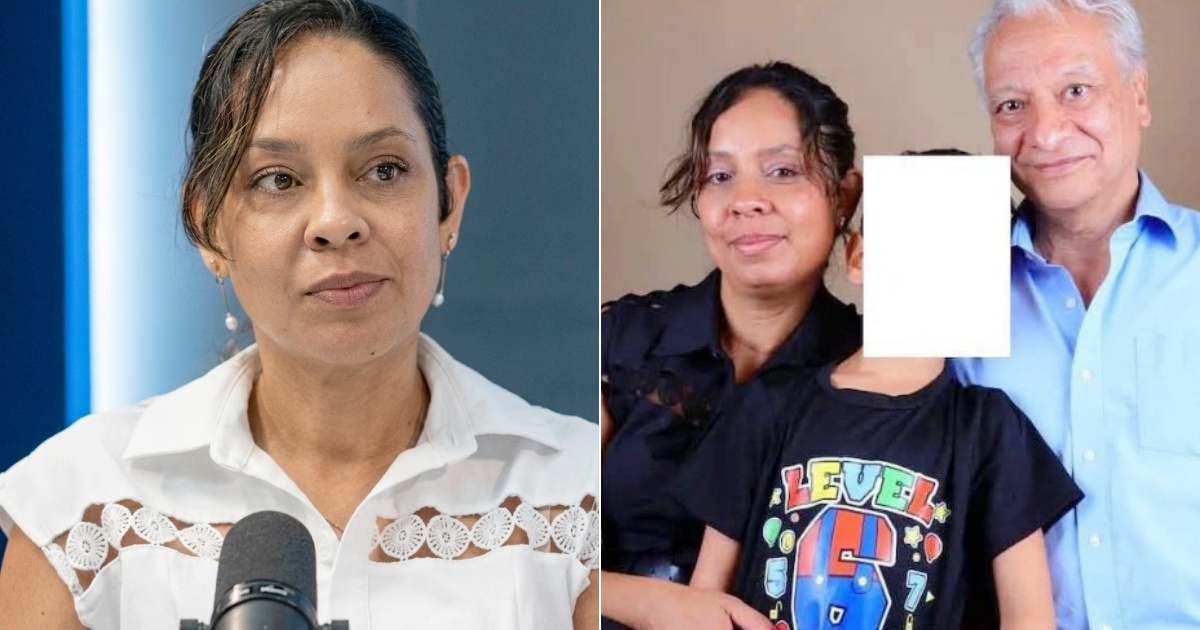
María Felicia Jiménez Lavié, the Cuban nuclear engineer who shook Mexico by publishing a video in which her husband, the former director of Petróleos Mexicanos Víctor Rodríguez Padilla, assaulted her in front of their six-year-old son, submitted a formal letter of forgiveness to the judge in the case on Monday in order to halt the criminal process against him.
The document, dated July 10 and submitted to the Parts Office of the Morelos Prosecutor's Office, was read in court by the Control judge, Adriana Correa Ortiz, during the second appearance of the former official in the Judiciary of Atlacholoaya.
Upon hearing the reading, Rodríguez Padilla displayed a visible smile in the room, as reported by Mexican media.
The letter took both the defense and the Public Prosecutor's Office by surprise, as just the day before, the documentary evidence supporting the assault on March 3, 2026 had gained strength, including the security camera footage showing the former official grabbing his wife by the neck and repeatedly hitting her.
Jiménez Lavié's arguments for justifying forgiveness
In her letter, the Cuban engineer put forward four reasons to request the cessation of the investigations opened in Morelos and Mexico City.
The first is the supposed reconciliation of the couple.
Jiménez Lavié states that they have both achieved “a genuine reconciliation, resulting from a process of reflection, dialogue, and mutual commitment, primarily aimed at preserving the emotional stability, harmonious coexistence, and overall well-being of our minor child”.
The second appeals to their own well-being and that of their children:
"The continuation of the legal case represents an unnecessary source of stress, uncertainty, and emotional strain for the undersigned and for her minor children, concerning a conflict that has already been resolved through family reconciliation."
The third is of a legal nature.
The letter asserts that continuing the process without their consent amounts to "institutional revictimization that goes against the spirit of the law and international protection standards," and that "forcing the victim to continue participating in a process they no longer wish to or need to is tantamount to instrumentalizing their complaint against their own will and well-being."
The fourth argument invokes a criterion from the Supreme Court of Justice of the Nation regarding the best interests of the child to prioritize family unity, as long as there is no risk to the child's well-being, a condition that, according to the document, is not present in this case.
The letter concludes with a definitive statement: "I have no claim to assert against the citizen Víctor Rodríguez Padilla."
A turn that contrasts with his previous statements
Forgiveness is particularly striking because just on July 1st, in an interview with Radio Fórmula, Jiménez Lavié had ruled out any reconciliation.
On that occasion, she revealed that Rodríguez Padilla had asked for forgiveness through an intermediary, but she made it clear that there would be no turning back and that she planned to request a divorce once the legal process was concluded. In that same interview, she described the impact of power on her husband: "I never imagined the extent of Pemex, I never imagined that power could change you. Unfortunately, Pemex made him more arrogant."
In earlier statements, he recounted the escalation of violence: "First there were verbal insults, then a slap, shoving, but none like this one, which was very brutal. I even had several days of intense pain while walking."
And I had explained why it took me so long to report it: "Breaking the silence would mean losing my job, my income, having nowhere to live, and losing my children simply because of their proximity to the upper echelons of the presidency."
The judge's reaction: Forgiveness does not extinguish the criminal action
Judge Correa Ortiz did not immediately accept the document as valid due to the lack of certification verifying the authenticity of the signature. Therefore, she scheduled a hearing for this morning at 8:00 AM, in which Jiménez Lavié must appear in person to affirm the document.
The magistrate also emphasized a crucial legal point: crimes of domestic violence are prosecuted ex officio in Morelos, which means that the victim's forgiveness does not automatically terminate the criminal action.
As a result, Rodríguez Padilla was linked to the process for domestic violence, and the justified preventive detention ordered on July 8 was maintained, when he was arrested in the Narvarte neighborhood of Mexico City and transferred to the Atlacholoaya prison.
The charge of vicarious violence was dismissed due to lack of sufficient evidence.
The case originated on June 26, when Jiménez Lavié published the security camera video that triggered the opening of two investigation files and the public condemnation from President Claudia Sheinbaum, who demanded "that the full force of the law be applied" and assured that the former official "will not hold any public office again."
If Jiménez Lavié confirms his statement this morning, the defense will seek a reparatory agreement which, as the defense attorney confirmed, includes financial compensation for the victim and the minor, which could allow Rodríguez Padilla to face the trial free.
Related videos:
Filed under: