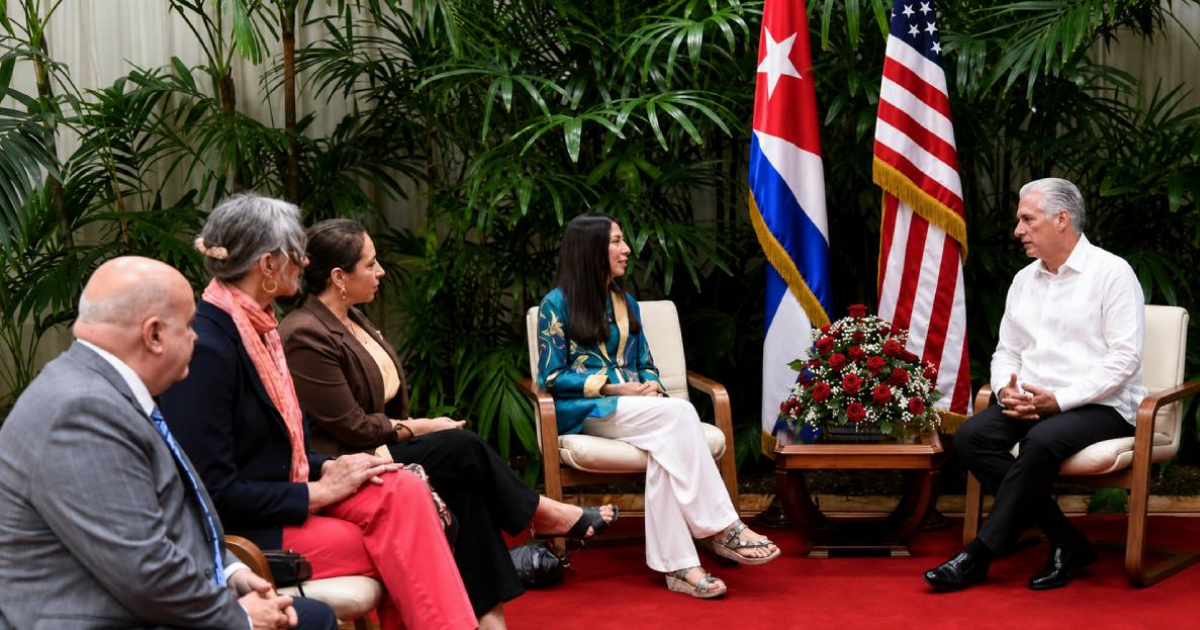
Four Democratic congress members from the United States House of Representatives rejected the possibility of military action against Cuba on Monday and urged President Donald Trump's administration to resume diplomatic efforts with Havana, following the conclusion of a four-day investigative mission on the island.
Legislators Mark Pocan (Wisconsin), Teresa Leger Fernández (New Mexico), Delia C. Ramírez (Illinois), and Maxine Dexter (Oregon) returned to Washington after staying in Cuba from July 9 to July 13.
Upon their arrival, they released a joint statement expressing concern over the worsening humanitarian situation on the island and questioning the White House's maximum pressure policy.
In the document, the congress members also expressed their views on a possible scenario of military confrontation between the two countries.
"The Trump administration has provided no evidence that Cuba poses an urgent threat to the national security of the United States and our interests, both domestically and internationally," they stated.
They also warned that "any pretext used to launch an illegal, unauthorized, and unpopular military operation against the island would exacerbate a severe humanitarian catastrophe, unnecessarily endanger members of the U.S. armed forces, and harm the very people we claim to support."
Díaz-Canel received the delegation before their return to Washington
The position of the legislators became known just hours after concluding a visit that included meetings with representatives of the Cuban government, business leaders, religious leaders, and other sectors of society.
On July 11, Miguel Díaz-Canel received the congressmen at the Palace of the Revolution, accompanied by Foreign Minister Bruno Rodríguez Parrilla and Deputy Minister Carlos Fernández de Cossío.
According to information from the Presidency of Cuba, during their stay, the legislators visited several places in Havana and "interacted with various sectors of society."
The regime asserted that this experience allowed them to "confirm the harmful effects of the economic blockade," as they officially refer to the U.S. embargo, and that during the meeting, the possibilities of developing a "respectful" relationship between both countries were discussed.
Upon returning to the United States, the congressmen described the situation they encountered on the island as a "silent Gaza," a phrase that Mark Pocan attributed to a Cuban he spoke with during the trip.
In their statement, they also called for the lifting of U.S. sanctions, resuming negotiations with Havana, and facilitating the entry of medicines and medical equipment.
Furthermore, they stated that economic pressure measures exacerbate the humanitarian crisis and contribute to the difficulties faced by the Cuban population.
This is the second visit by Democratic lawmakers to Cuba in less than four months. In April, Díaz-Canel received representatives Pramila Jayapal and Jonathan Jackson, who also questioned the sanctions imposed by Washington.
The statements coincide with Trump's warning about possible Iranian drones in Cuba
The statement from the congressmen was released on the same Monday that President Donald Trump warned that the United States will act if the presence of Iranian military drones stored in Cuban territory is confirmed.
"If they have them, and they very well could have them, we will take care of that in no time. We are not going to have a problem. We will not allow it to happen," the president stated when asked about intelligence reports suggesting a possible presence of those attack systems on the island.
Trump also specified that the matter is under investigation. "It could be that they are storing some. We are investigating it now. It could be that way, and maybe it isn't," he asserted, while mentioning that Secretary of State Marco Rubio is directly involved in monitoring the case.
The president's statements come amid heightened tensions between Washington and Tehran, and after various intelligence reports indicated that Cuba received over 300 military drones manufactured in Iran and Russia since 2023, including Shahed-136 models capable of reaching targets hundreds of kilometers away.
While lawmakers argue that there is no evidence that Cuba poses an immediate threat to U.S. security and reject any military intervention, the Trump administration continues to investigate the potential military cooperation between Havana and Iran and has reiterated that it will not allow the island to be used as a platform to jeopardize the security of the United States.
Related videos:
Filed under: