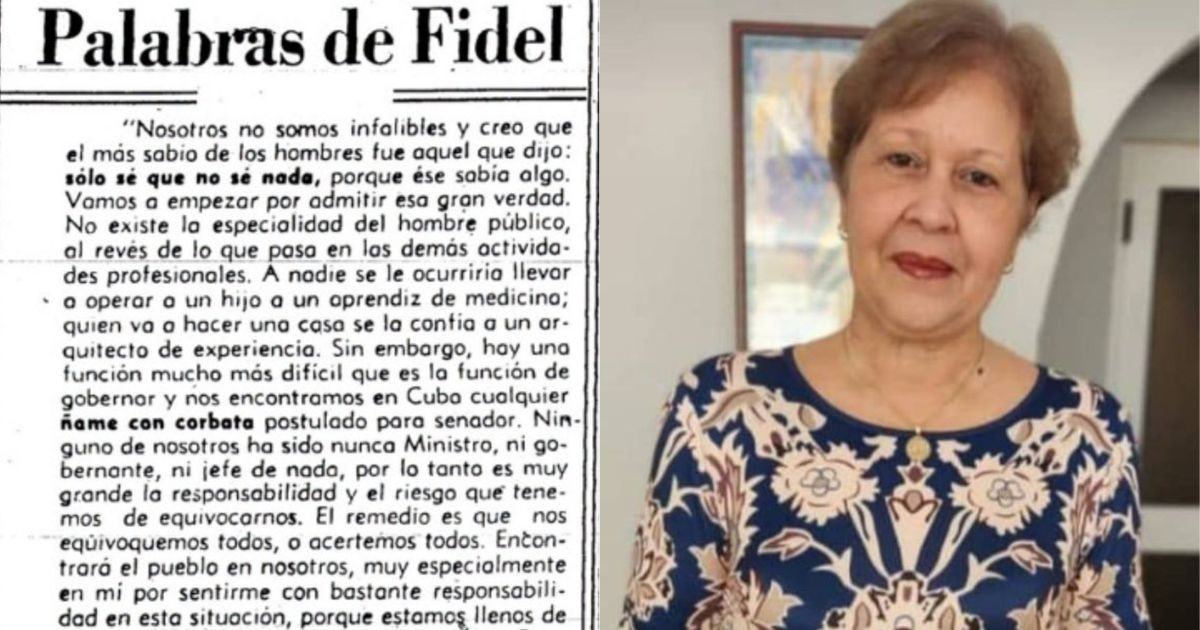
The Cuban academic Alina Bárbara López Hernández posted on her Facebook profile a clipping from the Diario de la Marina dated November 19, 1959, featuring a quote from Fidel Castro that, according to her, the official Cuban media intentionally avoids spreading in light of the upcoming centenary of his birth.
The fragment, published under the title "Words of Fidel" on page 8-B of that newspaper, shows a Castro who has just come to power acknowledging his own limitations and warning about the dangers of governing without preparation, humility, and the ability to listen to criticism.
"On the occasion of the upcoming centenary of Fidel Castro's birth, official media and websites are replicating numerous quotes and excerpts from his speeches; however, they rarely focus on the first year of the Revolution. Such omission is explained when we read evaluations like this one, which appeared in November 1959 in the Diario de la Marina and is more suitable for today’s leaders," López wrote.
In the recovered text, Castro stated: "We are not infallible, and I believe that the wisest of men was the one who said, 'I only know that I know nothing,' because he knew something."
The then-revolutionary leader compared the role of governing to other professions that require specific training, and he candidly acknowledged that in Cuba “any ñame with a tie” —a Cubanism referring to an ignorant person in an important position— could run for senator.
Castro also admitted that none of the revolutionaries had ever been "a Minister, or a ruler, or in charge of anything," and he made a distinction that resonates strongly today: "Goodwill does not mean being honest and not stealing. Goodwill means not being capricious, not being vain, not being obstinate. Because one can be very honest and still not listen to anyone, and know when one is being criticized and become filled with self-importance and want to crush anyone who offers criticism."
López concluded his post with a loaded irony: "Prophetic was the Commander. Gabriel García Márquez said that Fidel could travel to the future and know what would happen; it seems he was right."
The paradox underlying the post has an additional historical dimension: the Diario de la Marina, where Castro's words appeared in November 1959, was shut down by the revolutionary government just six months later, on May 12, 1960, after 128 years of existence.
The publication arrives in the midst of the official campaign for the centenary of Castro's birth — on August 13, 2026 — which the regime has made the focal point of its propaganda this year under the slogan #100YearsWithFidel, featuring international colloquiums, political events, and a careful selection of which phrases from the Commander are disseminated and which are not.
On July 1st, Miguel Díaz-Canel led an event at the National Library to celebrate the 1961 speech "Words to Intellectuals," whose phrase "Within the Revolution, everything; against the Revolution, nothing" has historically been used to justify decades of censorship on the Island.
On July 11, marking the fifth anniversary of 11J, López characterized the Díaz-Canel regime as a "terrorist state against its own people," a definition that contrasts with the image the official machinery tries to project in the year of its founder's centenary.
Related videos:
Filed under: