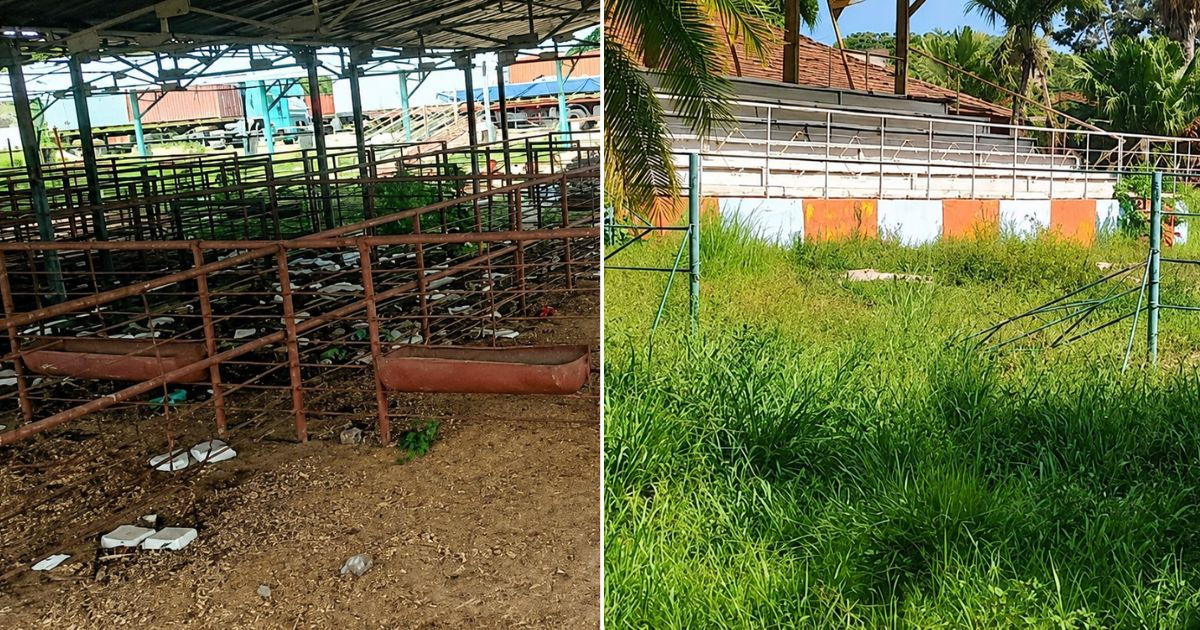
Fallen metal fences, warehouses with corroded zinc roofs, uncontrolled vegetation, and dry grass where the country’s best horsemen once competed: this is what the National Livestock Fair of Rancho Boyeros looks like today, according to images and an urgent call shared on Facebook by the digital community The Purest Cuban Rodeo.
"This venue is not just any facility. It is the grand home of the Cuban Rodeo, the cathedral of Cuban livestock, a place where for decades the most important fairs in the country were held, showcasing the best of our animal genetics and where thousands of families enjoyed events that shaped generations," the text published this Wednesday states.
The call to rescue the place points to a specific date as a horizon for action: "In 2033, the National Livestock Fair of Rancho Boyeros will celebrate 100 years of history. How beautiful it would be to see it reach that centenary fully restored, renovated, painted, beautified, and adorned, just as we always remember it," the profile El Más Puro Rodeo Cubano suggests.
The community demands that the authorities take responsibility before it is too late: "Rancho Boyeros does not need to be remembered with nostalgia. It needs to be revitalized through actions. Let its centenary in 2033 be a great celebration of its rebirth and not a reminder of what we let slip away. A country's heritage is also honored by preserving the places that tell its story."
The venue, inaugurated on February 23, 1933, is the oldest permanent fairground in Cuba and one of the oldest agricultural exhibition centers in Latin America.
For decades, it was the venue for international animal genetics exhibitions, the National Rodeo Championship, and events that shaped the country's livestock identity.
In 1961, it even hosted the founding of the National Association of Small Farmers.
That's why it is so painful to see the circulated photographs that show a landscape of widespread neglect: rusty metal structures, damaged doors, overgrown weeds covering the grounds, and the legendary Rodeo Stadium in evident disrepair.
The contrast is especially sobering for those who remember the splendor of the venue in its prime.
Despite the visible deterioration, the venue hosted the XXVI International Agricultural Fair (FIAGROP) in March 2025, with participation from over 80 foreign companies from 25 countries and the signing of around 30 contracts.
This suggests that abandonment hits hardest in the areas not utilized during the annual events: pavilions, pens, and the Rodeo Stadium itself.
But unfortunately, the deterioration of the venue does not occur in isolation.
Cuba has lost more than 900,000 heads of cattle since 2019, pork production has declined by nearly 90% over four years, and agricultural infrastructures across the country are collapsing due to a lack of supplies and investment.
This pattern of institutional neglect has also destroyed other significant sites in different areas, such as the campismo Puerto Escondido and the José White Hall in Matanzas.
Related videos:
Filed under: