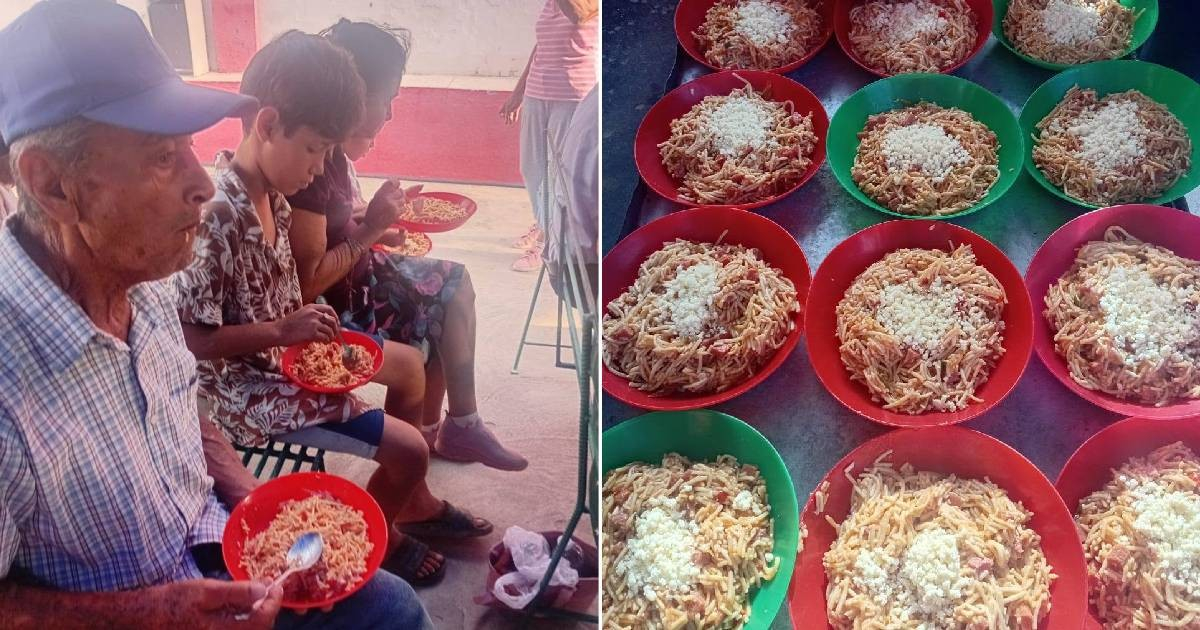
An evangelical congregation in Las Tunas has become one of the main food distribution points in the province, preparing meals for 480 people each week amidst the worst food crisis Cuba has faced in decades.
The apostle Mayim Jorge, leader of the Viento Recio Ministry, posted on Facebook a message describing the efforts of his congregation: two breakfasts a week and a lunch for hundreds of Cubans who would otherwise have nothing to eat. "We prepare food for 480 people. It's a real challenge under the current conditions," he wrote.
What concerns the pastor the most is the profile of those who come seeking food. "Children and young people are already coming, not just the elderly," he warned, a sign that hunger no longer distinguishes ages on the island.
Mayim Jorge directly links the crisis to the collapse of the immune system of the Cuban population, worsened by power outages that disrupt rest, shortages of medications, and chronic malnutrition.
"In Cuba, people hardly die from illness. They die from hunger," he stated, citing a statistic published by the state newspaper Granma regarding mortality in the country.
Granma itself acknowledged that the infant mortality rate closed 2025 at 9.9 per 1,000 live births, the highest level in over two decades and a 148% increase compared to 2018, when it was 4.0 per 1,000.
The work of the Viento Recio Ministry is not new. On July 2, the congregation served lunch to 190 vulnerable people in Las Tunas, and on Mondays and Tuesdays, they provide breakfast for 140 people, with volunteers who rise at four in the morning to prepare the meals.
However, the regime has attempted to halt this effort. In June, the authorities prohibited the Viento Recio Ministry from continuing its breakfast program for pregnant women at a maternity home in Las Tunas, requiring permission from the Communist Party for each food distribution.
Despite the obstacles, the church continues its operation. "We are not providing food, we are giving life," summarized the apostle.
This initiative is part of a broader phenomenon: in the absence of the State, Cuban churches have become the primary food assistance network in the country. The San Juan Methodist Church in Santiago de Cuba feeds over 400 people every Sunday, and Caritas Camagüey operates a soup kitchen for homeless individuals.
The numbers supporting this emergency are compelling: 96.91% of the Cuban population lacks adequate access to food, and one in three Cuban families is going hungry, according to independent surveys. 29% of Cubans only have two meals a day, and 4% barely have one.
The magnitude of the problem exceeds the capacity of religious response. Priest Rodhin Alonso Colomar from Santiago de Cuba acknowledged this directly last week: "We cannot feed an entire population."
Related videos:
Filed under: