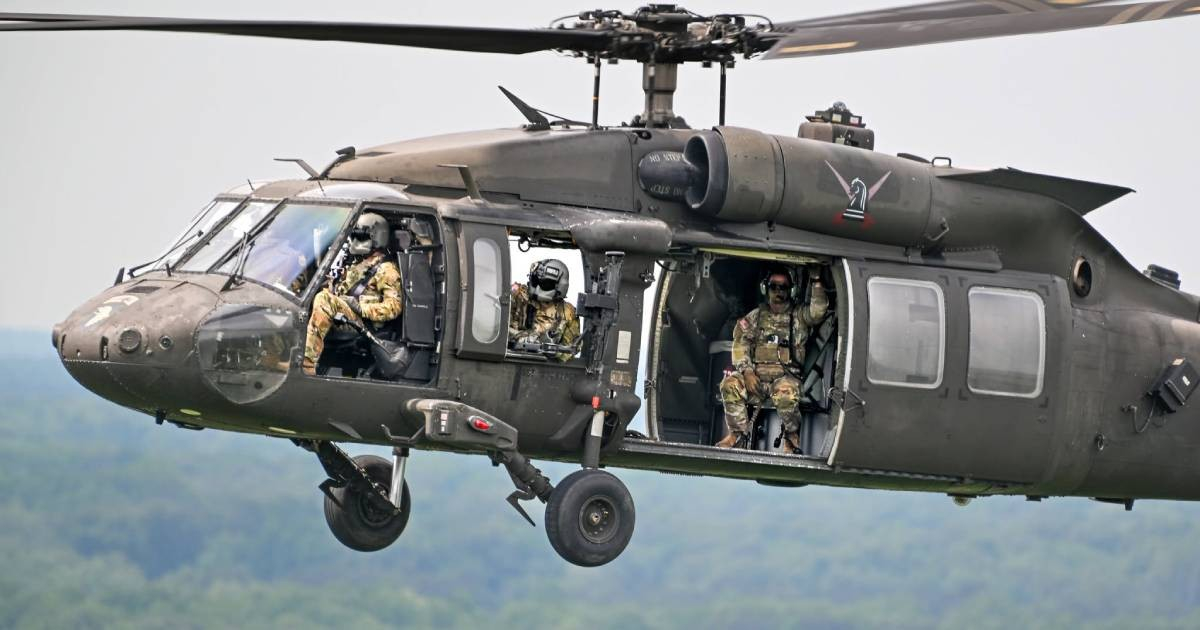
The Pentagon has assessed various scenarios over the past few weeks for a potential military operation against Cuba, including an aerial assault led by the 101st Airborne Division, as revealed this Wednesday by CBS News, quoting several U.S. officials who spoke on the condition of anonymity.
The information has sparked an inevitable question: what is the 101st Airborne Division and why would it be the chosen unit for a mission of this kind?
The only division specialized in large-scale airborne assaults
Known as the "Screaming Eagles," the 101st Airborne Division is regarded as one of the most iconic and seasoned units of the United States Army. According to CBS News, it is "the only unit trained for that type of task": inserting thousands of soldiers by helicopter into hostile territory within hours.
The division was created on August 15, 1942, at Camp Claiborne, Louisiana, as a paratrooper unit. However, during the Vietnam War, it evolved into an air mobility force and eventually specialized in air assault operations.
Although it retains the name Aerotransportada (Airborne), its mission no longer involves conducting mass parachute jumps. Its current specialty is helicopter operations.
Based at Fort Campbell, Kentucky, the division can deploy a full combat brigade—about 4,000 soldiers—during a single period of darkness and over 500 nautical miles away, using CH-47 Chinook, UH-60 Black Hawk, and AH-64 Apache helicopters.
That capability was put to the test earlier this year during Operation Lethal Eagle 26.1, a military exercise that mobilized around 7,000 soldiers and 22 rotary-wing aircraft at Fort Campbell.
A unit with an extensive combat history
The reputation of the 101st Airborne Division began to take shape during World War II.
On June 6, 1944, their paratroopers participated in the Normandy landings, dispersing over French territory under intense German anti-aircraft fire. Months later, they played a key role in one of the most memorable actions of the conflict by resisting the German encirclement in Bastogne during the Battle of the Bulge.
Since then, the unit has participated in some of the major conflicts in the United States, including the Vietnam War, the Gulf War, and the campaigns in Iraq and Afghanistan, where in 2008 it took on a central role within the U.S. forces deployed in that country.
The plans regarding Cuba
According to CBS News, the U.S. Army held a planning session at the end of June to evaluate possible courses of action related to Cuba. During the meeting, aspects such as mission objectives, the number of necessary personnel, logistics, and the risks of a potential operation were analyzed.
The consulted sources emphasized that these types of exercises are a regular part of the planning within the Department of Defense and do not indicate that President Donald Trump or the Pentagon have decided to undertake military action.
The acting spokesperson for the Pentagon, Joel Valdez, refrained from confirming any details.
"We do not comment on hypothetical military operations," he declared.
Officials themselves acknowledged that an immediate intervention seems unlikely, among other reasons, because a significant portion of U.S. military capabilities remains concentrated in the Middle East, where operations against Iran have resumed.
Pressure from Washington on Havana is increasing
The revelation from CBS News comes amid increasing pressure from the Trump administration on the Cuban regime.
In recent months, Washington has expanded sanctions against the military conglomerate GAESA, President Miguel Díaz-Canel, and members of his family. This is accompanied by surveillance flights near the Cuban coasts and the deployment of more than 1,300 Marines in the Caribbean as part of Operation Southern Spear.
During a visit to the Guantanamo Naval Base on June 10, the Secretary of War, Pete Hegseth, also issued a direct warning to Havana.
"It would be reckless for the Cuban government to attempt to acquire or access weapons that could reach this base or U.S. territory. They would be provoking a confrontation that they not only do not desire, but could also not tolerate," he stated.
A month later, on the occasion of the fifth anniversary of the 11J protests, Secretary of State Marco Rubio, again urged the Cuban leadership to undertake profound changes and warned that there is still time to choose “real reforms, peace, and prosperity, before it is too late.”
Related videos:
Filed under: