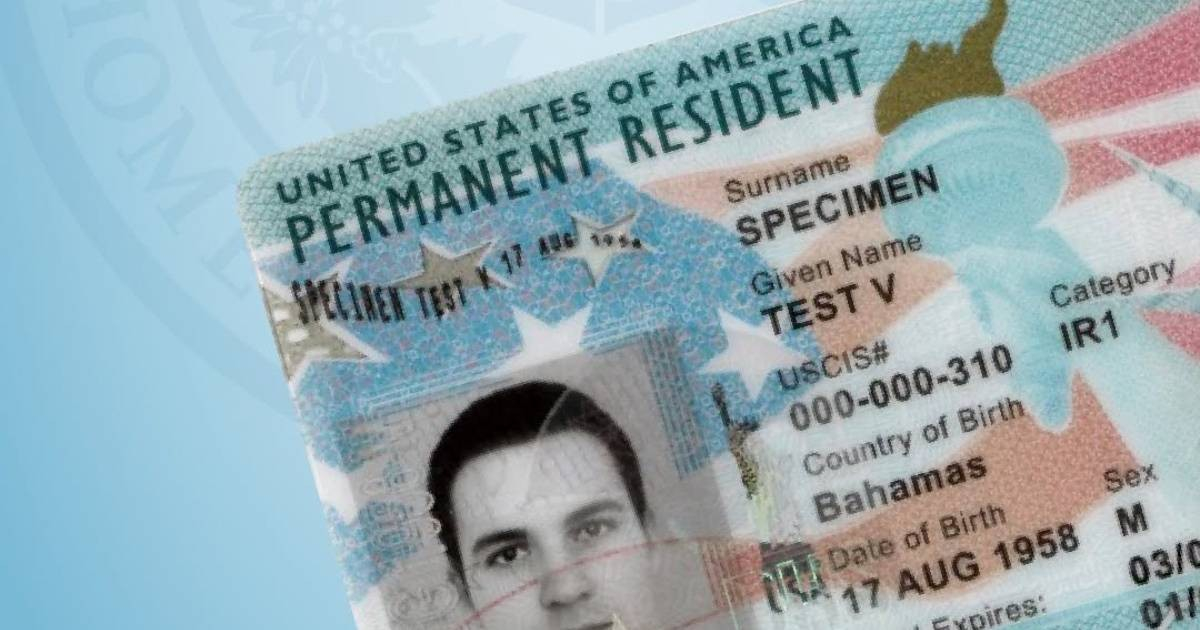
The Department of Homeland Security (DHS) announced this Thursday a new rule that tightens the public charge evaluation for those applying for permanent residency in the United States, by repealing the regulation approved in 2022 by the Joe Biden administration.
The measure that, according to the official announcement from the U.S. Citizenship and Immigration Services (USCIS), will take effect on September 18, 2026, will allow officials to reconsider, among other factors, the use of certain public benefits — such as Medicaid, food stamps, or housing assistance — when assessing whether an applicant might become a public charge.
The rule promoted by the Biden administration limited the assessment primarily to those receiving direct cash assistance or long-term institutional care funded by the government.
With the new regulations, USCIS officials are regaining a broader evaluation margin and will be able to analyze, on a case-by-case basis, factors such as age, health status, family composition, income, assets, education, job skills, and the history of utilization of certain public benefits subject to resource verification, added CBS News.
According to USCIS, the goal is to reinforce the principle of economic self-sufficiency among those seeking to obtain immigration benefits.
"The federal government reaffirms the need for self-sufficiency, protects public resources, and puts an end to policies that promoted dependency at the expense of American taxpayers," stated USCIS Director Joseph B. Edlow, in remarks quoted by CBS News.
In the same vein, the agency's spokesperson, Zach Kahler, stated that the Trump administration aims to prevent taxpayers from funding foreigners who may depend on public assistance.
Who does it affect?
The new regulation will apply to foreigners seeking to adjust their status within the United States, as well as to those applying to enter the country as immigrants or, in certain cases, as non-immigrants.
The groups that Congress has explicitly protected are excluded from this assessment, including refugees, asylees, special immigrant minors, certain victims of human trafficking or crimes, and those who submit applications under the Violence Against Women Act (VAWA).
DHS estimates that around 588,000 adjustment of status applications will be subject to this review each year.
Fear of a deterrent effect
Although the Government defends the measure as a tool to protect public resources, the DHS itself acknowledges that it could lead to a significant "deterrent effect."
According to official estimates, around 950,000 individuals from immigrant households may forfeit public benefits or refrain from applying for them out of fear of jeopardizing their immigration processes, even though they or their U.S. citizen children are legally entitled to receive that assistance.
Despite the debate generated by this policy, rejections of residency based on public charge have historically been quite rare.
Official data indicates that between the fiscal years 2020 and 2024, there were between 41 and 95 annual denials for this reason. Furthermore, during the period of the public charge rule adopted by Trump in 2019, only five cases of denial or intent to deny were identified, all of which were later reopened or reversed.
The I-485 Form will also change
As part of the implementation of the new regulation, USCIS will publish an updated version of Form I-485, which is used to apply for permanent residency or adjustment of status.
Starting September 18, the agency will reject previous versions of the form, even if they were submitted on the same day with a postmark dated after the regulation came into effect. Therefore, applicants must ensure that they use only the current version when submitting their application.
Related videos:
Filed under: