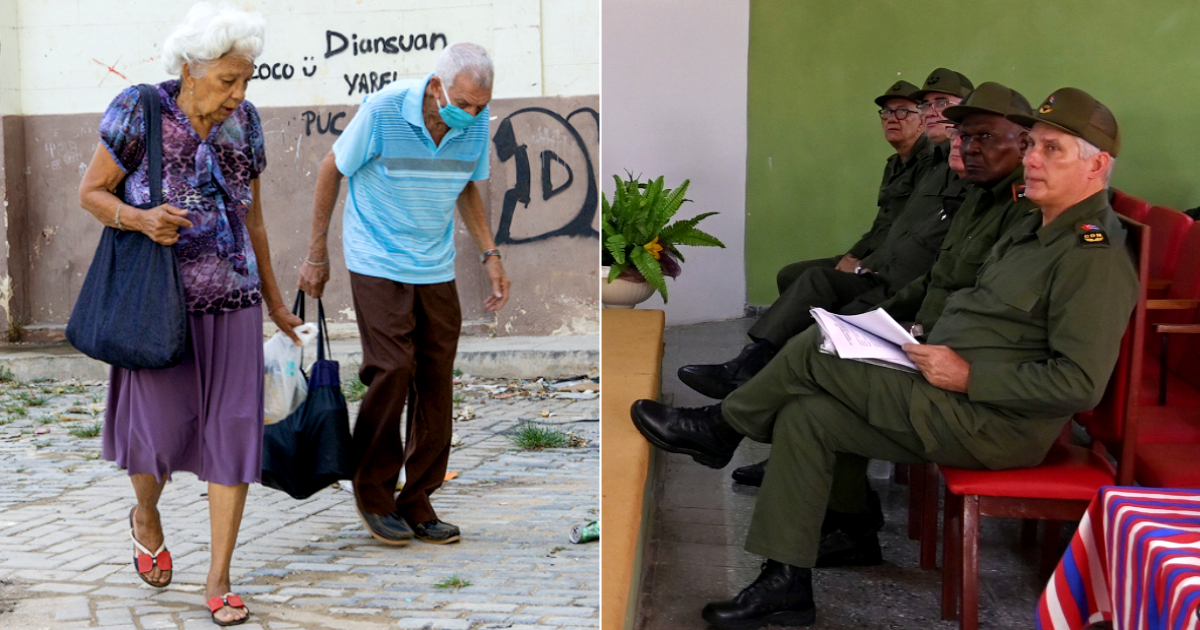
The statements by Miguel Díaz-Canel defending the increase in salaries and pensions as proof that the regime's reforms "protect those who are in the most difficult situations" sparked a wave of reactions on the Facebook page of CiberCuba.
Far from supporting the official message, the overwhelming majority of comments expressed incredulity, frustration, and skepticism regarding a measure that many believe is incapable of alleviating the economic crisis facing the population.
The post, which included the words of the leader during a visit to the Municipal Defense Council of East Havana, gathered hundreds of comments where readers questioned both the extent of the increase and the official narrative that presents it as a progress in social protection.
One of the messages that best summarized the general sentiment was from a user who wrote: "They can't even afford to eat poorly for three days". Others remarked that the increase "is a joke" or that it represents "just a smokescreen to distract the people".
Inflation was the most repeated topic among the reactions. Dozens of people agreed that raising wages without increasing production or stabilizing the economy will only lead to a new surge in prices.
You're going to increase the salary with a devalued peso; that doesn't help at all, commented a reader. Another recalled the consequences of the Tarea Ordenamiento: "Don't you remember what happened when salaries were raised? The currency lost more value and the dollar skyrocketed. Don't you learn from mistakes?"
Many insisted that the real issue is not the nominal amount of the salary, but rather its purchasing power. Several users pointed out that the increase barely covers the cost of some basic products.
They protect them and it only allows them to buy a bottle of oil, wrote one person. Another joked that the increase "is enough for a carton of eggs." There was also someone who summarized the problem with a powerful phrase: "No one in this country can eat and survive a month on those pensions and those salaries."
Comparisons with the actual cost of living were also plentiful. Some commentators argued that the increase falls far short of the real needs of a Cuban family.
It takes at least twenty times what they are increasing to be able to survive, stated a reader. Another added that the government "lives in a bubble" and is unaware of the real costs of food and essential products.
The criticism was not limited to the amount of the increase. Numerous participants demanded that the regime stop focusing on raising salaries and prioritize the increase of national production.
"What you need to increase is the production and incentives for agriculture, livestock, pigs, and poultry," wrote a user. Another commented that "more than raising salaries, we need to find solutions in agricultural, industrial, and livestock production; otherwise, they can raise it by ten thousand pesos, and it still won't be enough."
Several readers agreed that without a greater supply of goods, any wage increase will ultimately fuel inflation.
Another recurring issue was the difficulty in accessing the money deposited on bank cards. Some users reported that many workers and retirees have to rely on intermediaries to obtain cash, losing a significant portion of their income in the process.
A reader explained that in Santiago de Cuba, those who cash out by card "have to leave between 40% and 50% in the hands of those who provide them with cash." Another person indicated that salaries often do not arrive on the expected date, and consulting Transfermóvil is complicated due to a lack of coverage.
Díaz-Canel's words about protecting vulnerable sectors were especially questioned. "It really shows that he knows nothing about it," wrote one user. Another comment suggested that the leaders should "live on a similar salary and without any benefits" to understand the daily reality of Cubans.
There were also those who interpreted the announcement as a political strategy to project an image of social concern without addressing the causes of the economic crisis.
"This more shameless group cannot be," wrote an Internet user. Another claimed that "everything they do only serves to further oppress the people," while a third labeled the leader's statements as "an insult."
Some readers proposed alternative options to the wage increase. Among them was reducing the prices of products and services controlled by the state.
“Why don't they lower the prices of products and the rates controlled by the government so that the people can meet their needs with the salary paid by the State?” asked one of the commenters.
Critics also expressed concern that the increase could end up like other economic measures adopted in recent years. "Now we've really screwed ourselves with that salary increase again," wrote a user, convinced that prices will skyrocket once more.
Overall, the responses published on the Facebook page of CiberCuba reveal a deep divide between the official narrative and the perception of a significant portion of the citizenry.
While the government presents the increase as a demonstration of commitment to the most vulnerable sectors, the majority of readers participating in the debate consider that the measure is insufficient to tackle persistent inflation, the depreciation of the Cuban peso, and the high cost of living, issues that, in their view, continue to undermine any salary improvements announced by the regime.
Related videos:
Filed under: