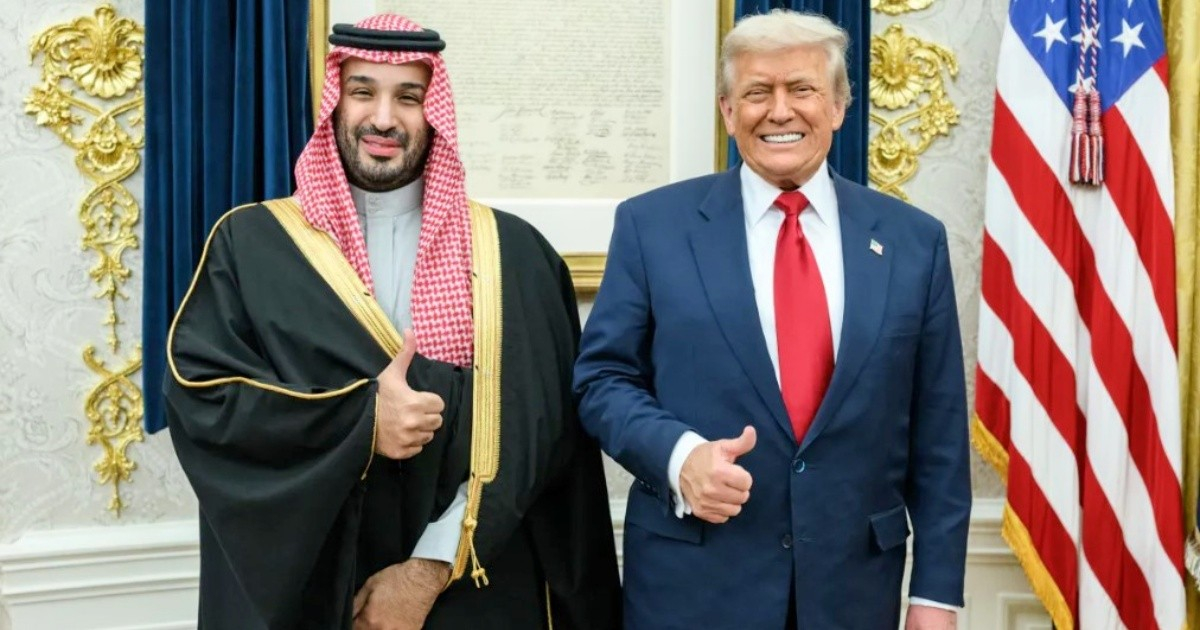
Donald Trump approved a historic civil nuclear cooperation agreement with Saudi Arabia at the end of last week, valued at tens of billions of dollars and lasting for 30 years, according to U.S. administration officials who informed The Wall Street Journal.
The agreement was formally signed on Wednesday by U.S. Secretary of Energy Chris Wright and his Saudi counterpart, Prince Abdulaziz bin Salman.
The agreement is designed to grant U.S. companies a central role in the development of the kingdom's nuclear infrastructure, sidelining strategic competitors such as Russia and China.
Westinghouse Electric and its AP1000 reactor -capable of generating about 1,100 megawatts of electricity- are among the main beneficiaries.
The most controversial clause: The enrichment of uranium
A key provision of the agreement paves the way for Saudi Arabia to enrich uranium on its own territory.
Before that happens, a joint team from both countries will conduct a two-year study to evaluate whether domestic enrichment is justified and commercially viable.
If the study supports it, American companies would build the facility under a "black box" system that would prevent the transfer of sensitive technology to Riyadh.
If Washington opposes the enrichment after learning the results, Saudi Arabia will not be able to develop that capability on its own or with another foreign partner for 10 years.
Experts on non-proliferation consulted by the American newspaper warned that "any active centrifuge on Saudi soil could open the door to a potential weapons program."
Without the "gold standard" or the IAEA Additional Protocol
The agreement raises additional concerns because Saudi Arabia refused to adhere to the Additional Protocol of the International Atomic Energy Agency (IAEA), a mechanism that would have allowed for more stringent inspections.
According to a U.S. official quoted by CNN, Riyadh hesitated to sign that protocol "for fear that, in theory, it would allow inspectors to enter the holy city of Mecca or the royal palaces."
The kingdom also rejected the so-called "gold standard" -the permanent renunciation of domestic enrichment and the reprocessing of spent fuel- unlike the United Arab Emirates, which accepted it in 2009, allowing them to build the Barakah nuclear plant.
Instead, the agreement includes a bilateral safeguards mechanism that must be ratified by the Board of Governors of the IAEA.
Voices for and against
Robert Einhorn, former senior official at the State Department specializing in non-proliferation, acknowledged the potential benefits but warned about the associated risks:
"The agreement could help revitalize the U.S. nuclear industry, strengthen ties between the United States and Saudi Arabia, and deny Russia and China a strategically important role. But, if it does not include sufficient restrictions, especially regarding uranium enrichment, it could increase the risks of nuclear proliferation in the Middle East and beyond."
More emphatic was Henry Sokolski, executive director of the Center for Nonproliferation Education:
"If Saudi Arabia takes this step, the United Arab Emirates, Turkey, and Egypt will follow suit. Thinking that this will end well is delusional."
The geopolitical background
The agreement comes at a time of heightened regional tension.
The crown prince Mohammed bin Salman stated in 2018 that if Iran were to develop a nuclear weapon, Saudi Arabia would follow suit "as soon as possible."
Iran maintains reserves of enriched uranium and has promised to uphold its nuclear program despite months of U.S. bombings.
Saudi Arabia and Pakistan -nuclear power- recently signed a mutual defense pact.
The Pakistani Defense Minister assured that the country's nuclear arsenal "will be available to Saudi Arabia if necessary," a statement interpreted as a warning directed at Israel.
The Biden administration had conditioned nuclear cooperation with Riyadh on the normalization of relations with Israel, a process that has been halted following the Hamas attacks on October 7, 2023.
Trump resumed negotiations without imposing that condition, in line with the trade agreement package worth over 600 billion dollars that he announced during his visit to Riyadh in May 2025.
Path to Congress
The agreement will be sent to the U.S. Congress for review in the coming days.
Blocking it would require a joint resolution and a two-thirds majority to override a potential presidential veto, which makes its rejection technically challenging.
Several lawmakers have already requested details regarding non-proliferation guarantees, and the debate over the balance between technology transfer, regional security, and the prevention of an arms race in the Middle East remains open.
Related videos:
Filed under: