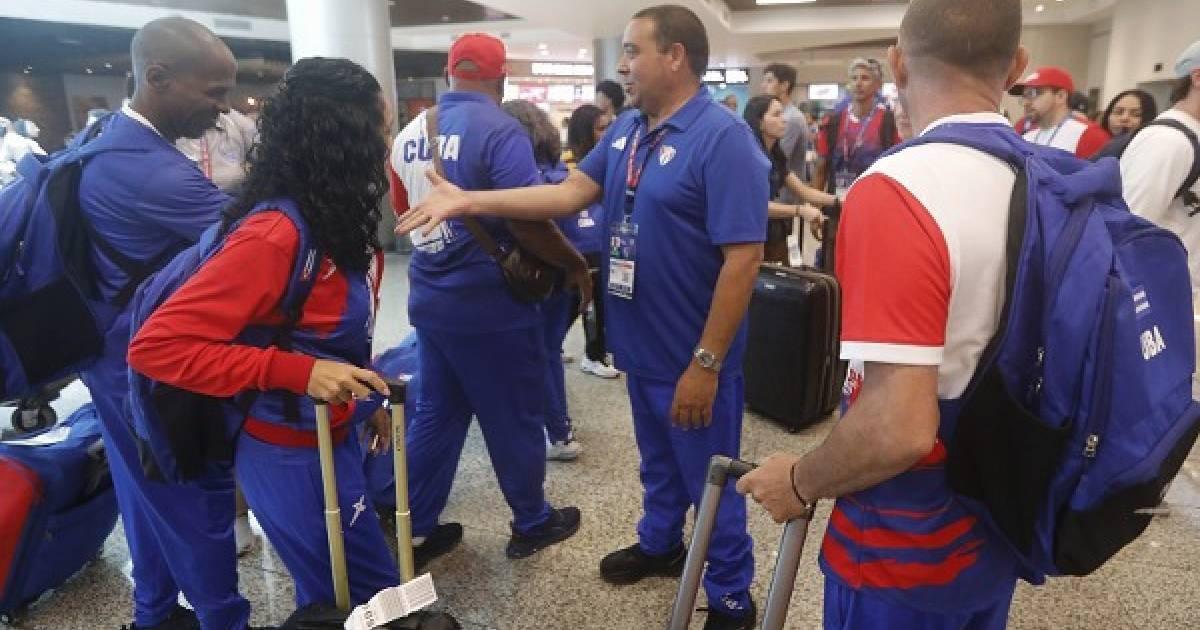
A new group of athletes, coaches, medical personnel, and Cuban officials arrived this Wednesday in Santo Domingo to strengthen the delegation that will compete in the XXV Central American and Caribbean Games, as reported by the state media JIT.
The group arrived led by Osvaldo Vento Montiller, president of the National Institute of Sports, Physical Education, and Recreation (INDER), and was received at Las Américas International Airport by the Cuban ambassador in the Dominican Republic, Ángel Arzuaga Reyes.
Among the athletes on this flight are competitors in cycling, rhythmic gymnastics, trampoline gymnastics, and field hockey, along with coaches from various disciplines and specialists from the Institute of Sports Medicine.
On Tuesday, the representatives of archery, badminton, and tennis had already arrived, while other teams—judo, shooting, triathlon, rowing, and weightlifting—have been on Dominican soil for days completing their preparation.
For the early hours of Thursday, a third group is expected, which will include judokas, indoor and beach volleyball players, taekwondo athletes, chess players, softball players, and sailors.
In total, Cuba registered 504 competitors in 42 disciplines, with participation expected in 356 of the 497 events scheduled, making it one of the largest delegations at the event.
Vento Montiller set a goal to remain among the top three in the overall medal standings, a position that Cuba already held in San Salvador 2023, where it earned 74 golds, 59 silvers, and 63 bronzes.
"The objectives are clearly identified, including the goal of remaining among the top three countries in the medal standings, and we are proud to know that we have many motivations to make this a reality," declared the head of INDER at the airport.
Cuban participation, however, comes with a notable drawback: nine out of the 12 members of the canoeing team deserted during a training camp in Montreal, Canada, between July 15 and 18, leaving Cuba without practical representation in that discipline.
The official discourse of the regime frames the delegation within the context of the centenary of Fidel Castro's birth and attributes the difficulties in preparation to the U.S. embargo. Díaz-Canel was quoted by Vento stating that the athletes "have trained amidst blackouts and shortages," although the energy crisis and supply issues affecting Cuba are a direct consequence of decades of management under the communist system.
The official flag bearer of the Cuban delegation is Leyanis Pérez, three-time world champion in triple jump, appointed in a ceremony held on July 18.
The inaugural ceremony of the Games is scheduled for Friday at the Félix Sánchez Olympic Stadium, although the competitions began on July 20 with water polo, where Cuba has already achieved victories in both the men's and women's events after defeating Guatemala and Venezuela, respectively.
Related videos:
Filed under: