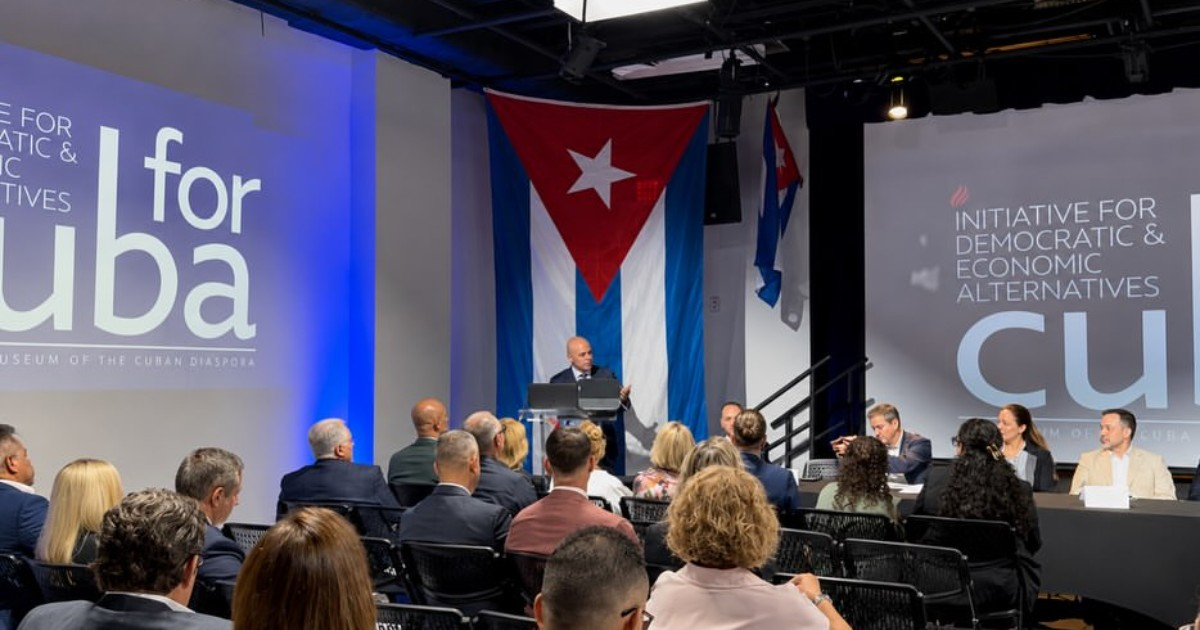
A dozen specialists in infrastructure, economics, and engineering gathered on Wednesday at the American Museum of the Cuban Diaspora in Miami to discuss how to rebuild Cuba following a potential democratic transition, with specific figures on costs and timelines.
The forum, titled "Initiative for a Democratic and Economic Alternative for Cuba," was the first in a series of conferences organized by the museum in collaboration with institutions such as the Cuban Studies Institute at Florida International University (FIU), the Cuban American Engineers Association, and the Foundation for Human Rights in Cuba, among others.
The main lines of the debate
Martí Noticias cited statements from several participants in the event. Among them, the words of Rafael Romeu, president of the Association for the Study of the Cuban Economy, stood out, who estimated that the first 180 days of stabilization after the start of a transition would cost between 180 and 270 million dollars.
These investments would be primarily financed by American private capital. The complete economic recovery —which would encompass energy, infrastructure, housing, agriculture, tourism, and telecommunications— would reach between 275 billion and 375 billion dollars within a timeframe of 10 to 15 years.
Jorge Piñón, researcher at the Energy Institute of the University of Texas at Austin, quantified the deterioration of the electrical sector: "The cost of recovering the electrical sector in Cuba would be between 5,000 and 8,000 million dollars and will take three to five years."
Piñón warned that more than a dozen generating units have been in operation for over 40 years: "These plants are tired, they are broken, they use outdated technology, and they are burning Cuban crude, which is the vicious cycle that continually deteriorates the power system on the island. So, it will take time."
Josenrique Cueto, former interim director of the Department of Water and Sewer of Miami-Dade County, estimated the reconstruction of the Cuban water and sewage system at approximately 8 billion dollars.
"An initial recovery could be feasible within about 24 months. However, having a functioning, stable, consistent system would take at least between 5 and 10 years," he specified.
The consensus of the forum was clear: without a prior change of regime, any reform or investment would be doomed to failure.
Marcell Felipe, president of the American Museum of the Cuban Diaspora, noted that the future of Cuba could be bright, but the conditions for action have not yet been established.
"We have the human talent, the capacity, and the private capital in exile that is ready to invest immediately to rebuild the country, without the American government participating in those areas, but all of this depends on an essential issue: the change of regime. This will not happen as long as the Castro family and the Díaz-Canel family are in charge of that system," he expressed.
The Cuban-American businessman Iván Herrera was the most straightforward: "I support an invasion. I support them taking Cuba," and he added that "there has never been a regime that has willingly relinquished power, especially not one that has spent 70 years spreading poverty."
The context: increasing pressure and structural crisis
The forum took place at a time of growing U.S. pressure on the Cuban regime and active planning by the exile community for a transition.
On Tuesday, a cargo plane departed from Miami to Cuba with 700 packages of food and hygiene kits, the first shipment of a 100 million dollar humanitarian aid program driven by the U.S. government, with direct distribution to the Cuban people through Catholic groups.
The energy crisis affecting the island intensifies the urgency of the debate. Cuba suffers in 2026 blackouts of up to 20-24 hours a day, with a generation deficit of around 2,100 MW. There is no fuel for public transportation, and the quality of life for the population is getting worse. Wages are not enough to meet basic needs.
The event organizers in Miami announced that in the coming weeks a second forum dedicated to health, education, and childhood will be held.
Jesús Tundidor, the vice president of the museum, summarized the message of exile: "We want the government of the United States, Secretary Marco Rubio, and everyone to understand that we have a plan. We are ready for a free Cuba."
Related videos:
Filed under: