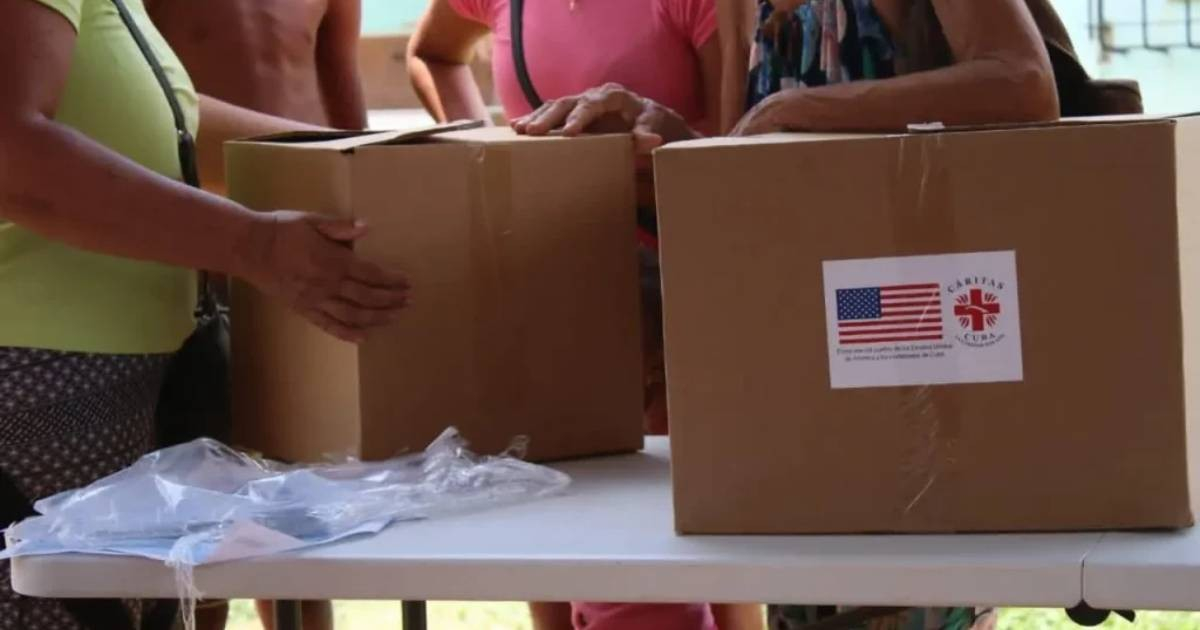
Cáritas Cuba acknowledged this Thursday that the humanitarian aid funded by the United States will not be enough to assist all the Cubans in need, a rare admission in an institutional statement that reflects the magnitude of the crisis facing the island.
In a message posted on its website, the Catholic Church organization requested understanding from those who will not benefit from the program and emphasized that assistance will be prioritized for individuals in conditions of greater vulnerability.
"We are fully aware that we cannot reach everyone. Therefore, we are providing this assistance 'which is not extensive in its coverage,' with our hearts dedicated to those who, amid the current humanitarian crisis, face greater vulnerability," stated the institution.
The program is part of the $100 million package approved by the United States government for humanitarian assistance in Cuba. Of this amount, $60 million will be managed by Cáritas Cuba and Catholic Relief Services (CRS), while the remaining $40 million will be channeled through other independent organizations.
Who will receive the assistance?
Cáritas explained that the selection of beneficiaries is not based on favoritism, but on previously defined social criteria.
Among the prioritized groups are elderly individuals living alone, pregnant women or those in the breastfeeding period, people with disabilities or bedridden, and families with children under five years old in vulnerable situations.
The organization emphasized that beneficiaries are identified through home visits conducted by volunteers and parish teams in each diocese, with the aim of ensuring that aid reaches those who need it most directly and without the mediation of the Cuban State.
What does each module include?
Each package contains staple foods and essential items to face the daily hardships experienced by thousands of Cuban families.
The modules include 10 pounds of rice, 10 pounds of beans, one gallon of oil, one pound of brown sugar, three pounds of pasta, six cans of sardines, and five cans of tuna, as well as hygiene products such as soap, toothpaste, and toothbrushes, water purification tablets, sanitary pads, a plastic bucket, a 20-liter container for storing water, and a rechargeable lamp.
The distribution has already begun
The delivery of aid began this Thursday in Bejucal and Alquízar, and over the coming months, it will gradually extend to the rest of the dioceses across the country, from Pinar del Río to Camagüey.
At the same time, the distribution of supplies continues in the eastern provinces affected by Hurricane Melissa, a response for which between three and six million dollars had already been allocated in the initial phase of the program.
The first shipment, weighing 18 tons, departed on Tuesday from Miami on a 7Air Cargo flight and arrived at José Martí International Airport on Wednesday. The cargo included 700 food kits and 700 hygiene kits, initially intended for families of the Archdiocese of Havana.
An insufficient relief in the face of the crisis
The complete plan aims to benefit between 100,000 and 120,000 families, although Catholic Relief Services estimates that the number could approach 200,000 households, which means over half a million people.
Nevertheless, Cáritas acknowledges that this aid represents only a fraction of the existing needs in a country plagued by shortages of food, medicine, basic products, and a prolonged economic crisis.
The organization concluded its message with a quote from Mother Teresa of Calcutta that encapsulates the scope and limitations of the program:
"Sometimes we feel that what we do is just a drop in the ocean, but the ocean would be less if it were missing a drop."
Related videos:
Filed under: