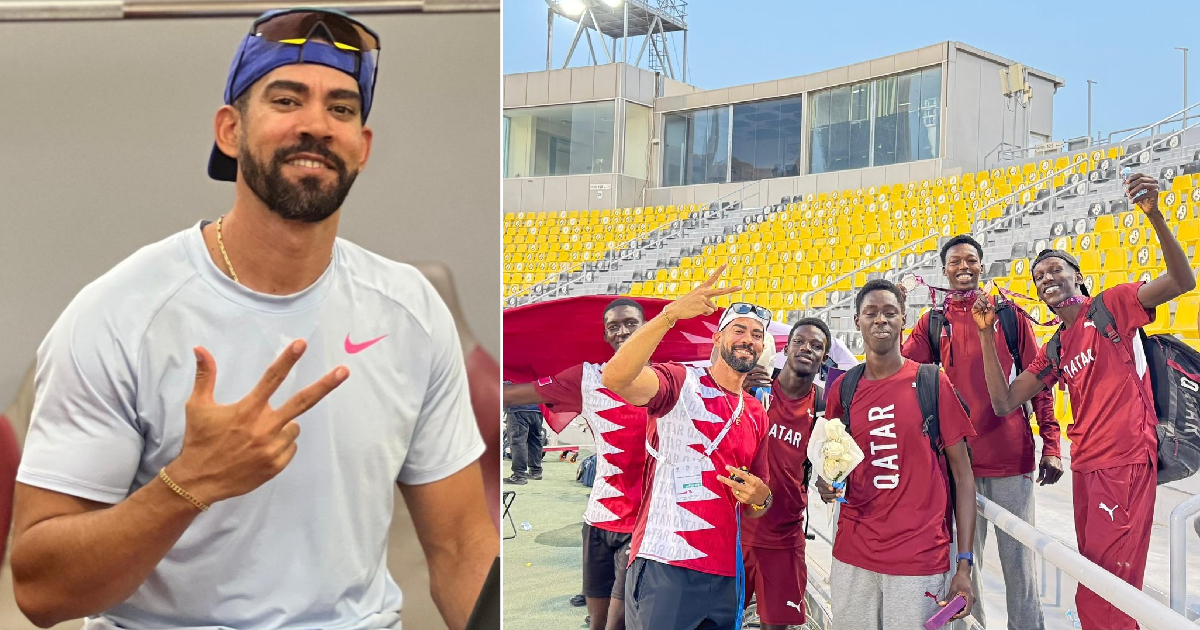
There was a time when his slender and graceful figure seemed to defy the stopwatch. Each stride was a blend of strength, elegance, and precision; each hurdle, merely another obstacle for a runner who transformed the 400-meter hurdles into the stage for his greatest achievements. Today, he no longer chases medals from the track, but he still retains the passion that brought him to the elite.
From the track of Khalifa Stadium in Qatar, he transforms his experience into teaching, convinced that true triumph is not always about crossing the finish line first, but in shaping those who will one day do so. Balancing fatherhood and his new life as a coach, the champion embarks on a different journey, where legacy is worth more than any podium.
—It’s a pleasure for me to talk again with Yasmani Copello, who recently became a dad… Congratulations, champ!
The pleasure is mine, and yes, I am the father of a boy. His name is Ares, and he is the greatest blessing that has come into my life. His mother, Elif, is very happy. She has been my driving force in achieving everything we have today, and as a mother, she is wonderful.
Personally, I feel very good. I wouldn't change anything. I continue to work in what I am most passionate about, which is athletics, only now from a different perspective: that of a coach.
—When and how did you say goodbye to active sports?
I retired after the 2024 Paris Olympics. I arrived very worn out, both physically and psychologically. It was a difficult and very sad decision because it meant leaving behind what I loved most in life: competing.
—Now you are developing a new role as a coach in Qatar. How did this stage begin?
I began as a coach in mid-2024, even while I was still active as an athlete. I would finish my training sessions and immediately move on to coaching my athletes, because that's how this profession works: right on the field.
I am currently in charge of eight athletes. Six of them have achieved the qualifying mark to participate in the Junior World Championships in Oregon, USA, which will take place in August of this year, although only three will be able to attend.
I primarily work with the 400-meter sprint and the 400-meter hurdles.
Among the standout athletes is "Zeze," as I call him, since Arabic names are a bit complicated for me. Last year, he was the Asian champion in the under-16 category with a time of 51.26 seconds. Faisal also stands out, being the Asian runner-up in the under-18 category, with a time of 50.54 seconds.
What stands out the most is that many of these young people never experienced a school sports system like the one we had in Cuba; most of them were recruited from soccer.
—Qatar has made a strong commitment to the development of sports. How do you assess the training conditions there?
Qatar has been recognized for providing opportunities to young coaches as well as to those with sports experience to enhance the development of sports—in my case, athletics—and to raise its standards.
We train at the Khalifa Stadium, the very venue that hosted the World Athletics Championships in 2019. It is a spectacular facility that has remained in excellent condition over the years and provides everything needed to perform at the highest level.
The story of Yasmani Copello is that of an athlete who never stopped believing in his talent. Trained in the Cuban sports system, he experienced a career marked by decisions that limited his opportunities, despite having won national titles and achieving international-level standards.
After being left out of the Cuban national team, he tried to revive his career in Spain, where injuries also did not give him a break.
The significant turning point came in Turkey, a country that embraced his potential, granted him nationality, and opened the doors to the global elite. There, he won gold at the European Athletics Championships held in Amsterdam in 2016, bronze at the Olympic Games in Rio de Janeiro in 2016, and silver at the World Championships in London in 2017.
For Copello, representing Turkey never meant giving up his roots, but rather expressing gratitude to the country that allowed him to showcase the potential he always knew he had.
—Yasmani, you were trained in the Cuban sports system and then spent much of your international career representing Turkey. How do you view the Cuban track and field scene for Los Angeles 2028?
Yes, I trained in the Cuban sports system, which was the foundation of my development as an elite athlete, although as you rightly said, I later represented Turkey.
Despite the challenges faced by Cuban sports, I believe it remains at a high level. Cuba continues to win medals at world championships and achieve good results in the Diamond League, especially in the jumping events.
In racing, the landscape is more subdued, if not below the level that Cuba historically had.
I believe that at the Los Angeles Olympic Games, if everything is in order and Cuba can compete without any difficulties in the United States, there will be real medal opportunities, especially in the triple jump and long jump, because there is a very strong school in those disciplines.
The 400 meters hurdles require a unique combination of speed, endurance, and technique. What does it take to achieve excellence?
The 400 meters hurdles is a very complex event. It requires a combination of speed, endurance, strength, and very precise technique. Achieving this balance is challenging and demands extensive study, planning, and experience. This is exactly what I continue to learn more about every day in my new phase as a coach.
—After having been an Olympic and world medalist, what legacy would you like to leave as a coach?
More than training great athletes, I want to shape good individuals. My greatest legacy would be to educate my athletes not only for sports but also for life. If they have a solid human foundation, they will be much better prepared to reach the international elite and achieve significant results.
"To finish, would you like to send a greeting?"
Yes. I want to send a very special greeting to my family, and especially to my parents, who are the source of this lion they have shaped. I also want to thank all the people who contributed to my sports growth… Thank you all so much!
Great races end when the finish line is crossed; great journeys, on the other hand, find new ways to continue.
After writing memorable pages in the world of athletics, Yasmani Copello's current challenge is to inspire from the other side of the track, guiding a new generation with the same discipline and passion that shaped his own story. Because while medals shine in display cases, the legacy endures in the people he helps to grow. That is, perhaps, the most important victory of all.
We bid farewell to the athlete and coach, but the echo of a life built on effort, humility, and love remains. Behind each medal was a family, parents, a dream, and many outstretched hands. Thank you for sharing your story, your heart, and for reminding us that true greatness always leaves a mark.
Related videos:
Filed under: