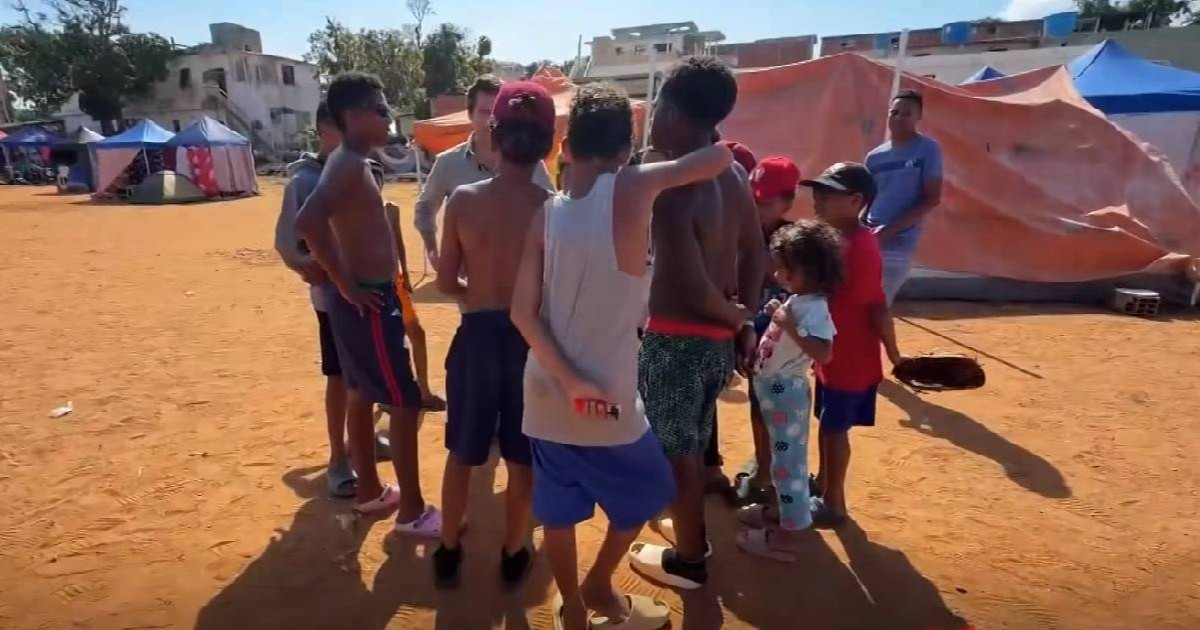
A month after the earthquakes that devastated northern Venezuela, dozens of families are still searching for their loved ones among the rubble of La Guaira, while thousands of displaced individuals are living in overcrowded tents without access to drinking water, basic services, and no near date in sight for returning home.
The earthquakes of June 24, 2026 —two tremors with magnitudes of 7.2 and 7.5 occurring just 39 seconds apart— have resulted in an official toll of 5,398 dead and 16,740 injured, according to updated figures released this Friday.
The UN estimates up to 68,000 missing persons and more than 6.7 million affected individuals across the country.
In the Brisas de Maiquetía urbanization, a social housing complex built in front of the international airport of Caracas, more than 3,000 people sleep under white and blue tents set up beneath the damaged buildings themselves.
The neighbor Ray Cazorla, who has been living in the area for almost 16 years, described to Noticias Telemundo the conditions in which they survive: “We barely manage to survive like this. We survive with the help of fans that we had to connect from the same power poles, using wiring that we installed ourselves.”
Drinking water does not reach the neighborhood. The only tanks with filters available were installed by the Cadena Foundation, a humanitarian organization from the Jewish community, not by the State. The system works so slowly that filling a five-liter container can take an entire day.
For more than 600 families, there are only 10 public showers, many of which are already unusable due to lack of maintenance. A young couple living there explained: "Now there is no water because the kids come unsupervised and use up the entire tank. By the time someone goes to shower, there is none left."
Cazorla also warned about the accumulating health risk: "There are many mosquitoes, many flies. We are prone to the proliferation of cholera or dengue. There are stagnant waters from the rains, and a virus could activate at any moment."
International aid, according to the victims themselves, has not arrived. "International assistance is either being blocked or isn't actually making it here [...] I saw posts showing a truck here with international boxes that were never delivered; it was a lie," Cazorla reported.
The acting president Delcy Rodríguez visited Brisas de Maiquetía on July 15 and ordered the residents to return to living in tents within the urbanization. The Venezuelan government informed them that they will not be able to return to their apartments until March 2027.
"Every day we feel more alone. On the first day, the government arrived with a huge crowd, all a commotion, because we thought they were going to make the process quick," Cazorla recounted about the initial promise that never came to fruition.
The looting further aggravates the situation. Some buildings have messages painted on their walls: "Already looted" or "Neighbors alert, no more looting."
The residents themselves assert that they have managed the situation on their own, despite the presence of police and national guards in the area.
Meanwhile, 38 bodies of children and adolescents remain unclaimed in a morgue in La Guaira, according to the Ministry of Interior Relations.
The National Service of Medicine and Forensic Sciences requested DNA samples from relatives of individuals who may be at the morgues of Los Silos de Bolipuerto or Bello Monte in Caracas.
A young man who continues to dig through rubble in search of his mother’s body encapsulated in a few words the determination of those who refuse to give up: "I won't leave her alone."
Related videos:
Filed under: