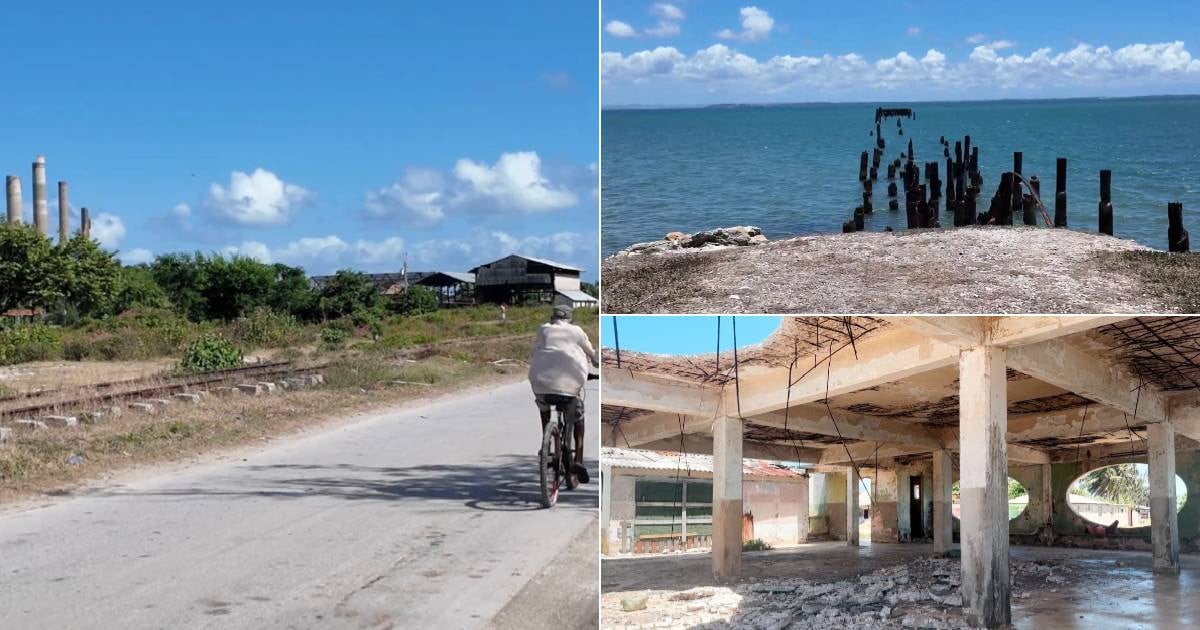
A recent video published by the YouTube channel Leo's Travel showcases the state of neglect in the village of Preston, officially known as Guatemala, located in the Holguin municipality of Mayarí. This former sugarcane enclave has transitioned from being one of the most prosperous towns in eastern Cuba to struggling amidst ruins and decaying buildings.
The images showcase the old sugar mill, the Miramar hotel reduced to rubble, the Alta Cocina restaurant destroyed by salt and neglect, and the 120-bed hospital, once considered one of the most modern in the region in the 1940s, now in a state of advanced decay.
Preston was established in 1905 as an industrial project of the Nipe Bay Company, a subsidiary of the United Fruit Company, along the bay of Nipe.
Their first harvest, in 1907, produced 97,320 bags of sugar in 132 days. The town was named in honor of Andrew W. Preston (1846-1924), one of the executives of the American company.
The settlement was designed following the urban planning model of American industrial cities. Its streets were identified with letters, and some neighborhoods bore names like Brooklyn, New York, and Washington.
The wooden houses on stilts, with wide porches and tiled roofs, housed a population made up of Cubans, Jamaicans, Haitians, Bahamians, Trinidadians, Chinese, and Spaniards.
After the rise to power of the dictator Fidel Castro (1926-2016), the properties of the United Fruit Company were nationalized in 1960, and the sugar mill was renamed Guatemala, in honor of the former president of that Central American nation, Jacobo Árbenz (1913-1971).
Although the industry continued operating for several decades under state management, the final blow came on June 3, 2002, when the mill sounded its alarm 93 times before permanently halting production.
The closure was part of the so-called Álvaro Reynoso Task, through which the regime shut down 71 of the 156 sugar mills in Cuba, leaving more than 100,000 workers unemployed.
The decision accelerated the economic and social deterioration of dozens of communities that depended on the sugar agro-industry.
"Imagine living in a town where generations have been dedicated to sugarcane cultivation and sugar processing, only to have everything taken away from you in an instant," reflects the author of the journey.
The comments on the video reflect the nostalgia of those who experienced the prosperity of the former enclave. "They were very prosperous towns," wrote one user.
"They have destroyed Cuba," asserted another. A third person, a local, summed up the shared sentiment: "I am from that town and I enjoyed its beauty very much."
The author of the tour concludes with a reflection on the memory of the town. "Today it is called Guatemala, but for many people it will still be Preston. As long as someone remembers where the central square was, as long as someone can say where their grandfather worked, as long as someone remembers the sound of the trains, Preston will not be a forgotten town; it will be a transformed town."
The case of Preston is no exception. In Holguín, the Urbano Noris sugar mill, the José Martí Vocational School, the El Mambisito children's park, and the old Holguín-Gibara train station remain in ruins, having turned into a dumping ground for trash and debris.
The decline of the town coincides with the collapse of the Cuban sugar industry. The 2024-2025 harvest ended with less than 150,000 tons of sugar, a production lower than that recorded in 1899, when Cuba was just emerging from the War of Independence. In Holguín, production did not reach 10% of the planned target.
Currently, the residents of Preston are facing frequent blackouts, a shortage of drinking water, and difficulties accessing the internet. Despite the name change imposed over six decades ago, most still refer to the town by its original name.
Related videos:
Filed under: