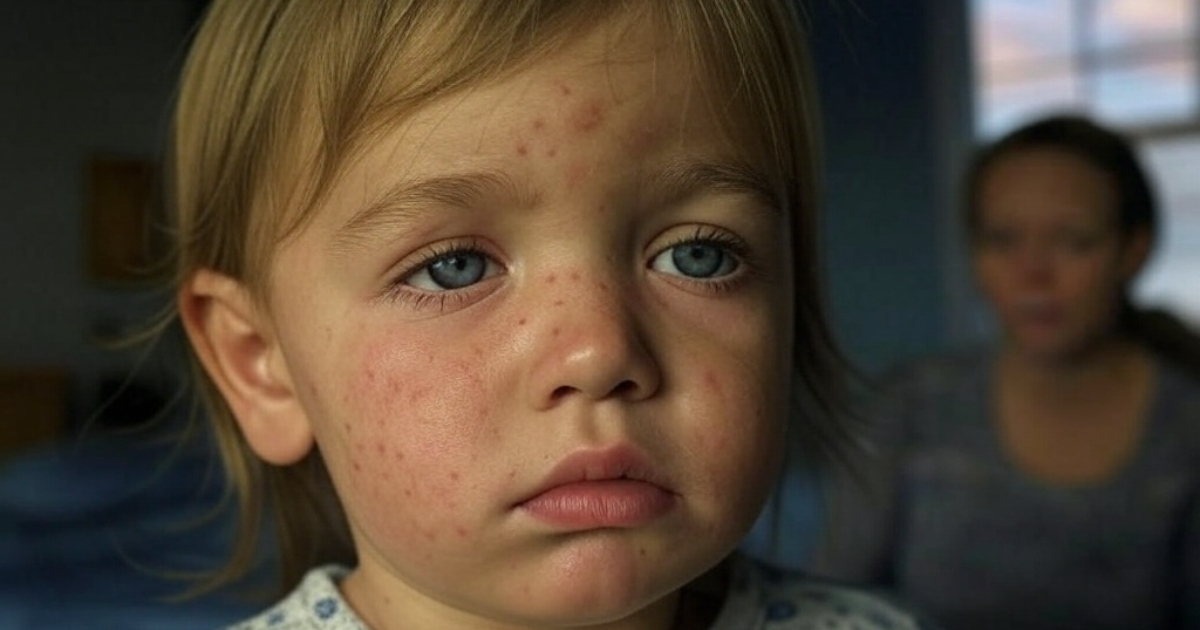
The Centers for Disease Control and Prevention (CDC) confirmed that the United States has already surpassed the total number of measles cases recorded throughout 2025 in 2026, with five months still remaining: 2,318 confirmed infections compared to 2,289 the previous year, making 2026 the worst year for this disease in the country since 1991.
The data, published by the CDC on Friday, July 24, reflects the progression of large outbreaks in South Carolina, Utah, and Arizona, in addition to dozens of smaller clusters spread across 45 jurisdictions nationwide.
South Carolina was the most devastating epicenter: its outbreak, which began in October 2025 in Spartanburg County, accumulated 997 confirmed cases before being declared over on April 26, 2026, becoming the largest state outbreak in 35 years.
Of those cases, 932 corresponded to unvaccinated individuals.
Utah has been battling the disease for over a year, with more than 700 people infected in 22 of its 29 counties.
The state epidemiologist, Dr. Leisha Nolen, warned that the actual outbreak at the Utah-Arizona border could be three to four times greater than the confirmed cases, according to mathematical modeling and genetic analysis.
Florida is also among the most affected states: it has accumulated 141 cases in 2026, compared to just eight in all of 2025, a nearly 18-fold increase in one year that places it as the fifth state with the highest number of infections nationwide.
The epicenter of the outbreak was Ave Maria University, in Collier County.
Behind the magnitude of the increase lies a structural factor: vaccination coverage with the measles, mumps, and rubella (MMR) vaccine among preschool children fell from 95.2% in the 2019-2020 school year to 92.5% in 2024-2025, leaving approximately 286,000 children unprotected, according to CDC data.
In Florida, that figure is even lower: 88.1%.
93% of the cases in 2026 correspond to unvaccinated individuals or those with an unknown vaccination status, a pattern identical to that of the previous year.
Experts also warn that official figures underestimate the reality. Texas's chief epidemiologist, Dr. Varun Shetty, explained that “what we can count and report is almost always an underestimation of what actually occurred, because it depends on people's willingness to get tested and share information with health providers.”
Regarding clinical severity, 2026 has so far recorded 151 hospitalizations and no deaths, a less lethal scenario than in 2025, when three people died —two children in Texas and one adult in New Mexico— all unvaccinated.
Dr. Mark Roberts, former director of the Public Health Dynamics Laboratory at the University of Pittsburgh, summarized the collective risk of not getting vaccinated with an analogy: "Not vaccinating your child is like saying: I don't want my car to have brakes. Because there are other people you could hit. It's not just you in your car. There are other people involved."
In November 2026, the Pan American Health Organization will formally review whether the United States and Mexico have lost their status as countries free of measles, a certification that the U.S. has maintained since the year 2000 and which now faces its greatest threat in over two decades.
Related videos:
Filed under: