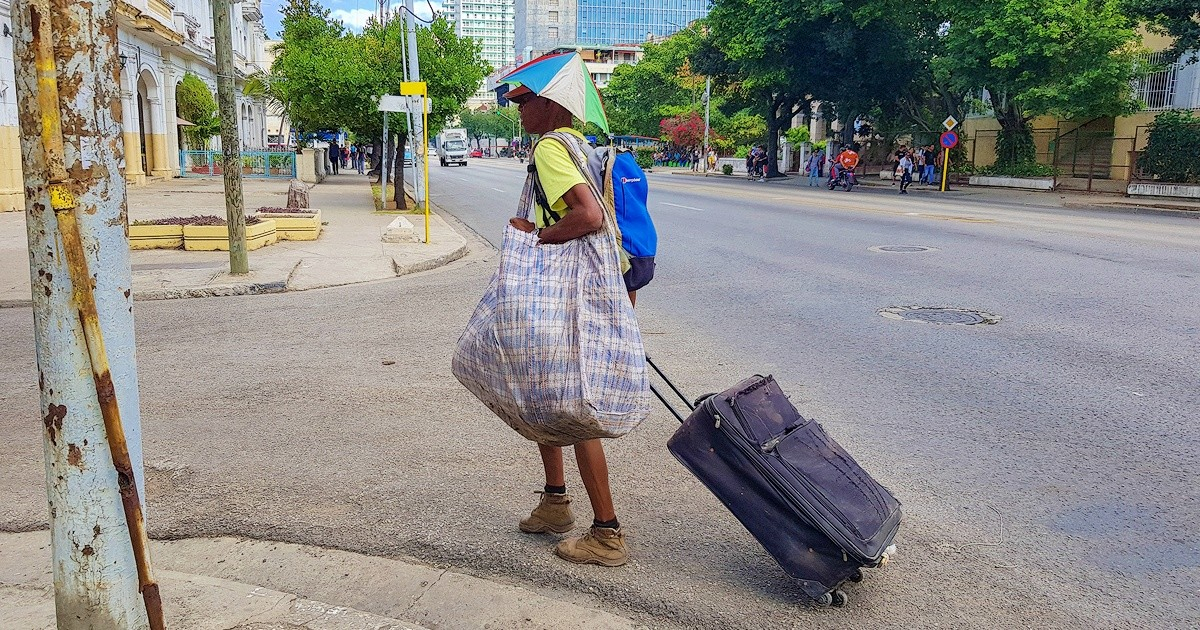
The Cuban regime announced a redefinition of its social protection policy with the aim of concentrating state assistance on individuals identified as "in situations of vulnerability", a decision that comes amid the worst economic crisis the island has faced in decades and when the deterioration of purchasing power is affecting a growing segment of the population.
The measure was explained by officials from the Ministry of Labor and Social Security (MTSS) during the official program "Cuadrando la Caja," the main points of which were summarized by Cubadebate.
According to Deputy Minister Ariel Fonseca Quezada, "before addressing the economic issues, we need to have the social transformations that will protect individuals."
The government is focused on targeting aid
Fonseca stated that the new model aims to direct public resources towards those who need them the most.
"We need to identify the individuals who require more support, more attention, who are in a state of vulnerability," he stated during the broadcast.
The official insisted that social protection "must reach those who truly need it" and argued that, in a context of limited resources, the State should focus its efforts on those with the greatest needs.
During the program, she also made a conceptual distinction by stating that "we are not talking about vulnerable people, we are talking about people in situations of vulnerability," asserting that this condition can be temporary and can be overcome through public policies.
As explained, the purpose is to accompany those individuals so they can overcome that situation.
A reality where vulnerability affects millions
The announcement comes, however, at a time when economic vulnerability has ceased to be a reality confined to specific sectors.
The accumulated inflation since the failed Tarea Ordenamiento, the loss of the real value of salaries and pensions, the partial dollarization of trade, the scarcity of food and medicine, and the constant blackouts have deteriorated the living conditions of millions of Cubans.
In that scenario, the main question is how the Government will determine who deserves assistance and who does not.
Although the authorities defended that the objective is to act with greater efficiency, they did not detail what the indicators will be to classify a person as vulnerable, how cases will be evaluated, or what mechanisms will exist to review possible exclusions.
The breadth of the crisis makes that definition particularly complex.
Today, it's not just the unemployed or families traditionally regarded as low-income who are facing difficulties.
Thousands of state workers, retirees, professionals, and households with more than one salary are also facing serious difficulties in covering basic expenses due to the constant rise in the cost of living.
From universal subsidy to selective aid
Officials also defended that the new model aims to ensure "equity" rather than "egalitarianism", an argument that the Government has used in recent years to justify the gradual elimination of universal subsidies and the concentration of resources in specific sectors.
The measure also reflects the financial limitations of the State. For decades, the regime portrayed the universal social protection system as one of the main achievements of the Revolution.
however, the economic crisis, the decline in national production, and the lack of liquidity have diminished the government's ability to sustain that model.
The reduction in the distribution of ration books, the expansion of stores selling in foreign currency, and the transfer of numerous products to the informal market are some of the changes that have increased the economic burden on Cuban families.
Experts warn about the challenges
Various economists have warned that a targeting policy can only be effective if there are transparent criteria, sufficient budgetary resources, and effective oversight mechanisms.
Otherwise, there is a risk that families with real needs will be excluded from assistance programs due to administrative decisions or the lack of financial capacity of the State.
This is compounded by the difficulty of establishing a clear boundary between those who qualify and those who do not, as a significant portion of the population has seen their standard of living decline in recent years.
Economic precariousness is no longer solely attributed to personal circumstances, but also to structural factors such as inflation, scarcity, and the collapse of purchasing power.
A change that tests the Cuban social model
Beyond the official discourse, the announcement represents an implicit acknowledgment that the State is no longer able to sustain the level of social protection that it has touted as one of its main achievements for decades.
While the government assures that no one will be left unprotected, the practical implementation of the new system will be closely watched by a populace facing persistent inflation, shortages, and increasingly deteriorating public services.
The big question will be whether the new definition of "vulnerability situation" can address a reality in which, for many Cubans, precariousness has ceased to be an exception and has become the norm.
Related videos:
Filed under: