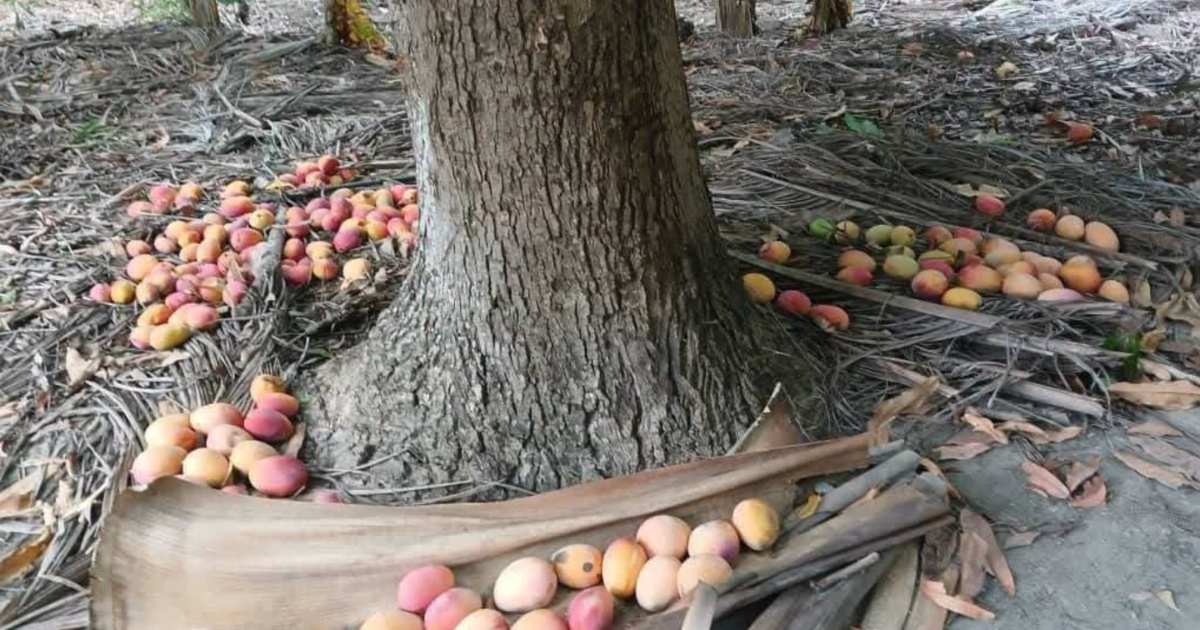
Agricultural producers from the community of Río Seco, in the province of Guantánamo, reported this Wednesday that tons of mangos are rotting on the ground because the state entities responsible for collection claim to lack fuel and transportation means to gather the harvest, according to a report from the Facebook profile La Tijera News.
The images and video shared show the ground of the farms completely covered with ripe fruits—yellow, orange, and reddish—left unpicked, while the farmers claim that months of work are wasted due to the inaction of the State.
Those affected indicate that many farmers avoid publicly reporting the situation for fear of reprisals or being ignored by the authorities.
The case is neither new nor isolated. At the end of July, the spokesperson Chely Tamayo had already published similar images of a farm in Maisí and described the situation as "catastrophic and unacceptable," citing the case of producer Aparicio Samón Leyva from the cooperative "Luis Ramírez López," in the same area of Río Seco.
"The lack of fuel is not an excuse; it is the bottleneck that turns an essential food item into waste," wrote Tamayo, whose complaint garnered significant attention on social media.
Days later, the deputy Emilio Interián Rodríguez, president of the cooperative CCS Sabino Pupo Milián and representative for Arroyo Naranjo, brought the issue to the National Assembly.
"We have completely lost the mango production, more than 100 tons of mangoes. A quality mango that we could have exported, that we could have processed, that we could have made the best juice in the world," he stated before the assembly. His phrase "we are not capable of making mango juice with so many mangoes that we have here" went viral as a summary of the paradox.
Interián also reported that families in his district told him, "Last night we couldn’t eat; my children couldn’t eat." He noted that power outages hinder cooking and food preservation, and that Cuba imports juices of "very poor quality and at extremely high prices" while allowing its own production to rot.
The mango collection campaign in Guantánamo began on May 25 with a goal of processing 5,000 tons by mid-July — already lower than the 7,000 collected the previous year — but by mid-month, about 1,600 tons were considered lost.
The theft of fuel exacerbates the logistical collapse: in June, a diesel theft ring was dismantled at a generator in the province.
The pattern repeats itself every season. In 2023, tons of mango were once again lost in Guantánamo due to the same inefficiencies; in 2022, the Ceballos agro-industrial company reported serious fuel shortages during the campaign; in 2021, 12,800 pounds of mangoes rotted in Camagüey due to the same collection failures.
Waste occurs at the worst possible moment. A survey by the Food Monitor Program and Cuido60 revealed that 96.91% of the Cuban population lacks adequate access to food, and that 33.9% of households had at least one member who went to bed hungry in the last month.
Guantánamo records one of the highest rates in the country, with 78.7% of households experiencing food insecurity.
Related videos:
Filed under: