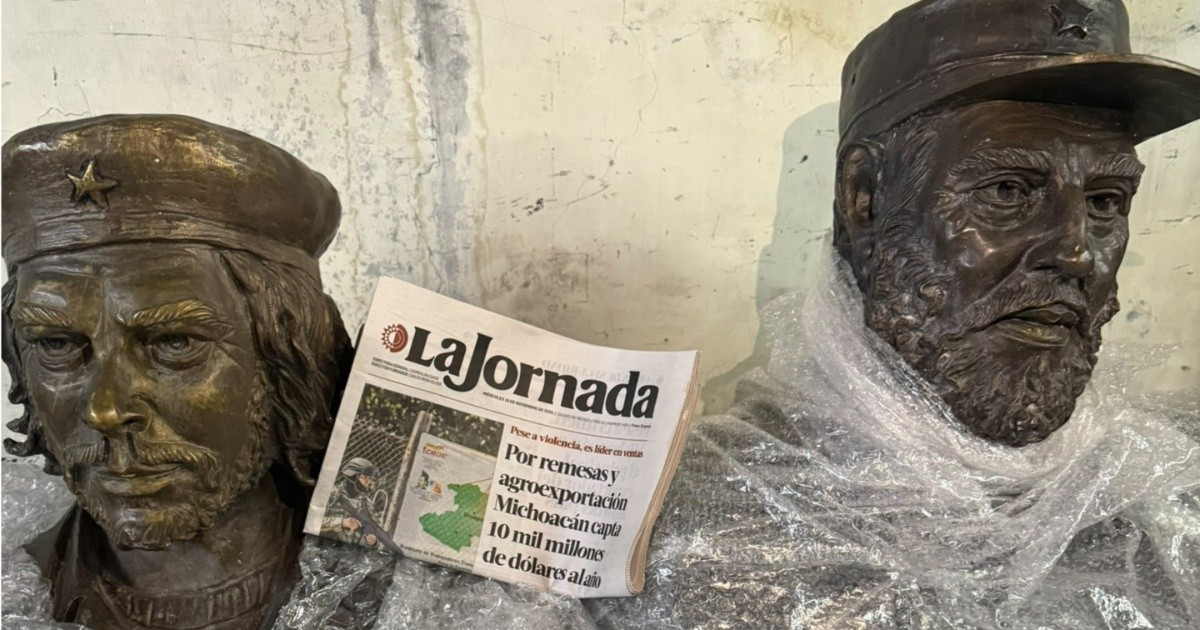
The mayor of Cuauhtémoc, Alessandra Rojo de la Vega, responded this Wednesday to the head of Government of Mexico City, Clara Brugada, after she rejected her proposal to hand over the statues of Fidel Castro and Ernesto "Che" Guevara in exchange for materials to pave streets or machinery for waste collection in the area.
Through an extensive thread posted on the social network X, the mayor questioned the defense that Morena has made of the symbols of the Cuban Revolution and posed a direct question to the capital administration.
"Is Cuba the destination that MORENA aspires to for Mexico City and the country? Is the Cuban dictatorship a model to follow for Mexico?" he wrote.
Rojo de la Vega accused Brugada of prioritizing her ideological convictions over the needs of the residents of the borough.
"He prioritized his ideology and personal admiration for the Cuban government model over serving the neighbors," he stated.
The mayor also described the Cuban regime as a "murderer" and supported that statement with figures from the organization Archivo Cuba.
"67 years later is more than enough for any democrat, regardless of their political affiliation, to reject the human tragedy directed by the so-called 'Cuban Revolution.' By early 2026, Archivo Cuba records 8,190 political murders at the hands of the Cuban regime: 5,775 executions and shootings, 1,231 extrajudicial killings, 200 disappearances, and 984 deaths of political prisoners, in addition to thousands of cases that have not been documented," he stated.
At another point in his message, he described the conditions that, in his opinion, Cubans currently face.
"While Cubans survive in hunger and misery, receiving food ration cards that provide an average of 500 grams of chicken and five eggs per month —yes, that is all the protein they consume in a month— the leaders of the revolution squander money living in luxury," he wrote.
Rojo de la Vega also stated that before the triumph of the Revolution in 1958, Cuba was the third strongest economy in Latin America and ranked 30th in the world. He attributed the island's impoverishment and the rise in extreme poverty to the model established by Fidel Castro.
The origin of the dispute
The controversy began in July 2025, when the mayor ordered the removal from the Tabacalera Garden of the sculptural ensemble "Monumento Encuentro," which features the figures of Fidel Castro and Ernesto "Che" Guevara.
The official argued that the installation of the sculptures had administrative irregularities and also addressed the complaints from local residents.
According to the mayor's office, the monument was originally placed in 2017 without the authorization of the Committee on Monuments and Artistic Works in Public Spaces, and although it was reinstalled in 2020, the legal concerns were never addressed.
The decision provoked a strong reaction from the federal government and the capital administration.
President Claudia Sheinbaum described the removal as an "illegal," "intolerant," and "hypocritical" measure, and demanded that the sculptures be returned.
For her part, Clara Brugada requested that the pieces be reinstalled in a "symbolic and central" location in the capital.
In response to the mayor of Cuauhtémoc's refusal, the Government of Mexico City announced last week that it will commission the creation of a new sculptural ensemble.
Brugada assured on Wednesday that the project will not involve public expenditure.
"Not a single peso will come from the public treasury for these sculptures, and it will be carried out based on the economic solidarity of social groups and activists," he stated.
According to El Financiero, a committee will be created to gather the resources to finance the project, although the location for the new sculptures has not yet been determined.
A debate that transcends statues
The controversy has also reignited the debate regarding the relationship between Morena and the Cuban regime. In May 2025, the party's secretary general signed a cooperation agreement with the Communist Party of Cuba in Havana, at an event led by Miguel Díaz-Canel.
Despite the critical tone of his message, Rojo de la Vega concluded by leaving the door open for dialogue with the head of government.
"I respect her and her position, but Mexico City deserves much more: a sustainable model that addresses the major underlying crises of water, mobility, and access to housing. The day she decides to walk that path, we will be waiting for her," he concluded.
Related videos:
Filed under: