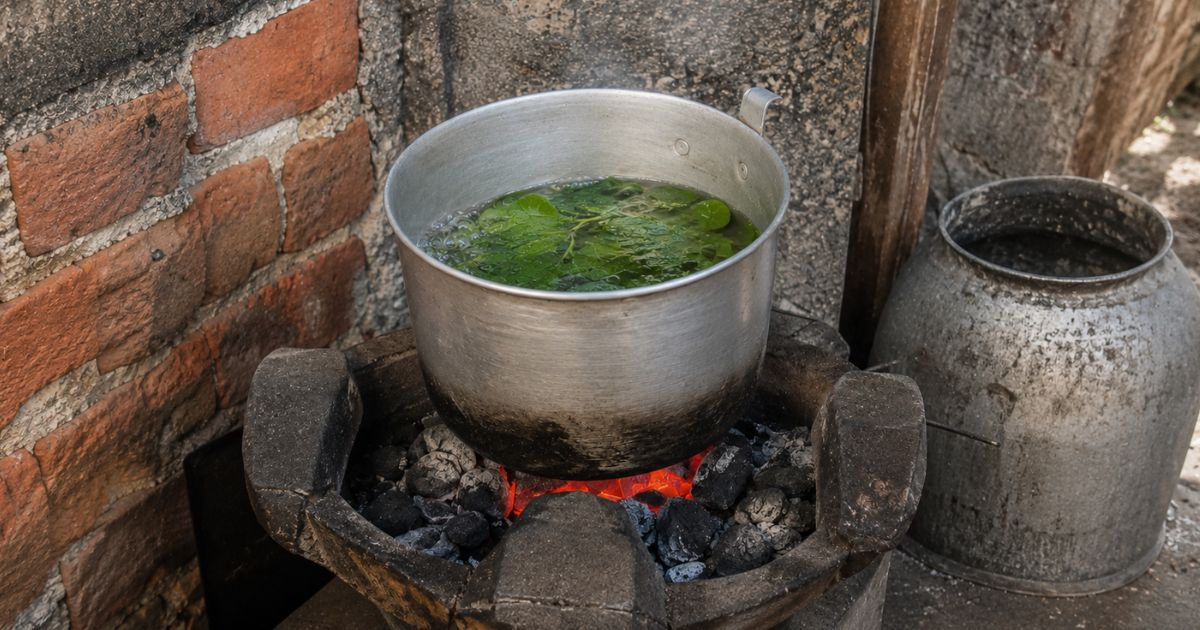
A Cuban woman recounted the harrowing search for medication, even at the polyclinic, to relieve her husband, who was suffering from intense pain that she identifies as a renal colic, eventually resorting to preparing an herbal decoction recommended in her family for years over a charcoal stove.
The story, titled I Have Them Down, was published this Saturday by La Hora de Cuba as a narrative by Eloísa García, who described her husband lying on the floor of the room, trying to find a position that could bring him some relief.
"My husband says it hurts to sit, lie down, walk, and even breathe. The pain is unbearable," wrote García, who stated that he is a strong man who rarely shows pain.
The couple went to a polyclinic, but according to their testimony, they were told there that they only had paracetamol, a situation that, while emotionally striking, is far from extraordinary in Cuba.
In the face of the impossibility of finding another analgesic, the woman returned to the neighborhood and began a house-to-house search with her mother-in-law to obtain diclofenac in ampoules.
The older neighbors had the medication in tablet form, but García explained that a pill did not relieve her husband's pain. She also couldn't find the ampoules at a nearby doctor's house, who suggested she try to locate tramadol.
It was then that she remembered a neighbor whose husband suffers from cancer. The scene, according to the story, made her hesitate before knocking on the door: "How can I ask this woman for the only thing that probably eases her husband's pain?".
Finally, he did it, and the woman handed him a pill without hesitation. His husband took it, but the pain persisted, and nausea set in.
The search continued online. García recounted that he walked several blocks until he got a connection, joined WhatsApp groups dedicated to obtaining medications, and asked for what he needed. He found nothing.
"She returned home defeated, not knowing how to help my husband," she recounted. It was then that she went out to the patio, lit charcoal using a nylon bag, and placed a pot of water on the fire.
Then he pulled up some wild herbs that his family knows as I've got them down, a plant that, as he recalled, his grandmother claimed helped with kidney stones.
"I wash the leaves well and put them in the water, which is already starting to bubble. I watch them boil while my husband writhes in pain on the floor of the room," she concluded.
The experience recounted by García summarizes a reality that manifests in various ways: from the polyclinic to neighbors' homes, from online groups for medications to remedies passed down from grandparents, Cuban families continue to improvise alternatives in the face of the impossibility of finding basic medications.
In April, a young Cuban recounted how a neighbor had to give a pill intended for her own daughter to help a grandmother who was experiencing panic attacks and lacked her medication.
Natural remedies have also become a recurring option. During the epidemiological crisis of 2025, sick Cubans turned to infusions of cherry leaves due to the lack of medicines, while another family prepared decoctions of papaya leaves in an attempt to relieve symptoms of chikungunya.
The use of plants is not limited to family initiatives. Health authorities have started to promote onion, garlic, and other plant syrups in Santiago de Cuba as an alternative due to the shortage, although a doctor consulted at the time by CiberCuba emphasized that these products should not replace pharmacological treatments that have proven effectiveness.
The official bet has also reached the field: Pinar del Río doubled the area dedicated to medicinal plants in 2025, amidst the difficulties of providing medication to the population.
A digital survey published last May once again highlighted the extent of the issue: out of 1,788 participants, 95.6% reported some level of difficulties in obtaining medications during the previous 12 months, and 54.2% indicated severe barriers or the inability to acquire them.
Related videos:
Filed under: