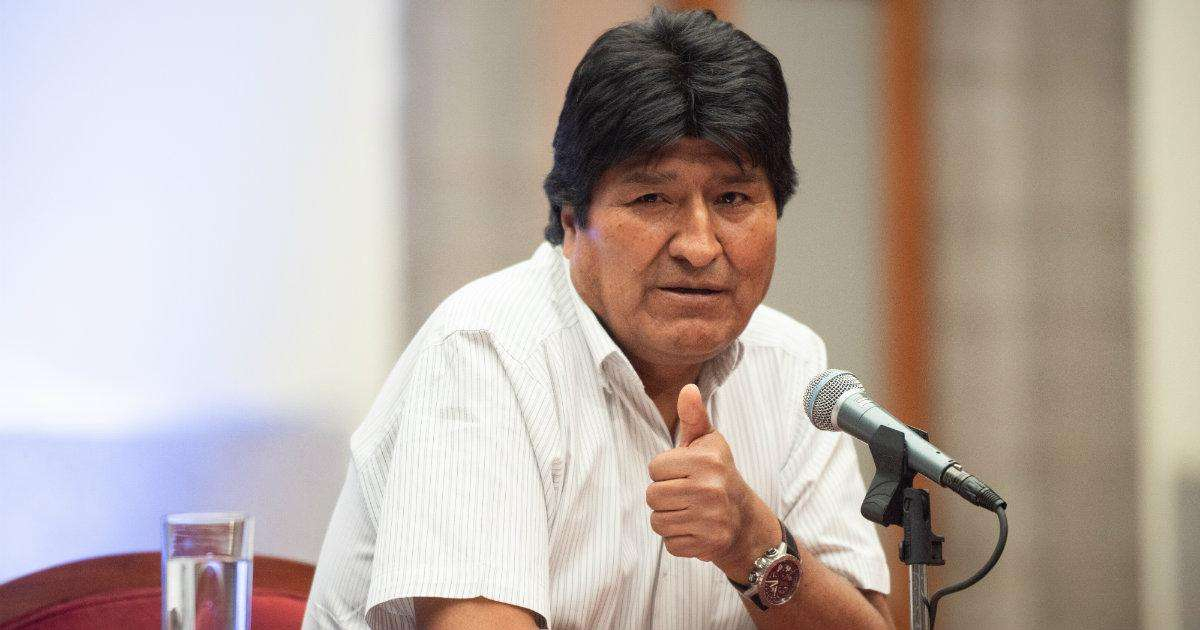
Former Bolivian president Evo Morales currently has two active arrest warrants—one for aggravated human trafficking and another for terrorism and armed uprising—none of which have been executed.
According to an analysis published this Sunday by the EFE agency, the main reason is that his supporters control access to the Tropic of Cochabamba, where the former president has been taking refuge since late 2024.
The first order dates back to October 2024, when the Tarija Prosecutor's Office charged him with aggravated human trafficking, linked to an alleged relationship with a minor during his presidency in 2016, with whom he is said to have had a daughter. According to the investigation, the young girl was "captured" by the so-called Youth Guard, and her parents allowed her to have "direct contact" with Morales and to be "at his disposal" in various places in Bolivia and abroad. In May 2026, after he failed to appear at the start of the oral trial, a court declared him in contempt and issued a new immediate arrest warrant, suspending the process until he appears or is detained.
The second order arrived on July 29th, when the Santa Cruz Prosecutor's Office ordered his capture for terrorism, armed uprising against state security, and public incitement to commit crimes, among other charges, in relation to the road blockades of May and June 2026.
Those protests, driven by farmers and groups aligned with the former president demanding the resignation of President Rodrigo Paz, resulted in 16 fatalities —13 of whom died due to being unable to receive medical attention during the roadblocks— and economic losses exceeding 3 billion dollars.
Although Morales denied asking for Paz's resignation, on May 24 he posted on X that the president had "two options" in response to the protests: "militarize the country" or call for elections within the next 90 days.
Since October 2024, Morales has remained in the town of Lauca Ñ, in the Tropic of Cochabamba, his stronghold both politically and union-wise. Hundreds of supporters maintain a constant vigil with several security perimeters controlling access to the area. In October and November of that year, they blocked roads for weeks to prevent the police from entering. On at least two occasions in the past two years, the agents retreated in the face of threats from the sympathizers.
The internal tension within the law enforcement itself was recently exposed when police commander Mirko Sokol declared to a local media outlet that the capture of Morales "is not a priority," citing thousands of pending arrest warrants. This statement was immediately contradicted by the Minister of Government, Marco Antonio Oviedo, who called it "a priority task to detain Evo Morales."
Morales himself fueled the controversy two weeks ago by sharing a video on social media in which he was talking to two police officers at a checkpoint while driving. The Ministry of Government has initiated disciplinary proceedings against those officers for "failing to comply" with police resolutions.
In response to the charges, Morales and his lawyers claim that the proceedings are driven by a "political intent" to disqualify him as a candidate. In the human trafficking case, the defense argues that "there is no victim," relying on documents that the alleged victim submitted to the court and the Prosecutor's Office in May and June, asserting that she has not been the object of any crime. The former president, for his part, stated that "no one should be condemned for political reasons based on false accusations, fabricated with invented evidence."
The alleged victim, along with her mother and daughter, received diplomatic asylum in Argentina in September 2025, claiming persecution by Morales' inner circle and officials of the government of Luis Arce, who was detained in December of that year for alleged irregular use of public funds.
Related videos:
Filed under: