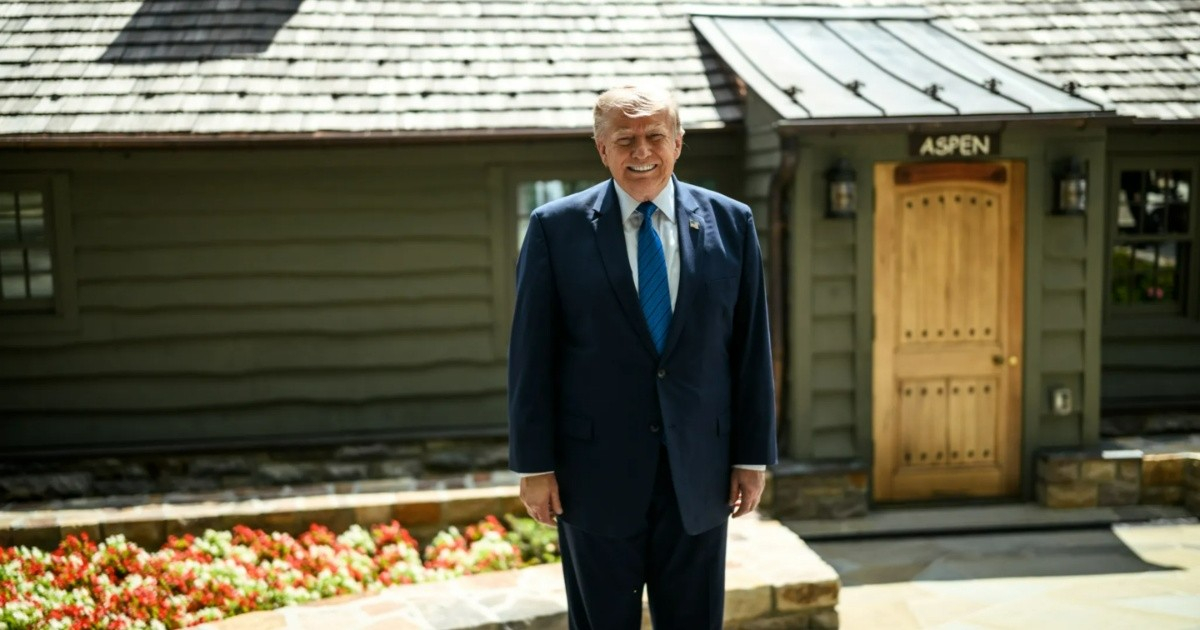
The North American Aerospace Defense Command (NORAD) intercepted two aircraft on Sunday that entered restricted airspace over Bedminster, New Jersey, where President Donald Trump was spending the weekend at his private golf club.
F-16 fighters from the Continental United States NORAD, based at Tyndall Air Force Base in Florida, escorted both aircraft out of the restricted area without any further incidents.
NORAD did not immediately report on the causes of the violation or the identity of the pilots involved.
The agency reminded in its statement that all pilots are required to check the Notices to Airmen (NOTAM) before each flight, as mandated by the Federal Aviation Administration (FAA). When an aircraft is intercepted, its pilot must change course and wait for further instructions.
The Trump National Golf Club Bedminster, located about 64 kilometers west of New York, serves as the president's regular summer residence, regarded since his first term as a sort of "summer White House."
Each presidential visit activates temporary flight restrictions that include a no-fly zone of 10 nautical miles and an outer zone extending up to 30 nautical miles with partial restrictions, affecting about 20 public-use airports in the region.
The episode this Sunday is not an isolated incident, but the most recent in a series of aerial incidents related to the president's security in recent weeks.
On July 19, over 10 general aviation aircraft violated temporary restrictions over Bedminster and East Rutherford during the World Cup final, when Trump was also in the area. On that occasion, NORAD conducted three intercepts, and in two of them, the F-16s deployed flares to draw the attention of the pilots.
Just four days before the incident this Sunday, authorities had opened an investigation following a more serious episode: the Marine One helicopter with Trump on board was less than a mile away from a commercial Envoy Air flight during takeoff from the Ellipse, near the White House. The FAA acknowledged a "temporary loss of separation" between the two aircraft, which prompted formal investigations by the National Transportation Safety Board (NTSB) and the FAA itself.
The accumulation of incidents regarding the presidential airspace has intensified scrutiny on civil pilots' adherence to flight restrictions, as well as on the security protocols surrounding the movements of the president.
Related videos:
Filed under: